
From oil dependence to a diversified global economy — what has Abu Dhabi achieved, and where are the opportunities for jobs, education, business and investment?
Plan Abu Dhabi | Future Economy Series – Part 1
Abu Dhabi 2030 Is No Longer Just a Vision
Abu Dhabi Vision 2030 Enhancement
There was a time when talking about Abu Dhabi’s economic future meant talking primarily about oil.
That conversation is changing.
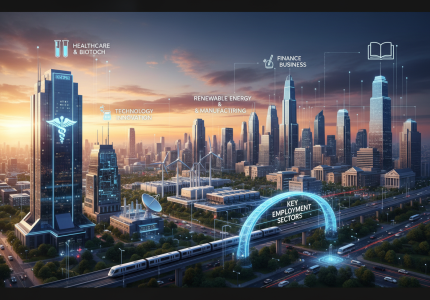
Today, Abu Dhabi is building something much larger: an economy where energy remains a powerful foundation, but increasingly operates alongside technology, advanced manufacturing, finance, healthcare, tourism, logistics, real estate, space, entrepreneurship and innovation.
And that raises a more interesting question.
How much of Abu Dhabi Economic Vision 2030 has already become reality?
The answer can be found not in slogans, but in the numbers.
In 2024, Abu Dhabi’s real GDP reached approximately AED 1.2 trillion, growing 3.8% year-on-year. More importantly, the non-oil economy grew 6.2% and accounted for a record 54.7% of total GDP.
That is a significant signal.
Abu Dhabi is not waiting for 2030 to begin its transformation.
The transformation is already happening.
And for people around the world, that changes the question from:
“Are there jobs in Abu Dhabi?”
to:
“What kind of economy is Abu Dhabi building—and where can I fit into it?”
What Is Abu Dhabi Economic Vision 2030?
Abu Dhabi Economic Vision 2030 is the emirate’s long-term economic development framework.
At its core is a simple ambition: build a modern, diversified, sustainable and globally competitive economy while reducing dependence on oil revenues.
But diversification does not mean moving away from energy.
It means building additional economic engines around it.
The emerging economic structure increasingly connects:
Energy + Industry + Technology + Finance + Healthcare + Tourism + Education + Logistics + Entrepreneurship
The objective is to create an economy capable of attracting investment, developing talent, supporting businesses, generating employment and competing internationally.
This is why Vision 2030 matters not only to governments and corporations.
It matters to students choosing what to study, professionals deciding what skills to develop, entrepreneurs deciding where to build, and investors deciding where to look.
The Biggest Signal: The Non-Oil Economy
If there is one number that people should remember, it is this:
54.7%
That was the share of Abu Dhabi’s GDP generated by the non-oil economy in 2024.
The non-oil economy also grew by 6.2% during the year.
This is important because diversification is not simply about announcing new industries.
A genuinely diversified economy must create:
- Jobs
- Businesses
- Investment
- Exports
- Innovation
- Research
- Entrepreneurship
- International partnerships
Abu Dhabi’s recent economic performance suggests that these new engines are becoming increasingly important.
And the transformation becomes even clearer when individual sectors are examined.
1. Global Trade: Abu Dhabi Is Connecting Itself to the World
A modern economy cannot depend only on its domestic market.
It needs international customers, supply chains, exports and global partnerships.
Abu Dhabi’s non-oil foreign trade exceeded AED 415.4 billion in 2025, representing a 36% increase over 2024.
Non-oil exports increased by 63% to AED 175.4 billion, while re-exports reached approximately AED 70 billion.
These figures indicate something important.
Abu Dhabi is not simply building products and services for its own market.
It is increasingly participating in global trade and supply chains.
That creates opportunities far beyond traditional trading companies.
The demand extends into:
- International trade
- Logistics
- Supply-chain management
- Procurement
- Manufacturing
- Export management
- Shipping
- Finance
- Business development
- Professional services
For young professionals, this means understanding global commerce can become just as important as understanding a particular industry.
2. Manufacturing: Abu Dhabi Wants to Build
Diversification requires production.
And Abu Dhabi is investing heavily in becoming a stronger industrial and manufacturing center.
The Abu Dhabi Industrial Strategy is supporting local manufacturing capacity, stronger supply chains and industrial investment.
In 2025, 115 new industrial establishments moved into full operation, compared with 75 in 2024—a 53% increase.
At the wider UAE industrial level, industrial exports reached AED 262 billion in 2025, while medium- and high-tech exports reached AED 92 billion, according to figures highlighted at the 2026 Make it in the Emirates event.
This points towards a more sophisticated industrial economy.
The opportunity is therefore moving beyond conventional manufacturing.
Future areas include:
- Advanced manufacturing
- Automation
- Robotics
- Industrial AI
- Aerospace
- defense-related industries
- Food manufacturing
- Pharmaceuticals
- Medical technology
- Energy technology
- Industrial engineering
For engineers and technical professionals, this is an area worth watching closely.
The future factory will need people who understand both machines and technology.
3. Finance: Abu Dhabi Is Building a Capital Hub
Another major transformation is taking place in financial services.
The Abu Dhabi Global Market (ADGM) has become a major component of Abu Dhabi’s ambition to develop an internationally connected financial center.
By the end of 2025, ADGM had more than 12,000 active licenses, while employment within the financial center increased 51% to 44,339 people.
Assets under management also increased significantly.
The momentum continued into 2026.
By the end of Q1 2026, ADGM had surpassed 13,353 active licenses, while assets under management had increased by 57%. The number of asset and fund managers reached 179.
This is not simply a story about banks.
It creates demand across an entire professional ecosystem:
- Banking
- Investment
- Accounting
- Compliance
- FinTech
- Risk management
- Legal services
- Data
- Cybersecurity
- Wealth management
For finance professionals, Abu Dhabi’s transformation means that traditional financial knowledge increasingly needs to be combined with technology, regulation and data.
4. Technology & Startups: Building the Future Before It Arrives
Perhaps nowhere is Abu Dhabi’s future-oriented strategy more visible than in technology and entrepreneurship.
Hub71 has become an important part of this ecosystem.
By the end of 2025, startups within the Hub71 community had raised more than US$2.7 billion in funding and generated approximately US$1.5 billion in revenue.
The international interest is equally significant.
In June 2026, Hub71 selected 27 startups from a record 2,453 applications across 112 countries for Cohort 18.
All 27 selected startups were headquartered outside the UAE and were establishing operations in Abu Dhabi.
By August 2026, more than 5,500 founders had registered for Hub71’s Initiate early-stage founder program.
Abu Dhabi’s startup ecosystem also entered the world’s top 50 emerging ecosystems in the 2026 Global Startup Ecosystem Report, with ecosystem value reported at approximately US$73.4 billion.
That changes the opportunity equation.
You do not necessarily have to come to Abu Dhabi only to find employment.
You could come to:
Build.
That could mean:
- Starting a technology company
- Joining a startup
- Building an AI solution
- Creating a FinTech product
- Developing health-tech
- Building sustainability solutions
- Providing B2B services
- Expanding an existing company
- Entering the UAE-India startup corridor
For Indian entrepreneurs, the opportunity is particularly interesting. Hub71 announced support for a second UAE-India Start-Up Series in 2026, aimed at helping high-potential Indian startups scale through Abu Dhabi.
The message is clear:
Abu Dhabi wants talent, but it also wants ideas.
5. Tourism: Visitors Are Becoming an Economic Engine
Tourism is often viewed simply through the number of visitors arriving at an airport.
That is too narrow.
A growing tourism industry supports hotels, restaurants, airlines, events, entertainment, retail, transport, culture and thousands of businesses connected to visitors.
In 2025, Abu Dhabi welcomed a record 26.6 million visitors.
Hotel revenues increased 19.5% to AED 9.1 billion, while MICE delegates increased 40% to 2.2 million.
International hotel guests also increased by 10%.
India remains an important market.
Indian hotel guests reached 436,124, representing a 22% increase over 2024.
This creates opportunities across:
- Hotels
- Restaurants
- Events
- Travel companies
- MICE
- Luxury tourism
- Entertainment
- Cultural tourism
- Aviation
- Retail
- Destination management
Tourism, therefore, is not simply about hospitality jobs.
It is an economic ecosystem.
6. Real Estate: Growth Creates Another Opportunity Layer
Abu Dhabi’s real estate sector also recorded a major milestone in 2025.
Total real estate transactions reached a record AED 142 billion, across 42,814 transactions.
Transaction value increased 44%, while transaction volume increased 52% compared with 2024.
This reflects increased activity across areas such as:
- Residential property
- Commercial property
- Hospitality
- Mixed-use developments
- Infrastructure-linked real estate
- Property services
For investors, this can create opportunities.
But opportunity should never be confused with guaranteed returns.
A growing market does not mean every property or investment will succeed.
Research, due diligence, regulations, financing conditions and market fundamentals still matter.
7. Infrastructure: Building the Economy Behind the Economy
Economic transformation requires infrastructure.
In May 2026, the Abu Dhabi Investment Office and Abu Dhabi Projects and Infrastructure Centre launched a AED 55 billion public-private partnership pipeline, covering 24 infrastructure projects across transport, infrastructure and social sectors planned for 2026–27.
The significance goes beyond the projects themselves.
Large infrastructure programmes create secondary opportunities for thousands of businesses and professionals.
That includes:
- Engineering
- Construction
- Architecture
- Project management
- Procurement
- Logistics
- Technology
- Consultancy
- Financial services
- Facility management
- Professional services
In other words, when a major project is announced, the opportunity does not belong only to the company building it.
An entire supply chain can grow around it.
So, How Close Is Abu Dhabi to Vision 2030?
This is where we need to be careful.
There is no single official percentage that says “Vision 2030 is X% complete.”
Therefore, claiming a specific completion percentage would be misleading unless Abu Dhabi officially publishes such a measurement.
A better approach is to look at measurable economic indicators.
The picture is compelling:
| Indicator | Latest figure |
|---|---|
| Non-oil share of GDP | 54.7% in 2024 |
| Non-oil GDP growth | 6.2% in 2024 |
| Non-oil foreign trade | AED 415.4 billion in 2025 |
| Non-oil exports | AED 175.4 billion in 2025 |
| New industrial establishments | 115 in 2025 |
| ADGM active licences | 13,353 by Q1 2026 |
| Hub71 startup funding | US$2.7+ billion |
| Tourism visitors | 26.6 million in 2025 |
| Real estate transactions | AED 142 billion in 2025 |
| Infrastructure PPP pipeline | AED 55 billion |
These numbers are not a prediction of what Abu Dhabi will become in 2030.
They show something arguably more interesting:
what Abu Dhabi is already becoming.
What Does Vision 2030 Mean for Someone Sitting Outside Abu Dhabi?
This may be the most important question of all.
Imagine a young person sitting in India, Bangladesh, Nepal, Egypt, the Philippines, Pakistan, Europe or somewhere else in the world.
How should that person interpret Abu Dhabi’s economic transformation?
Not simply as a job market.
There are at least four different doors.
1. Work
As the economy diversifies, professional demand will evolve across technology, engineering, healthcare, finance, tourism, logistics, manufacturing and professional services.
The question is not only:
“Who is hiring today?”
It is:
“Which industries are likely to require more talent tomorrow?”
2. Education
The future economy will require specialised skills.
Therefore, students should stop asking only:
“Which degree will get me a job?”
A better question is:
“Which industries are growing, and what skills will those industries need?”
That change in thinking can completely alter an education decision.
3. Entrepreneurship
Abu Dhabi is increasingly developing an ecosystem where entrepreneurs can access:
- Capital
- Mentors
- Customers
- Government programmes
- Research
- Technology
- Global markets
For the right founder, the opportunity may be much larger than employment.
4. Investment
Growth in infrastructure, real estate, finance, technology and industry can create investment opportunities.
But investors need to distinguish between long-term economic opportunity and short-term speculation.
Understanding the economy should come before putting money into it.
The Biggest Lesson for Young Professionals
Vision 2030 should change the way young people think about careers.
Don’t ask only:
“Which jobs are available today?”
Ask:
“Which industries is Abu Dhabi building for tomorrow?”
Then build your skills around that direction.
If Abu Dhabi is investing in AI — learn AI.
If manufacturing is becoming more advanced — understand automation and industrial technology.
If financial services are expanding — develop finance, data, risk and compliance capabilities.
If healthcare is growing — develop specialised healthcare expertise.
If tourism is expanding — develop hospitality, events, luxury-service and destination-management skills.
The smartest career strategy is often not to chase demand after everyone sees it.
It is to prepare before the demand becomes obvious.
Abu Dhabi 2030: Bigger Than a Job
The Abu Dhabi Economic Vision 2030 story is ultimately not about a single government program.
It is about economic transformation.
Energy remains important.
But around that foundation, Abu Dhabi is building new economic engines:
Technology.
Industry.
Finance.
Healthcare.
Tourism.
Logistics.
Education.
Innovation.
Entrepreneurship.
Investment.
And that creates something more valuable than a list of vacancies.
It creates an opportunity ecosystem.
Plan Abu Dhabi’s View
At Plan Abu Dhabi, we believe people should never make a career, education, business or investment decision simply because someone tells them:
“There are opportunities in Abu Dhabi.”
The more important question is:
Why are those opportunities being created?
Vision 2030 helps us understand that bigger picture.
The numbers show an economy becoming increasingly diversified. Trade is expanding. Manufacturing capacity is growing. Financial services are deepening. Technology and startups are attracting global attention. Tourism is expanding. Real estate activity is increasing. Infrastructure investment is opening new possibilities.
And that makes the next few years particularly important.
2030 is not the beginning of Abu Dhabi’s future.
It is the milestone against which the transformation taking place today will eventually be measured.
For someone sitting thousands of kilometres away, that means Abu Dhabi should not be viewed simply as a destination for employment.
It can be viewed as:
a place to work,
a place to learn,
a place to build,
a place to invest,
and potentially,
a place to participate in the future economy.
So perhaps the most important question is no longer:
“Should I come to Abu Dhabi?”
The better question is:
“Where can I fit into the economy Abu Dhabi is building?”
This is where the Future Economy Series begins.
Plan Abu Dhabi | Understanding the Economy Behind the Opportunities