
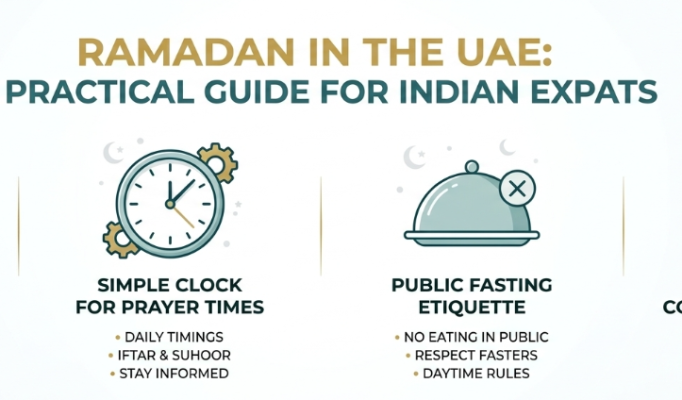
UAE Footprint | Culture, Community & Daily Living
Information checked: 6 November 2026
Experiencing Ramadan in the UAE is something every expatriate should understand, whether it is your first year in the country or you have been living here for a long time.
For Indian expatriates, Ramadan brings some changes to everyday life. Office schedules may become shorter, school timings may change, restaurants adjust their operating hours, supermarkets introduce special offers and evenings become more active with family gatherings and community events.
But Ramadan is much more than a change in daily routine. It is an important month of fasting, prayer, charity, self-discipline and togetherness for Muslims.
The UAE is home to people from many nationalities and religious backgrounds. Residents are encouraged to respect the traditions of the country while continuing their everyday activities.
This guide explains what Indian expatriates should know about Ramadan in the UAE, including workplace arrangements, public etiquette, food and dining, shopping, family life and community participation.
1. What is Ramadan?
Ramadan is the ninth month of the Islamic calendar and one of the most important periods in Islam.
During this month, Muslims who are required to fast abstain from food and drink from dawn until sunset. Fasting is one of the five pillars of Islam.
However, Ramadan is not only about fasting. It is also a time for:
- Prayer and spiritual reflection.
- Spending time with family.
- Helping people in need.
- Giving charity.
- Practising patience and self-discipline.
- Strengthening relationships within the community.
The month follows the Islamic lunar calendar, so its dates move earlier by approximately 10–11 days each year in the Gregorian calendar.
Ramadan lasts either 29 or 30 days, depending on the sighting of the new crescent moon.
Important for expatriates: The exact starting and ending dates are announced officially in the UAE. Do not rely only on calendar predictions when planning leave, travel or family activities.
2. What changes during Ramadan in the UAE?
Life continues normally in the UAE during Ramadan, but daily schedules and social activities adjust around fasting and prayer times.
You may notice:
- Reduced working hours in many workplaces.
- Changes to school timings.
- Different opening hours for some restaurants and cafés.
- Supermarkets and shopping malls offering Ramadan promotions.
- More evening shopping and dining.
- Increased family gatherings and Iftar invitations.
- Special community and charitable activities.
- Changes to public parking and transport timings.
For Indian expatriates, the most noticeable changes are often related to office schedules, food arrangements, traffic and evening activities.
3. Working hours during Ramadan: What should Indian employees know?
One of the most important practical changes concerns employment.
Under the UAE private-sector labour framework, normal working hours are reduced by two hours per day during Ramadan.
This reduction applies to both Muslim and non-Muslim employees.
For example:
| Normal daily schedule | Illustrative Ramadan schedule |
|---|---|
| 8:00 am – 5:00 pm | 8:00 am – 3:00 pm |
| 9:00 am – 6:00 pm | 9:00 am – 4:00 pm |
| 8:30 am – 5:30 pm | 8:30 am – 3:30 pm |
These are examples only. Your employer determines the actual Ramadan schedule, taking account of applicable working-hour rules and operational requirements.
What about private-sector employees?
Article 17 of Federal Decree-Law No. 33 of 2021, as amended, provides the framework for working hours.
The UAE Government confirms that private-sector working hours are reduced by two hours per day during Ramadan.
Employers may also introduce flexible or remote working arrangements where appropriate.
What about government employees?
Federal government entities follow working schedules announced by the Federal Authority for Government Human Resources (FAHR).
For Ramadan 2026, the announced federal government schedule was:
| Working day | Official hours |
|---|---|
| Monday to Thursday | 9:00 am – 2:30 pm |
| Friday | 9:00 am – 12:00 pm |
Government entities could also continue approved flexible working arrangements and allow eligible remote working on Fridays.
Important: These were the federal government hours for Ramadan 2026, not a permanent annual schedule. The schedule for each Ramadan should be checked against the latest FAHR circular.
What should Indian employees do?
- Confirm your Ramadan office timings with HR.
- Check whether remote or flexible working is available.
- Understand any shift or customer-service arrangements.
- Plan appointments around revised working hours.
- Check the employer’s schedule before making travel arrangements.
Do not assume that every company follows the same opening and closing time.
4. Public etiquette: What should non-Muslim expatriates understand?
The UAE welcomes residents and visitors from different nationalities and religious backgrounds.
Non-Muslims are not required to fast during Ramadan. However, everyone should be mindful of the religious and cultural environment.
Eating and drinking during the day
The UAE Government explains that non-Muslims can find dining options in shopping malls, where food courts and restaurants may provide designated areas away from people who are fasting.
Some restaurants may adjust their daytime opening hours, while others continue to serve customers.
The practical approach is simple:
- Check whether restaurants are operating during the day.
- Use designated dining areas where provided.
- Avoid unnecessarily drawing attention to food and drink around people who are fasting.
- Follow instructions displayed by restaurants and public venues.
Do not assume that every restaurant closes during the day or that non-Muslims must fast.
Dress appropriately
Choose respectful clothing in public places, particularly around religious and family settings.
This is a good general practice in the UAE throughout the year, and especially relevant when visiting mosques or attending religious and community events.
Be considerate in public
- Respect people who are fasting.
- Avoid arguments and unnecessary confrontation.
- Be patient in queues and busy public areas.
- Keep public behaviour respectful.
- Follow venue instructions and local rules.
Ramadan is an opportunity to understand the culture of the country where you live.
5. Iftar and Suhoor: Understanding the two important meals
Two words become particularly familiar during Ramadan: Iftar and Suhoor.
What is Iftar?
Iftar is the evening meal with which Muslims break their fast after sunset.
In the UAE, it is common to begin Iftar with dates and water. Families then enjoy a larger meal.
You may find traditional Emirati dishes, Arabic food, Indian meals and international cuisines at Iftar gatherings.
What is Suhoor?
Suhoor is the meal eaten before dawn, before the daily fast begins.
It is usually a family meal and may include rice, bread, eggs, dairy products, fruits and other foods.
What should Indian expatriates know?
Indian families may continue preparing their regular meals at home.
Some may also invite Muslim colleagues or neighbours to share Iftar.
If you receive an Iftar invitation, it is a thoughtful opportunity to understand local hospitality and community traditions.
6. Can non-Muslims visit restaurants during Ramadan?
Yes. The UAE Government confirms that non-Muslims can access dining options during the daytime.
However, restaurant arrangements can vary.
You may find:
- Restaurants serving food in designated indoor areas.
- Hotel restaurants operating during the day.
- Shopping mall food courts with designated dining sections.
- Restaurants opening shortly before Iftar.
- Special Iftar menus after sunset.
- Suhoor dining experiences later in the evening.
A practical dining guide
Breakfast and lunch: Check restaurant opening times before travelling. Some establishments may operate with modified hours.
Iftar: Many restaurants offer special menus and buffet arrangements. Advance booking may be useful at popular venues.
Suhoor: Selected restaurants, hotels and cafés offer late-night dining.
Food delivery: Delivery services may operate during the day, but demand and delivery times can change around Iftar.
Do not assume that all restaurants follow the same schedule.
7. Ramadan food shopping: What changes for Indian families?
For Indian expatriates, grocery shopping remains an important part of the monthly routine.
Supermarkets, hypermarkets and grocery stores generally remain operational during Ramadan, although individual opening hours may change.
You may notice:
- Special Ramadan food offers.
- Discounts on rice, flour, cooking oil and pulses.
- Dates and dried fruit promotions.
- Larger family food packages.
- Special ingredients for Iftar and Suhoor.
- Increased demand for fresh produce.
Practical grocery planning
Indian households can continue purchasing familiar ingredients such as:
- Rice and atta.
- Dal and pulses.
- Vegetables and fruits.
- Milk, curd and paneer.
- Eggs and chicken.
- Cooking oil and spices.
- Dates, nuts and dried fruits.
It is sensible to plan grocery purchases before peak evening shopping hours.
Avoid unnecessary food waste
Ramadan is associated with generosity and sharing. Families can support this spirit by preparing appropriate quantities of food and sharing surplus through permitted charitable channels.
The UAE Ministry of Economy and Tourism also monitors essential commodity prices and consumer protection during Ramadan.
8. Traffic, parking and daily transportation
Daily travel can feel different during Ramadan, particularly in the late afternoon and around sunset.
Many people finish work and travel home before Iftar. Roads around residential communities, shopping centres and restaurants may become busier.
What should drivers expect?
- Increased traffic before sunset in some locations.
- Busy restaurant and shopping areas.
- Higher demand for taxis around Iftar.
- Changes to public parking timings.
- Different operating schedules for some public transport services.
Practical travel tips
- Plan important journeys earlier in the day where possible.
- Allow additional travel time before Iftar.
- Avoid rushing to reach home before sunset.
- Check current parking timings through the relevant local authority.
- Consider booking taxis in advance during busy evening periods.
- Follow road signs and normal traffic regulations.
The UAE Government advises residents to check local parking arrangements because paid parking timings may change during Ramadan.
9. Schools and family routines during Ramadan
Families with school-going children may notice changes in school schedules.
Schools in Abu Dhabi follow guidance and circulars issued by the relevant education authorities, including ADEK.
The precise school day, timings and arrangements may differ between schools and academic programmes.
What should Indian parents do?
- Check the school’s official Ramadan circular.
- Confirm revised arrival and departure times.
- Check school bus arrangements.
- Plan after-school activities around the revised schedule.
- Confirm any changes to extracurricular activities.
- Avoid assuming that all schools follow identical timings.
Family activities
Ramadan can be a good opportunity for Indian families to introduce children to UAE culture.
You may consider:
- Visiting a Ramadan market.
- Exploring traditional Emirati food.
- Attending public cultural events.
- Learning about Iftar traditions.
- Visiting a mosque through its approved visitor programme.
- Participating in suitable community initiatives.
Children can learn about cultural respect and the importance of generosity through everyday experiences.
10. Community activities and Ramadan experiences
One of the most interesting aspects of Ramadan in the UAE is the sense of community.
People from different nationalities participate in cultural activities, food-sharing initiatives and family events.
A. Community Iftar gatherings
Iftar tents and community meals are organised by charitable organisations and other approved entities.
These gatherings may bring together people from different nationalities and economic backgrounds.
The UAE Government describes free Iftar meals as a common charitable practice during Ramadan.
B. Ramadan at Sheikh Zayed Grand Mosque
The Sheikh Zayed Grand Mosque in Abu Dhabi is an important cultural and religious destination.
During Ramadan, visitors may experience special seasonal programmes and community activities.
Check the mosque’s official visitor announcements for opening hours, visitor arrangements and any special Ramadan programme.
C. Ramadan markets and shopping events
Shopping malls and community venues may organise:
- Ramadan markets.
- Traditional food stalls.
- Cultural performances.
- Family entertainment.
- Special shopping promotions.
- Seasonal exhibitions.
Events and schedules change each year, so check official Abu Dhabi event listings before visiting.
D. Traditional Iftar cannon
The Iftar cannon, known as Midfa Al Iftar, is a long-standing Ramadan tradition in the UAE.
Its firing signals the time when Muslims can break their fast.
The UAE Government describes this as an established cultural tradition that takes place in several parts of the country.
11. Charity and giving: How can Indian expatriates participate?
Ramadan encourages generosity and support for people who need assistance.
Indian expatriates can participate in charitable activities through appropriate licensed organisations and approved initiatives.
Examples include:
- Donating to licensed charitable organisations.
- Supporting approved food distribution programmes.
- Contributing to authorised Ramadan campaigns.
- Volunteering through approved community initiatives.
- Supporting registered humanitarian activities.
An important legal point about fundraising
The UAE regulates fundraising and charitable collections.
Individuals should not independently organise public fundraising campaigns, collect money or distribute donation requests without following the applicable legal requirements.
Use licensed charities and authorised channels.
This is particularly important for community groups, social media administrators and people who wish to organise food or donation drives.
12. Workplace relationships during Ramadan
For Indian expatriates working in a multicultural environment, Ramadan can be a good time to strengthen professional relationships.
A few thoughtful habits can make workplace interactions more comfortable.
- Respect colleagues’ fasting schedules.
- Avoid unnecessary meetings close to Iftar.
- Plan deadlines realistically.
- Follow revised office hours.
- Be considerate when arranging team meals.
- Respect prayer breaks and workplace arrangements.
- Continue normal professional communication.
Non-Muslim employees do not need to fast or change their religious practices. Respectful cooperation is what matters.
Should you wish colleagues Ramadan Kareem?
Yes. A simple greeting is a friendly way to acknowledge the occasion.
Common greetings include:
- Ramadan Kareem.
- Ramadan Mubarak.
Both are widely recognised greetings during the holy month.
13. What happens at the end of Ramadan?
Ramadan concludes with Eid Al Fitr, one of the most important celebrations in the Islamic calendar.
The beginning of Eid is determined by the official moon-sighting announcement.
Eid celebrations may include:
- Special prayers.
- Family gatherings.
- Traditional food.
- Visiting relatives and friends.
- Giving gifts and Eidiya to children.
- Charity and community celebrations.
- Public entertainment and shopping events.
For Indian expatriates, Eid can also be an opportunity to join colleagues, neighbours and friends in celebrating together.
Planning leave and travel
If you are planning to travel to India during Eid:
- Check the official public holiday announcement.
- Confirm your employer’s leave policy.
- Book flights early if travelling during a busy period.
- Check airport and transport arrangements.
- Confirm the final holiday dates before making non-refundable plans.
14. Common mistakes Indian expatriates should avoid
Mistake 1: Assuming everyone must fast
Non-Muslims are not required to fast. However, respectful public behaviour is expected.
Mistake 2: Assuming all restaurants close during the day
Many dining options remain available, including designated areas in shopping malls.
Mistake 3: Ignoring revised office hours
Confirm your employer’s Ramadan schedule instead of following your normal routine.
Mistake 4: Planning every journey just before Iftar
Allow additional time for traffic and transportation.
Mistake 5: Assuming every government office follows the same timings
Federal and local government entities may issue separate schedules.
Mistake 6: Organising unauthorised fundraising
Use licensed charities and approved channels for donations and public fundraising.
Mistake 7: Assuming Ramadan dates are fixed
The official dates depend on the lunar calendar and the UAE’s moon-sighting announcement.
15. A practical Ramadan checklist for Indian expatriates
Before Ramadan begins:
- Check the official start date announcement.
- Confirm revised office hours with HR.
- Check school timings and transport arrangements.
- Review supermarket and restaurant opening hours.
- Plan family meals and grocery purchases.
- Check parking and public transport announcements.
- Plan important appointments.
- Explore approved community and cultural events.
- Identify licensed charitable organisations if you wish to donate.
- Plan Eid travel and leave only after official holiday announcements.
Frequently asked questions
Do non-Muslims have to fast during Ramadan in the UAE?
No. Non-Muslims are not required to fast. They should, however, respect local customs and follow the arrangements provided in public dining spaces.
Are working hours reduced for Indian employees?
Yes. Under the general UAE private-sector framework, daily working hours are reduced by two hours during Ramadan. This applies to Muslim and non-Muslim employees.
Are supermarkets open during Ramadan?
Generally, yes. Supermarkets and grocery stores continue operating, although individual stores may adjust their opening hours.
Can I eat at a restaurant during the daytime?
Yes. The UAE Government identifies dining options for non-Muslims, including designated areas in shopping malls. Restaurant arrangements differ by establishment.
Are schools closed during Ramadan?
No general closure applies throughout the month. School schedules may be adjusted, and parents should follow their school’s official circulars.
Can non-Muslims attend Iftar gatherings?
Yes. Non-Muslims may be invited to Iftar gatherings and can participate respectfully in suitable community events.
Can I donate food or money during Ramadan?
You can contribute through licensed charities and authorised charitable initiatives. Public fundraising must comply with UAE regulations.
When does Ramadan end?
Ramadan ends with the sighting of the new crescent moon, followed by Eid Al Fitr. The official date is announced by the UAE authorities.
Conclusion: Experience Ramadan with understanding and respect
Ramadan is an important part of life in the UAE. For Indian expatriates, it is an opportunity to understand the country’s traditions, experience its hospitality and become more connected with the wider community.
Your daily routine may change slightly, but work, education, shopping, travel and family life continue.
By understanding the revised working hours, respecting public customs, checking restaurant arrangements and participating in suitable community activities, expatriates can enjoy a comfortable and meaningful Ramadan experience.
You do not need to follow every tradition to appreciate its importance.
A little cultural understanding, consideration and community spirit can make Ramadan a memorable experience for everyone living in the UAE.
Official Information Sources
- UAE Government – Ramadan: traditions, etiquette, dining, work schedules and charitable activities.
- UAE Government – Working Hours and Overtime: private-sector employment rules.
- Ministry of Human Resources and Emiratisation (MoHRE) – Ramadan working-hours announcements.
- Federal Authority for Government Human Resources (FAHR) – Federal government Ramadan working schedules.
- Abu Dhabi Residents Office – Employment Rights and workplace information.
- UAE Government – Charitable and humanitarian organisations and fundraising regulations.
Information and Legal Disclaimer
This article is published by PAD Media House for general educational and cultural-awareness purposes.
Working hours, public holiday dates, school schedules, restaurant timings, parking arrangements and public events may change each year. Readers should verify the latest information through the relevant UAE authorities, employers, schools and service providers.
The article does not replace legal, employment, religious or medical advice.
Information checked: 6 November 2026.