
Information checked: 6 November 2026
UAE Footprint | Work, Employment & Labour Rights
Leaving a job in the UAE involves more than receiving your final salary. Eligible employees may also be entitled to end-of-service benefits, commonly known as gratuity. The amount can depend on the applicable employment law, qualifying service period, last basic salary, work arrangement and whether the employer uses the traditional gratuity system or an approved alternative savings scheme.
For employees planning a career move, resignation, retirement or return to their home country, understanding these rules can help them review their final settlement and ask the right questions.
This guide explains the standard federal private-sector gratuity calculation, provides practical examples and highlights important exceptions.
1. What are UAE end-of-service benefits?
End-of-service benefits are payments or savings entitlements that may become payable when an employment relationship ends.
Under the standard UAE federal private-sector framework, eligible foreign employees working full-time generally receive a gratuity based on:
- Their last basic wage.
- Their continuous period of service.
- The applicable calculation rate.
- Any legally permitted deductions.
However, not every employee is covered by the same calculation. UAE nationals, government employees, domestic workers, employees in certain financial free zones and employees enrolled in an approved alternative savings arrangement may be governed by different rules.
The first step is therefore to identify the employment law and benefit system that apply to your job.
2. Who is eligible for standard private-sector gratuity?
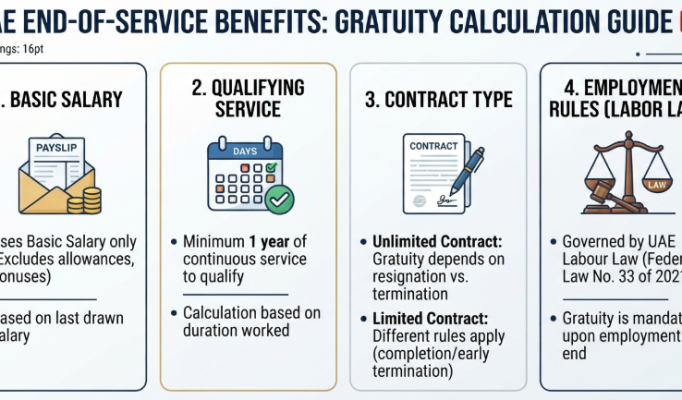
Under Article 51 of Federal Decree-Law No. 33 of 2021, as amended, a foreign full-time employee working under the general federal private-sector framework is generally eligible for end-of-service gratuity after completing at least one year of continuous service with the employer.
The principal conditions include:
- The employee must have completed at least one year of continuous service.
- Unpaid absence days are excluded from the service calculation.
- A proportionate benefit may be payable for a part of a year after the employee completes the first qualifying year.
- The calculation is based on the employee’s last basic wage.
- The total gratuity cannot exceed the equivalent of two years’ wage.
Important: Employees who leave before completing one year of continuous service are generally not entitled to statutory gratuity under this standard federal private-sector formula.
3. Basic salary versus gross salary: Why the difference matters
One of the most common misunderstandings concerns the salary figure used in the calculation.
Under the standard federal private-sector formula, gratuity is calculated using the employee’s last basic wage, not the entire salary package.
Consider this illustrative salary structure:
| Salary component | Monthly amount |
|---|---|
| Basic salary | AED 5,000 |
| Housing allowance | AED 2,000 |
| Transport allowance | AED 1,000 |
| Other fixed allowance | AED 1,000 |
| Total monthly salary | AED 9,000 |
For the standard federal calculation, the relevant monthly amount is AED 5,000, not AED 9,000.
Housing, transport, utilities and similar allowances are not added to the basic wage for this calculation.
This distinction can make a significant difference to the final gratuity amount.
Practical tip: Check the salary breakdown in your employment contract and compare it with your payslips. Do not assume that the total monthly amount credited to your bank account is the figure used for gratuity.
4. How is UAE gratuity calculated?
For an eligible foreign full-time employee under the standard federal private-sector system, the calculation is:
- First five years: 21 days of basic wage for each year of service.
- After five years: 30 days of basic wage for each additional year of service.
The benefit for a part-year is calculated proportionately after the employee has completed the first qualifying year.
Simple calculation formula
For an employee paid monthly:
Daily basic wage = Monthly basic salary ÷ 30
For the first five years:
Gratuity = Daily basic wage × 21 × qualifying years
For service beyond five years:
Gratuity = First five years’ gratuity + (Daily basic wage × 30 × additional years)
The total benefit is subject to the statutory maximum of two years’ wage.
5. Worked examples: Gratuity based on AED 5,000 basic salary
The following examples use a monthly basic salary of AED 5,000 and assume an eligible foreign full-time employee covered by the standard federal private-sector framework.
Daily basic wage:
AED 5,000 ÷ 30 = AED 166.67 approximately.
| Qualifying service | Calculation | Illustrative gratuity |
|---|---|---|
| 1 year | 21 × AED 166.67 | AED 3,500 |
| 2 years | 21 × AED 166.67 × 2 | AED 7,000 |
| 5 years | 21 × AED 166.67 × 5 | AED 17,500 |
| 8 years | AED 17,500 + (3 × AED 5,000) | AED 32,500 |
| 12 years | AED 17,500 + (7 × AED 5,000) | AED 52,500 |
These figures are simplified illustrations. Actual entitlements depend on the exact qualifying service dates, the applicable law, the employee’s basic wage at the relevant date, any unpaid absence and any lawful deductions.
What happens after five years?
The calculation changes after the first five years.
For example, an employee with eight qualifying years does not receive 30 days for all eight years.
The correct calculation is:
- First five years: 5 × 21 days.
- Remaining three years: 3 × 30 days.
This distinction is important when checking a long-service employee’s final settlement.
6. Does the type of employment contract affect gratuity?
The UAE private-sector framework recognises fixed-term employment contracts and different working arrangements.
For an eligible full-time employee covered by the standard federal rules, a fixed-term contract does not automatically reduce the statutory gratuity rate.
The relevant considerations include:
- Whether the employee completed the qualifying service period.
- Whether the service was continuous.
- The employee’s work arrangement.
- The applicable legal framework.
- Whether an approved alternative savings scheme applies.
Older explanations based on the previous unlimited-contract system should not be treated as the current standard calculation.
Employees should also distinguish between the contract’s duration and the actual qualifying service period. Successive contracts with the same employer may require careful examination rather than treating each renewal as an entirely new employment relationship.
7. What if an employee works part-time?
Part-time and other work arrangements do not necessarily use the same direct calculation as a full-time employee.
Article 30 of Cabinet Resolution No. 1 of 2022 provides a proportional calculation mechanism for part-time and other work models.
The general method is:
Annual contracted working hours ÷ Annual full-time working hours × 100
This produces the percentage used to calculate the corresponding full-time end-of-service benefit.
For example, if an employee’s annual contracted hours are 50% of the comparable full-time annual hours, the relevant percentage is 50%.
That percentage is then applied to the gratuity calculated under the full-time method.
The actual calculation must use the contractual working hours and applicable full-time working hours. Temporary employment arrangements of less than one year are subject to a separate exclusion under the relevant regulation.
8. Does resignation affect gratuity?
Employees sometimes believe that resigning automatically reduces their gratuity.
Under the current standard federal private-sector framework, the old distinction between resignation and employer-initiated termination does not operate as a general reduction of the statutory gratuity in the way some older guidance suggested.
The standard calculation is based on qualifying service and the last basic wage, subject to the applicable legal conditions.
However, the circumstances surrounding the end of employment can still matter for other issues, including notice obligations, contractual claims, deductions and the final settlement.
Remember: Gratuity entitlement and compliance with notice-period obligations are separate questions. An employee should not assume that leaving without completing a contractual notice period has no financial consequences.
9. What about UAE nationals?
UAE nationals working in the private sector are generally covered by the applicable UAE pension and social-security legislation rather than the standard expatriate gratuity calculation described above.
Their entitlement depends on the relevant pension framework, registration and contribution rules.
Therefore, the 21-day and 30-day formula should not automatically be used to calculate the end-of-service entitlement of an Emirati employee.
10. ADGM and DIFC: Separate employment frameworks
The UAE has financial free zones with their own employment regulations. Their rules should not be confused with the general federal private-sector framework.
Abu Dhabi Global Market (ADGM)
ADGM has its own Employment Regulations 2024, effective from 1 April 2025.
Its gratuity provisions also refer to 21 days’ basic wage for each of the first five years and 30 days for each additional year, but the calculation has important differences.
For example, ADGM’s official guidance states that:
- The daily basic wage is calculated by dividing the annual basic wage by 365.
- Basic wage must not be less than 50% of annual wages.
- Successive fixed-term contracts with the same employer are considered when determining total service.
- A proportionate calculation applies where employment ends before a full year is completed.
ADGM also has specific provisions concerning pension or savings arrangements offered by an employer. Employees should check the current regulations and their employer’s arrangement before calculating an entitlement.
Dubai International Financial Centre (DIFC)
DIFC has a separate employment law framework and a workplace savings arrangement known as DEWS.
For employees covered by the qualifying savings arrangement, the treatment of benefits can differ from the traditional gratuity system. Previous service and any applicable transitional gratuity entitlement may also need to be considered.
An employee working in DIFC should not simply apply the general federal private-sector formula without checking their applicable DIFC employment and savings scheme rules.
11. Understanding the UAE alternative Savings Scheme
The UAE introduced a voluntary alternative end-of-service Savings Scheme for participating employers.
Under this system, an employer can enrol selected employees and make monthly contributions to an approved investment fund instead of continuing to accrue traditional gratuity for the relevant covered period.
For full-time employees, the standard basic employer contribution rates are:
- 5.83% of monthly basic salary for employees with less than five years of service.
- 8.33% of monthly basic salary for employees who have completed more than five years of service.
The employee may also be able to make additional voluntary contributions, subject to the applicable rules.
A particularly important point is that gratuity accrued before an employee’s enrolment is not simply erased. The employer must calculate and settle the previously accrued entitlement in accordance with the applicable requirements.
Employees should ask their HR or payroll department:
- Is the company enrolled in the Savings Scheme?
- Am I included in the scheme?
- From what date did my participation begin?
- Has my previously accrued gratuity been calculated?
- Which approved fund manages the contributions?
- How can I review my contributions and investment balance?
The Savings Scheme is an alternative benefit arrangement, not an automatic system for every UAE employee.
12. When should the employer pay the final settlement?
Under Article 53 of the federal private-sector labour law, the employer must pay the employee’s wages and other entitlements stipulated under the law within 14 days from the date the employment contract ends.
This includes applicable end-of-service gratuity.
The final settlement may also involve:
- Outstanding salary.
- Payment for eligible unused annual leave.
- Notice-period payment, where applicable.
- Other contractual or statutory entitlements.
- Any lawful deductions.
The payment deadline and applicable remedies can differ under separate employment frameworks, including ADGM and DIFC. Employees should check the rules governing their workplace.
13. What documents should employees check before accepting their final settlement?
Before signing a final settlement or acknowledging receipt of all payments, employees should review the calculation and supporting records.
A practical checklist:
- Employment contract and amendments.
- Last basic salary breakdown.
- Payslips and salary records.
- Employment start date and termination date.
- Records of unpaid leave or unpaid absence.
- Gratuity calculation statement.
- Savings Scheme enrolment and contribution statement, if applicable.
- Unused annual leave calculation.
- Outstanding salary and other payments.
- Any proposed deductions and their legal basis.
- Final amount payable and payment date.
If the calculation appears incorrect, request a written explanation and itemised breakdown from HR or payroll.
Do not sign a statement confirming receipt of money that has not actually been paid. If a dispute remains unresolved, seek guidance from the relevant employment authority or a qualified legal professional.
14. Common mistakes employees should avoid
Mistake 1: Calculating gratuity on gross salary
The standard federal calculation uses the last basic wage, not the entire salary package.
Mistake 2: Applying the 30-day rate to all years
The 30-day rate applies to service beyond the first five years, not to the entire employment period.
Mistake 3: Ignoring the one-year qualifying period
The standard federal full-time gratuity entitlement generally requires at least one year of continuous service.
Mistake 4: Using outdated unlimited-contract rules
Older articles may contain rules from an earlier version of UAE labour legislation. Always check the current law.
Mistake 5: Assuming every free zone follows the same rules
ADGM and DIFC have separate employment frameworks. Other free-zone employees should confirm which employment law and authority apply to their employer.
Mistake 6: Ignoring the Savings Scheme
An employee enrolled in an approved alternative system may have a different benefit calculation for the period covered by that system.
Mistake 7: Treating the gratuity estimate as the complete final settlement
Gratuity is only one part of the final employment settlement. Salary, leave, notice and other entitlements may need to be considered separately.
15. Frequently asked questions
Is gratuity calculated on basic salary or gross salary?
Under the standard federal private-sector formula for eligible foreign full-time employees, gratuity is calculated on the last basic wage. Housing, transport and other allowances are not included.
Can an employee receive gratuity after two years?
Yes. An eligible foreign full-time employee under the standard federal private-sector framework who completes at least one year of continuous service generally qualifies. Two qualifying years at a basic salary of AED 5,000 would produce an illustrative gratuity of AED 7,000.
Is gratuity payable after five years?
Yes. The first five years are calculated at 21 days of basic wage per year. Each additional year is calculated at 30 days of basic wage.
Does resignation cancel gratuity?
Resignation does not automatically cancel the standard statutory gratuity entitlement under the current federal private-sector framework. Other obligations, such as notice requirements, must still be considered.
Is there a maximum gratuity amount?
Under the standard federal private-sector formula, the total gratuity cannot exceed the equivalent of two years’ wage.
Are unpaid leave days included?
Unpaid absence days are excluded from the service period used for the standard federal private-sector gratuity calculation.
Does every UAE employer use the traditional gratuity system?
No. Eligible employers may participate in the approved alternative Savings Scheme. Some jurisdictions also have separate employment and savings arrangements.
Where can an employee raise a gratuity complaint?
Employees covered by the federal private-sector labour framework can seek assistance through the Ministry of Human Resources and Emiratisation (MoHRE). Employees in ADGM, DIFC or other separately regulated employment frameworks should approach the relevant authority.
16. A practical employee checklist
Before leaving a UAE job, make sure you can answer these questions:
- Which employment law governs my contract?
- What is my last recorded basic salary?
- What is my qualifying continuous service period?
- Have unpaid absence days been accounted for correctly?
- Am I covered by traditional gratuity or an alternative savings scheme?
- Has my employer provided an itemised final settlement?
- Have I checked all salary, leave and other outstanding entitlements?
- Have I received the payment before confirming that it has been received?
A little preparation can make the final settlement process clearer and help prevent misunderstandings.
Conclusion
UAE end-of-service benefits are an important part of employment planning. For eligible foreign full-time employees under the standard federal private-sector system, the familiar 21-day and 30-day calculation provides a useful starting point. But the correct amount depends on more than years of service alone.
Basic salary, qualifying service, work arrangement, jurisdiction and participation in an alternative savings scheme must all be considered.
For employees, the most useful habit is to maintain accurate employment and salary records and request a written gratuity calculation before accepting the final settlement.
Legal and Information Disclaimer
This article is published by PAD Media House as general educational information. It is not legal advice, financial advice or an official gratuity calculation.
UAE employment entitlements may differ according to the applicable legislation, employment category, jurisdiction, contract, work arrangement and any approved savings or pension scheme. Laws and official procedures may also be amended.
Readers should verify their individual circumstances with the Ministry of Human Resources and Emiratisation (MoHRE), the relevant free-zone authority, the applicable pension or savings scheme administrator, or a qualified legal professional before making employment or financial decisions.
Information checked: 6 November 2026.