
By PAD Media House | UAE Footprint
Publication date: 28 October 2026
Information checked: 28 October 2026
Category: Family Residency & Immigration
Audience: UAE residents planning to bring their spouse or parents to live with them
Introduction: Bringing Your Family to the UAE
For many people working in the UAE, the next important step after settling into a job is bringing their family to live with them.
However, sponsoring a spouse and sponsoring parents can involve different eligibility conditions, financial requirements and supporting documents.
Before making travel arrangements or paying application fees, it is important to understand the basic process, prepare the required paperwork and confirm the latest rules with the relevant immigration authority.
This guide explains the general requirements in simple language, using official UAE government information as its starting point.
Please note: This article concerns family residence sponsorship. A visit visa is a different arrangement and has its own requirements.
1. Who Can Sponsor Family Members?
Foreign residents with valid UAE residence permits may be eligible to sponsor certain family members, subject to the applicable conditions.
For standard family sponsorship, eligible family members generally include:
- A legally recognised spouse.
- Eligible children, subject to the applicable age and other conditions.
- Children with special needs, subject to the relevant rules.
Sponsoring parents is a separate process and may involve additional requirements.
The applicable conditions can depend on your residence category, income, accommodation, family circumstances and the authority processing the application.
First step: Check your eligibility before arranging your family’s travel.
2. Sponsoring Your Spouse: Basic Eligibility
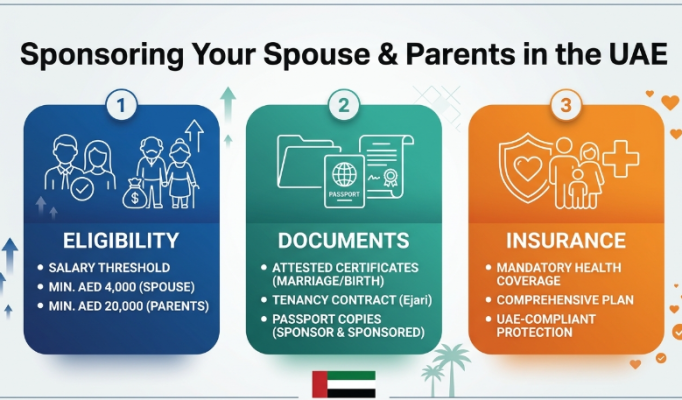
For standard family sponsorship, the UAE Government’s published guidance states a minimum monthly salary of:
- AED 4,000, or
- AED 3,000 plus accommodation provided by the employer.
These are the general financial thresholds published for eligible family sponsorship. They should not be treated as a guarantee of approval or as the complete requirements for every residence category.
You should also be prepared to demonstrate the required family relationship, suitable accommodation and compliance with the applicable application procedures.
Documents commonly requested
Depending on the application, the following documents may be required:
- Sponsor’s passport and valid UAE residence documentation.
- Spouse’s valid passport and photograph.
- Emirates ID details, where applicable.
- Attested marriage certificate.
- Certified Arabic translation of the marriage certificate, where required.
- Sponsor’s employment contract or salary certificate.
- Proof of accommodation, such as an accepted tenancy document.
- Health insurance documentation, as required.
- Other documents requested by the relevant authority.
Do not assume that an ordinary photocopy of a marriage certificate will be sufficient. Ask the authority what authentication and translation are required for a certificate issued in your home country.
3. Sponsoring Your Parents: What Is Different?
Parents’ residence sponsorship requires particularly careful preparation.
Unlike standard spouse sponsorship, an application to sponsor parents may be assessed under additional conditions relating to financial responsibility, family circumstances and the parents’ care arrangements.
Depending on the applicable rules, the authority may request:
- Proof of the parent-child relationship.
- Evidence of the sponsor’s income and financial capacity.
- Proof of suitable accommodation.
- Valid health insurance for the parents.
- Additional supporting documents relating to the parents’ circumstances.
- A financial guarantee or deposit, if required by the applicable procedure.
Some authorities may also require a sponsor to apply for both parents together, subject to exceptions supported by appropriate documents.
Important: Do not assume that the general AED 4,000 or AED 3,000-plus-accommodation threshold automatically qualifies you to sponsor your parents. Confirm the current parent-sponsorship income criteria, insurance requirements, guarantees and exceptions directly with the authority handling your case.
If you intend to sponsor only one parent because the other has passed away or your parents are divorced, ask what official evidence is required.
4. Documents to Prepare Before Applying
Preparing documents in advance can reduce delays.
Create a separate file containing the sponsor’s documents and the documents of each family member.
| Document | Spouse sponsorship | Parent sponsorship |
|---|---|---|
| Sponsor’s valid UAE residence documentation | Commonly required | Commonly required |
| Sponsor’s passport and identification | Commonly required | Commonly required |
| Sponsored person’s passport and photograph | Commonly required | Commonly required |
| Proof of family relationship | Attested marriage certificate | Documents establishing the parent-child relationship |
| Salary or income evidence | May be required | May be required; additional evidence may apply |
| Accommodation evidence | May be required | May be required |
| Health insurance | Confirm the applicable requirements | Confirm the applicable requirements for each parent |
| Additional declarations or supporting documents | Depending on the case | May be required because of the parents’ circumstances |
This is a planning checklist, not an exhaustive official document list.
What about attestation?
Documents issued outside the UAE may need authentication, attestation or certified translation before they can be accepted.
For example, a marriage certificate issued abroad may need to be attested and translated into Arabic according to the applicable procedure.
Documents proving the relationship between a sponsor and their parents may also require verification.
Before paying for attestation or translation, ask the relevant authority which steps apply to your specific document and country of issue.
5. Health Insurance and Medical Fitness
Health insurance is an important part of family settlement.
The insurance requirements may differ according to the emirate, the family member’s residence arrangement and the applicable rules.
Before applying, confirm:
- Whether a separate policy is required for each family member.
- The minimum coverage or policy conditions applicable to the application.
- Which insurance providers and policies are accepted.
- Whether any additional conditions apply when sponsoring parents.
- When the insurance must be in place.
Residence applicants aged 18 and above are generally required to complete the applicable medical fitness examination at an approved centre.
Confirm the current procedure, applicable exemptions if any, and the sequence of medical testing, insurance and residence issuance with the relevant authority.
Do not assume that the employee’s employer-provided insurance automatically covers a spouse or parents.
6. The General Application Process
The precise steps can vary, but the usual process follows this broad sequence.
Step 1: Confirm eligibility.
Check the requirements for your specific family relationship and residence category.
Step 2: Prepare the documents.
Collect passports, proof of relationship, income evidence and accommodation documents as applicable.
Step 3: Complete any required attestation or translation.
Confirm the correct procedure before submitting documents issued outside the UAE.
Step 4: Submit the application.
Use the appropriate official immigration service or an authorised service channel.
Step 5: Complete additional requirements.
These may include medical fitness examinations, insurance documentation, financial guarantees or further verification.
Step 6: Complete residence issuance.
Follow the authority’s instructions for the residence permit and any related Emirates ID procedures.
Step 7: Keep records of validity and renewal dates.
Maintain copies of the documents and confirm the applicable renewal requirements for each family member.
Do not book non-refundable travel or assume a particular approval date until you understand the relevant entry and residence procedures.
7. Where Should You Confirm the Requirements?
The UAE has different immigration service arrangements depending on the emirate and the type of application.
For Abu Dhabi and other emirates covered by federal immigration services, consult the Federal Authority for Identity, Citizenship, Customs and Port Security (ICP) and the appropriate official government service.
For Dubai, the General Directorate of Residency and Foreigners Affairs (GDRFA Dubai) provides its own service information.
When checking the requirements, ask specifically:
- What is the current minimum income requirement for my case?
- What proof of accommodation is accepted?
- Which relationship documents need attestation or translation?
- What health insurance coverage is required?
- Is a deposit or financial guarantee required?
- Can I sponsor one parent, or must I apply for both?
- What are the current application fees and processing steps?
- Which documents must be submitted before or after entry into the UAE?
These questions are particularly important for parent sponsorship, where additional conditions may apply.
8. A Simple Checklist Before You Begin
Before submitting your application, confirm the following:
☐ I hold the appropriate valid UAE residence status.
☐ I have checked the eligibility rules for the family member I intend to sponsor.
☐ I have verified the applicable income criteria.
☐ I have prepared the correct relationship documents.
☐ I have confirmed whether attestation and Arabic translation are required.
☐ I have checked the accommodation requirements.
☐ I have confirmed the applicable health insurance conditions.
☐ I understand any medical fitness requirements.
☐ I have checked the current fees and supporting documents.
☐ I have confirmed the process with the relevant immigration authority.
☐ I understand the residence validity and renewal requirements.
Official Sources
The information in this guide is based primarily on the following official resources:
- UAE Government — Residence visa for family members.
- Federal Authority for Identity, Citizenship, Customs and Port Security (ICP) — Residence permit and family sponsorship services.
- UAE Government — General provisions for residence visas.
- General Directorate of Residency and Foreigners Affairs, Dubai (GDRFA Dubai) — Family residence services.
Readers should consult the current official service page for their emirate and application type before taking action.
Disclaimer and Publication Date
Published on: 28 October 2026
Information checked: 28 October 2026
This article has been prepared by PAD Media House for UAE Footprint for general informational and educational purposes. It is based on publicly available official UAE government and immigration authority information identified in the article and checked on the stated information-check date.
Eligibility criteria, income thresholds, accommodation requirements, document attestation, translation, health insurance, medical fitness, deposits, fees and application procedures may vary according to the sponsor’s circumstances, the family relationship, the residence category and the relevant authority. Official requirements may change.
The information in this article does not constitute immigration, legal, financial or medical advice and does not guarantee approval of any residence application.
Readers must independently confirm the latest requirements directly with ICP, GDRFA Dubai where applicable, or the relevant official immigration authority before making payments, arranging travel or submitting an application. The authority handling the case determines the applicable requirements.
To the fullest extent permitted by applicable law, PAD Media House disclaims liability for losses or consequences arising from reliance on this article. Nothing in this disclaimer excludes or limits any liability that cannot lawfully be excluded or limited.
UAE Footprint by PAD Media House — helping families understand the process before making important decisions.