
UAE Footprint by PAD Media House
Information checked: 30 October 2026
Category: UAE Footprint → Business & Compliance
Opening a corporate bank account is an important step when establishing a business in the United Arab Emirates. It enables a company to receive customer payments, pay suppliers, manage operating expenses and maintain clearer separation between business and personal finances.
However, registering a company does not automatically guarantee that a bank will open an account for it.
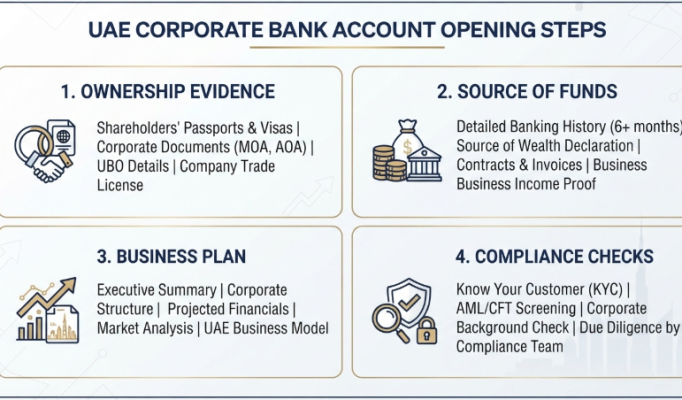
Banks conduct their own customer verification and compliance checks. Depending on the business, its ownership structure and its expected transactions, they may request company documents, beneficial ownership information, evidence of the source of funds, a business plan, supplier and customer details, or additional supporting records.
For a new business, the most practical approach is to prepare a consistent, well-documented explanation of who owns the company, what it does, how it will earn money and where its initial funding comes from.
This guide explains how new businesses can prepare for a UAE corporate bank account application, which documents may be requested, and what entrepreneurs should understand before approaching a bank.
Important: This is a general preparation guide, not a promise of account approval. Requirements differ by bank, account type, business activity and individual circumstances.
1. Does Every New UAE Business Need a Corporate Bank Account?
A corporate bank account is commonly used to manage a company’s business transactions and maintain separation between company funds and the personal funds of its owners.
It can help a business:
- Receive payments from customers.
- Pay suppliers and service providers.
- Manage rent, salaries and operating expenses.
- Make permitted domestic and international transfers.
- Maintain a record of business income and expenditure.
- Reconcile transactions with invoices and accounting records.
- Demonstrate a clear financial history as the business develops.
The appropriate account depends on the company’s legal structure and banking needs.
For example, a business that expects to receive international payments may need different transaction facilities from a small company that operates only within the UAE.
Before applying, identify the transactions the business genuinely expects to make.
Do not choose an account solely because it is advertised as suitable for startups. Check its eligibility conditions, permitted transactions, fees, balance requirements and international-transfer facilities.
2. Does a Trade Licence Guarantee Bank Account Approval?
No. A valid trade licence is important, but it does not guarantee that a bank will approve an account application.
Banks have their own account-opening criteria and must comply with applicable customer due diligence, anti-money laundering and other regulatory requirements.
The bank may need to understand:
- Whether the company is legally registered.
- What activities it is authorised to conduct.
- Who owns and controls the company.
- Who is authorised to operate the account.
- Why the company needs the account.
- Where the initial funding will come from.
- What kinds of transactions the company expects.
- Which countries, customers and suppliers are involved.
- Whether the information supplied is consistent and verifiable.
A bank may request further documents or clarification during its review.
It may also decline an application under its eligibility, risk or compliance policies.
Therefore, entrepreneurs should avoid making financial commitments on the assumption that a corporate account will be approved within a particular number of days—or approved at all.
3. Understand the Main Compliance Checks
Banks do not necessarily apply an identical process to every customer. The extent of verification depends on the relevant legal requirements and the bank’s assessment of the business.
The following concepts help explain what applicants may be asked to demonstrate.
A. Know Your Customer (KYC)
Know Your Customer procedures help a bank establish the identity of its customer and relevant individuals associated with the account.
For a company, this can include verifying the legal entity, its owners, directors, authorised signatories and other relevant persons.
The bank may request identity documents and independent evidence to verify the information provided.
B. Customer Due Diligence (CDD)
Customer Due Diligence involves understanding the customer and the proposed banking relationship.
For a business, the bank may need to establish the purpose of the account, the nature of its operations, its ownership and the transactions it expects to conduct.
The information helps the bank develop an appropriate customer risk profile.
C. Beneficial Ownership
A beneficial owner is a natural person who ultimately owns or controls a company, directly or indirectly, or otherwise meets the applicable legal definition.
The bank may need to look beyond the company’s immediate shareholders to understand its ultimate ownership and control.
This is particularly important when the company has multiple shareholders, corporate shareholders, overseas ownership or a complex ownership structure.
D. Source of Funds
Source of funds refers to where the money involved in a particular funding arrangement or transaction comes from.
For example, a company may receive its initial funding through:
- A documented contribution from its owner.
- A capital contribution from shareholders.
- A business loan, where applicable.
- Revenue from customers.
- Another legitimate and documented source.
The bank may ask for evidence that supports the stated source.
E. Source of Wealth
Source of wealth concerns how an individual or entity accumulated its overall wealth.
Depending on the circumstances and the bank’s risk assessment, an applicant may be asked to explain how the owner accumulated the wealth used to fund the business.
For example, supporting information could relate to employment income, proceeds from a documented asset sale, accumulated business profits or other legitimate sources.
Source of funds and source of wealth are related but different concepts. A bank may ask about one or both, depending on its assessment and applicable requirements.
F. Expected Account Activity
The bank may ask how the company expects to use its account.
This can include the anticipated number and value of incoming and outgoing payments, the expected countries involved, the main customer and supplier categories, and whether international transfers are part of normal operations.
The explanation should reflect the business’s actual plans rather than an artificially optimistic forecast.
G. Ongoing Monitoring
Compliance does not necessarily end when the account is opened.
Banks may monitor transactions and request updated company information or supporting documents when appropriate.
A company should keep its banking information accurate and respond promptly to legitimate requests for clarification.
4. Documents to Prepare Before Applying
There is no single document checklist that applies identically to every UAE bank and every company structure.
The following is a preparation checklist, not a guarantee that these documents will be sufficient for an application.
A. Company documents
Prepare the relevant documents for the company’s legal form and licensing authority, which may include:
- Valid trade or commercial licence.
- Certificate of incorporation or registration, where applicable.
- Memorandum and Articles of Association, or equivalent constitutional documents.
- Commercial registration details, where applicable.
- Current shareholder or ownership records.
- Share certificates, where applicable.
- Details of directors and authorised representatives.
- Board or shareholder resolution authorising account opening, where required.
- Power of attorney, if an authorised representative is acting under one.
- Relevant amendments to company documents.
Not every company will have every document listed above. The required documents depend on its legal form and registration framework.
B. Identity documents
The bank may request identification and verification documents for relevant individuals, including:
- Shareholders.
- Beneficial owners.
- Directors.
- Managers.
- Authorised signatories.
- Persons acting on behalf of the company.
Depending on the bank and the applicant’s circumstances, these may include passports, Emirates IDs, residence information and other identification documents.
The bank may request information about overseas shareholders or individuals who do not live in the UAE.
Check whether any documents need to be translated, notarised, legalised or attested before submission.
C. Proof of address
A bank may request evidence of the company’s registered or operating address.
Depending on the company and bank, this could involve a tenancy contract, premises documentation or another acceptable address document.
The bank may also request residential address evidence for shareholders, beneficial owners or authorised signatories.
Ask the bank which documents it accepts. Do not assume that a registered address or flexi-desk arrangement automatically satisfies every bank’s requirements.
D. Ownership and control information
Prepare a clear ownership chart showing:
- The company’s shareholders.
- Their respective ownership percentages.
- Any corporate shareholders.
- The individuals who ultimately own or control the company.
- The persons authorised to make banking decisions.
For complex structures, include the relevant intermediate entities and supporting records.
The bank may require information or documentation beyond the immediate shareholders to establish the ultimate beneficial owners.
Make sure the ownership information agrees with the company’s official records and the information supplied to the licensing authority.
5. How to Prepare Evidence of the Source of Funds
Source-of-funds questions can be particularly important for newly established businesses because the company may not yet have trading revenue.
The aim is to document the actual origin of the money and provide evidence that supports the explanation.
The appropriate documents depend on the funding method and the bank’s requirements.
Scenario 1: The owner funds the business from personal savings
Potential supporting documents may include:
- Personal bank statements showing the relevant funds.
- Evidence of the owner’s income or accumulated savings, if requested.
- Records of the transfer into the company or the account proposed for funding.
- Corporate records documenting the contribution, where applicable.
The evidence should explain how the funds were accumulated and how they are being introduced into the business.
Scenario 2: A shareholder provides capital
Potential supporting documents may include:
- Corporate ownership and shareholder records.
- A capital contribution record or relevant resolution.
- Evidence of the shareholder’s funding.
- Bank statements or transfer records showing the movement of funds.
The accounting and legal treatment of the contribution should be consistent with the company’s documents.
Scenario 3: A related company provides funding
If another company is funding the new business, the bank may request information about the relationship between the entities and the commercial basis for the transfer.
Potential documents may include:
- Ownership records for both companies.
- Relevant agreements or resolutions.
- Financial statements or bank statements, where requested.
- Evidence explaining the purpose and source of the transfer.
The description of the transfer should accurately reflect whether it is a capital contribution, loan, payment for services or another arrangement.
Scenario 4: The company has started trading
A business that has already begun operations may be asked to provide supporting evidence of its trading activity.
Depending on the circumstances, this could include:
- Customer contracts.
- Invoices.
- Purchase orders.
- Supplier agreements.
- Sales records.
- Relevant bank statements.
- Accounting records.
These documents should reflect genuine transactions.
Practical rule: Explain where the money came from, show the relevant evidence, and make sure the records tell a consistent story.
Do not create artificial transactions or provide documents that misrepresent the source or purpose of funds.
6. How to Prepare a Business Plan for a Bank
A business plan can help explain the company’s commercial purpose and expected banking activity.
Not every bank requires a formal business plan from every applicant. However, a concise, credible plan is useful preparation, particularly when a company is new and has little or no trading history.
A practical plan could contain the following sections.
1. Business overview
Explain:
- What the company does.
- Where it is registered.
- Which activities appear on its licence.
- What products or services it offers.
- What problem it solves for customers.
Keep the explanation consistent with the company’s actual licensed activities.
2. Products and services
Describe the products or services the company intends to provide.
Explain how the company will deliver them, who the intended customers are and whether the business involves physical goods, digital services, consulting or another model.
If the business operates in a regulated sector, identify the relevant approvals and explain their status accurately.
3. Target customers and markets
Describe the company’s intended customer groups and the markets in which it expects to operate.
For example, a company might serve customers in the UAE, other Gulf countries or selected international markets.
If cross-border transactions are expected, identify the countries and explain the commercial reason for those transactions.
Do not claim to have customers, contracts or market access that the business has not actually secured.
4. Suppliers and business partners
Explain how the company will obtain products or services and who its principal supplier categories are.
Where relationships have already been established, retain the relevant contracts, quotations, purchase orders or correspondence.
If suppliers are still being selected, state that clearly rather than presenting proposed relationships as confirmed agreements.
5. Revenue model
Explain how the business expects to earn money.
Examples include:
- Product sales.
- Professional service fees.
- Consulting fees.
- Subscription revenue.
- Contract payments.
- Commission income, where the business is authorised to earn it.
The revenue model should match the company’s actual activities.
6. Startup funding
Explain how the company will fund its initial operations.
Identify the anticipated funding source, the expected amount if known, and the relevant supporting documentation.
If funding will come from a shareholder, loan or another company, explain the arrangement accurately.
7. Expected banking activity
This section is especially useful when preparing for a bank discussion.
Provide a reasonable estimate of:
- Expected monthly incoming payments.
- Expected monthly outgoing payments.
- Typical transaction values.
- Main payment methods.
- Anticipated international transfers.
- Expected currencies.
- Main customer and supplier locations.
- Expected payroll or other regular expenses, where applicable.
These figures should be estimates based on the business plan, not guarantees.
If actual activity later changes substantially, the company should be prepared to explain the change and provide supporting information when requested.
8. Financial forecast
A simple forecast can show anticipated revenue, operating expenses, cash flow and funding requirements.
Explain the assumptions behind the figures.
For a new business, a forecast is not the same as a trading history. Label projections clearly and do not present them as actual results.
7. What Is an Expected Transaction Profile?
A bank may seek to understand the transactions a company expects to make so it can assess whether the account activity is consistent with the stated business.
For example, consider a newly formed company that provides permitted digital consulting services.
Its expected account activity might include:
- Payments from business clients.
- Payments to software providers.
- Professional service expenses.
- Office or workspace costs.
- Regular transfers to approved service providers.
If the company expects significant international payments, it should explain the commercial reason and identify the expected counterparties or countries as accurately as possible.
A different business model, such as importing goods for resale, may have a different transaction profile involving suppliers, logistics providers, customs-related payments and customer receipts.
Neither example represents a prescribed banking template. They illustrate why the expected account activity should be consistent with the company’s real operations.
Do not inflate forecasts to make a company appear larger or underestimate expected transactions merely to avoid questions.
8. What If the Company Has No Revenue Yet?
A newly incorporated company may not have customers, completed contracts or historical business revenue.
That alone does not establish whether the bank will approve or decline the application.
The applicant should explain the company’s current stage honestly.
For example, it may be:
- Preparing to launch.
- Developing a product or service.
- Negotiating with prospective customers.
- Establishing supplier relationships.
- Waiting for additional operational approvals.
- Preparing to begin commercial activity.
The company can provide a business plan, evidence of startup funding, relevant incorporation records, supplier quotations or other genuine documents that explain its position.
Where there are no invoices or completed contracts, do not manufacture them.
Instead, ask the bank which alternative evidence it will accept for a pre-revenue company.
9. Can a Non-Resident Foreign Shareholder Open a UAE Corporate Account?
A foreign shareholder’s residence status can affect the documentation and verification process, but it should not be treated as the only factor determining account eligibility.
The bank may need to establish the shareholder’s identity, ownership, source of funds, business background and other information relevant to its assessment.
Depending on the bank and circumstances, additional questions may arise concerning:
- Overseas addresses and identity documents.
- The ownership structure.
- The source of startup funding.
- The business’s connection to the UAE.
- The expected transactions and countries involved.
- The presence or role of authorised signatories.
- Any in-person verification or other procedural requirements.
Some banks may impose account-specific residency or presence requirements. Others may provide different application routes, subject to their current policies.
Do not assume that a company can open an account remotely simply because it was incorporated online.
Before committing to a business setup, contact the bank directly and ask whether it considers companies with your particular ownership structure, shareholder residence status and business activity.
Obtain confirmation of the applicable requirements rather than relying on a general promise from a third party.
10. How to Choose a Bank for a New Business
A suitable bank should fit the company’s actual operating needs.
When comparing business accounts, consider the following factors.
Account eligibility
Ask whether the bank accepts your company’s legal form, licensing authority, business activity and ownership structure.
Minimum balance and charges
Check the current minimum balance, maintenance fees, transaction charges and other applicable costs.
Do not rely on an old comparison article for current account pricing.
Domestic and international transactions
If the business expects international payments, confirm that the selected account supports the required currencies, incoming transfers, outgoing transfers and payment routes.
Some entry-level business accounts have transaction restrictions.
Online banking
Review the available digital banking facilities, user access controls, payment authorisation arrangements and statement services.
Business requirements
Consider whether the account supports the company’s anticipated payments, collections, supplier transfers and other regular operations.
Customer support
Understand how the bank handles onboarding questions, document requests and ongoing account support.
Written confirmation
Before applying, ask the bank for its current document checklist and applicable account terms.
Account availability, charges, transaction restrictions and eligibility criteria may change.
11. Common Preparation Mistakes to Avoid
A well-organised application cannot guarantee approval, but avoidable inconsistencies can create additional questions.
Mistake 1: Choosing an unsuitable account
An account that does not support the business’s expected currencies or cross-border transactions may not fit its needs.
Better approach: Match the account features to the actual business model.
Mistake 2: Providing inconsistent information
Differences between the licence, company documents, application form, ownership chart and business plan may require clarification.
Better approach: Check names, activities, ownership percentages, addresses and other details before submission.
Mistake 3: Giving a vague source-of-funds explanation
Saying that the funds are personal savings or investment money may not provide enough detail for the bank’s assessment.
Better approach: Explain the source accurately and prepare relevant supporting evidence.
Mistake 4: Presenting projections as actual revenue
Forecasts can help explain a new business, but they should not be confused with completed transactions or confirmed contracts.
Better approach: Label estimates clearly and explain the assumptions.
Mistake 5: Ignoring ownership and control
An application may require information about the ultimate beneficial owners, not just the person submitting it.
Better approach: Prepare accurate ownership and control information.
Mistake 6: Assuming the licence is sufficient
A licence establishes important information about the company, but the bank may need further evidence before approving the account.
Better approach: Prepare company, identity, funding and business-activity documents together.
Mistake 7: Assuming approval is guaranteed
No general guide can guarantee that a bank will approve a particular company.
Better approach: Discuss eligibility with the bank before making commitments that depend on account opening.
Mistake 8: Using an unofficial intermediary without checking
A third party may assist with document preparation, but the bank makes its own decision under its policies and applicable requirements.
Better approach: Verify any representative’s role and confirm material requirements directly with the bank.
12. A Practical Corporate Bank Account Preparation Checklist
Before submitting an application, work through the following checklist.
Company information
- Valid trade licence and relevant registration documents.
- Constitutional documents appropriate to the legal form.
- Current ownership and shareholder information.
- Details of directors and authorised signatories.
- Required board or shareholder resolution, if applicable.
- Valid company address documentation, where required.
Identity and ownership
- Relevant identification documents collected.
- Beneficial ownership information prepared.
- Ownership structure checked against official records.
- Authorised signatories correctly identified.
- Any overseas documents checked against the bank’s requirements.
Source of funds
- Initial funding source clearly explained.
- Supporting records collected where available and relevant.
- Shareholder contributions or loans documented appropriately.
- Transfer records retained where applicable.
Business plan
- Business activities explained consistently with the licence.
- Target customers and markets identified.
- Revenue model described.
- Suppliers and business partners identified where known.
- Startup funding explained.
- Expected transaction profile prepared.
- Financial forecasts labelled as estimates.
Bank selection
- Eligibility confirmed with the chosen bank.
- Current document checklist obtained.
- International transaction needs checked.
- Minimum balance and charges reviewed.
- Application method and verification requirements confirmed.
- No assumption of guaranteed approval or processing time.
Use this checklist as a planning aid. The bank’s current requirements take precedence over this general list.
13. What Happens After the Account Is Opened?
Account opening is the beginning of the banking relationship, not the end of the company’s compliance responsibilities.
A business should:
- Keep its trade licence and company information current.
- Notify the bank of relevant ownership or authorised-signatory changes.
- Update information when requested.
- Maintain accurate invoices, contracts and accounting records.
- Ensure that transactions reflect the company’s genuine activities.
- Retain supporting documents for significant business payments.
- Respond to legitimate bank queries promptly.
- Review the account’s fees, transaction limits and permitted uses.
- Keep personal and business finances appropriately separated.
Banks may conduct ongoing reviews and request updated information. If the company’s business model or transaction pattern changes, it should be prepared to explain the change and provide relevant evidence.
For example, a company that initially receives local consulting fees but later begins handling substantial international trade payments may need to update its business and transaction information with the bank.
Do not assume that approval at account opening means every future transaction will automatically be accepted.
14. Official Sources and Where to Verify Requirements
The following sources provide the starting point for checking relevant requirements. Individual banks’ current account terms and application instructions must also be reviewed.
Central Bank of the UAE (CBUAE)
The CBUAE Rulebook contains customer due diligence requirements concerning identity verification, beneficial ownership, risk profiles, source of funds, expected account activity and ongoing monitoring.
UAE Government — Banking in the UAE
The UAE Government’s banking guidance provides general information about opening bank accounts and commonly requested documents.
Emirates NBD — Business Banking
Emirates NBD publishes its own business account opening information, including documentation requirements and application instructions.
Abu Dhabi Commercial Bank (ADCB) — Business Account FAQs
ADCB publishes account-specific eligibility, documentation and operating information. Its requirements and account terms should not be assumed to apply to every other bank.
Use these sources to understand the framework, then obtain a current checklist from the bank you intend to approach.
Conclusion: Prepare the Evidence Before You Apply
Opening a UAE corporate bank account is easier to approach when the company can clearly explain its ownership, commercial purpose, startup funding and expected transactions.
The strongest preparation is not simply a thick folder of documents. It is a consistent set of genuine records that allows the bank to understand the business and verify the information relevant to its assessment.
Start with the company’s legal documents. Establish who owns and controls it. Document the source of its funding. Prepare a realistic business plan and expected transaction profile. Then confirm the selected bank’s current requirements before submitting the application.
A prepared application does not guarantee approval, but it helps the business respond clearly and accurately to the bank’s questions.
Information and Legal Disclaimer
Information checked on 30 October 2026.
This article is published by PAD Media House for general educational and informational purposes only. It is not legal, banking, financial, tax or compliance advice, and it does not constitute an offer, recommendation or guarantee of a banking product or account approval.
The document lists, examples and explanations are general preparation guidance. Actual requirements depend on the bank, account type, company structure, applicant circumstances, applicable laws and the bank’s assessment. Banks may request additional documents, apply their own eligibility criteria or decline an application.
Regulations, bank policies, account features, fees and document requirements may change. Readers should verify current information directly with the Central Bank of the UAE where relevant and with their selected bank. Readers who require advice on a specific company or transaction should consult an appropriately qualified professional.
PAD Media House makes reasonable efforts to present information accurately as of the stated check date, but cannot guarantee that every statement remains current or applies to every reader. Nothing in this article removes or limits any responsibility that cannot legally be excluded.