
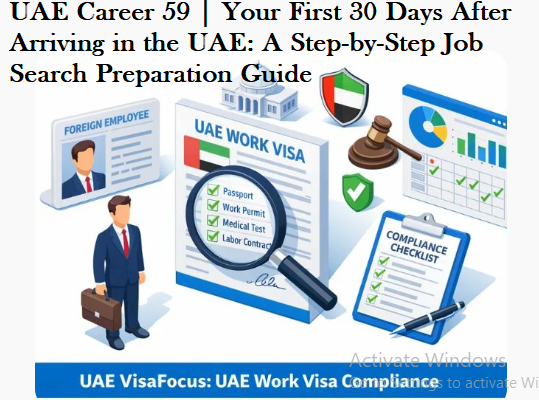
A practical guide to accommodation, food, transport, daily expenses, job applications, personal safety and financial planning
Information checked: 9 October 2026
Introduction: Your first month is a preparation phase
Arriving in the United Arab Emirates can be an important step towards a new career. But before you begin attending interviews, meeting recruiters and exploring opportunities, you need a structured plan for your first 30 days.
Your first month should not be treated as a holiday or an unplanned search for employment. It should be a carefully managed period to:
- Settle into safe and affordable accommodation.
- Understand your local transport options.
- Prepare your CV and professional profiles for UAE employers.
- Identify suitable employers and vacancies.
- Build professional connections.
- Attend genuine interviews and follow up professionally.
- Monitor your expenses and decide whether your job-search strategy is working.
The most important rule: Do not arrive with only enough money for a few weeks, hoping that a job will come through immediately. Recruitment timelines vary, and an interview is not a job offer.
This guide is educational. PAD is an information platform, not a recruitment, visa or employment agency.
1. Before travelling: Complete these seven preparations
Do not wait until you land in the UAE to begin preparing.
Step 1: Confirm your legal entry route
Understand which visa or entry permission applies to your circumstances.
The UAE Government lists a jobseeker visit visa with 60-, 90- or 120-day validity options, subject to eligibility and approval. Eligibility includes specified professional skill levels or certain recent graduates from approved top-ranked universities, a bachelor’s degree or equivalent, and prescribed financial guarantees.
Official reference: UAE Government — Jobseeker Visit Visa.
A tourist or ordinary visit visa does not authorise you to work, whether paid or unpaid. A job-search visit visa is also not permission to begin employment.
Step 2: Prepare your professional documents
Keep printed copies and secure digital copies of:
- Passport and relevant visa or entry documents.
- Updated CV tailored to your target roles.
- Passport-size photographs, if required.
- Educational certificates and attestations, where applicable.
- Professional licences or registrations, where required.
- Experience letters and employment references.
- Portfolio, project samples or professional certifications.
- Contact details of professional referees.
Check whether your target occupation requires local licensing or additional qualification verification.
Step 3: Research your target employers
Create a list of 30–50 relevant employers before travelling. Divide them into three groups:
- Priority employers: Strong match for your experience.
- Secondary employers: Suitable alternatives.
- Exploratory employers: Organisations where you want to learn about future opportunities.
Use official company career pages, credible job portals and professional networking platforms. Do not send the same generic CV to every vacancy.
Step 4: Book your initial accommodation
Arrange a confirmed, reasonably priced place to stay for your first 7–14 nights before travelling. Check the full address, reviews, house rules, access to public transport and cancellation terms.
Do not pay an unknown person a large advance for a room you have not verified.
Step 5: Estimate your monthly expenses
Prepare a daily and weekly budget before departure. Include accommodation, food, transport, mobile service, job-search expenses and emergencies.
Keep the money for returning home separate from your routine spending.
Step 6: Prepare your digital identity
Before travelling:
- Update LinkedIn with your current skills and experience.
- Use a professional email address.
- Keep your voicemail and telephone number accessible.
- Prepare a concise introduction about your experience and target role.
- Test access to your email, documents and banking services.
Step 7: Set a realistic objective
Do not measure success only by the number of CVs sent.
Your objective should be to identify appropriate vacancies, improve your visibility, speak with relevant professionals and secure genuine interviews.
2. How much money should you keep for the first 30 days?
There is no single official amount that guarantees a safe job search. Expenses depend on the emirate, accommodation arrangement, lifestyle, travel distance and the length of time it takes to find employment.
The following figures are planning estimates, not official tariffs or guaranteed market prices. They assume one adult using shared accommodation, preparing many meals independently and relying mainly on public transport.
Estimated 30-day living budget
| Expense | Lean budget (AED) | Safer planning budget (AED) |
|---|---|---|
| Shared accommodation or bed space | 800–1,400 | 1,200–2,000 |
| Food and drinking water | 500–800 | 700–1,000 |
| Public transport | 200–350 | 300–500 |
| Mobile plan and data | 75–150 | 100–200 |
| Laundry and personal essentials | 100–200 | 150–250 |
| CV printing, interview and job-search expenses | 75–150 | 150–300 |
| Miscellaneous expenses | 150–250 | 250–400 |
| Estimated total | 1,900–3,300 | 2,850–4,650 |
These are budget scenarios rather than a prediction of what every person will spend. Accommodation deposits, temporary hotel stays, taxis, medical expenses and other unexpected costs can increase the total substantially.
Private accommodation can be much more expensive. A 2026 cost-of-living report estimated that a single person in Dubai could need at least AED 8,000 per month when rent for an affordable private apartment is included. Read the cost-of-living analysis by The National.
How much should you actually have available?
For someone arriving without a confirmed job, I would use these conservative planning targets:
| Financial position | Suggested approach |
|---|---|
| AED 3,000–4,000 | A very tight budget. Do not assume it will safely cover the full month and emergencies. |
| AED 5,000–6,000 | May cover a carefully managed month in shared accommodation, but offers limited protection against delays or unexpected costs. |
| AED 7,000–10,000 | A more prudent starting reserve for a budget-conscious job seeker, after separately accounting for airfare, visa costs and any pre-booked accommodation. |
| More than AED 10,000 | Provides a larger cushion, but still requires expense controls and a clear job-search deadline. |
These amounts are recommendations for financial planning, not official UAE immigration requirements. Your own circumstances may require more.
My recommendation: If you cannot comfortably fund your stay, emergency expenses and return journey without relying on an unconfirmed job offer, postpone the trip or reconsider your plan.
Keep three separate financial reserves
Reserve A — Daily living: Rent, food, local travel and telephone expenses.
Reserve B — Emergency: Unexpected accommodation changes, medical needs or a delayed departure.
Reserve C — Return journey: Money reserved for leaving the UAE if your finances or job-search prospects deteriorate.
Do not use Reserve C for ordinary expenses. Keep access to more than one secure payment method where possible, and do not carry all your cash in one place.
What is not included in the table?
Budget separately for:
- Airfare to and from the UAE.
- Visa application and issuance charges.
- Any required insurance.
- Document attestation or professional licensing.
- Accommodation deposits or advance payments.
- International banking and foreign-exchange charges.
- Any change to your return ticket.
Visa charges vary by application route and circumstances. Check the relevant official immigration authority before paying.
3. Accommodation: Where should you stay?
Accommodation is likely to be one of your largest expenses, so choose it carefully.
Option A: Shared room or bed space
This may be the most economical option for a single job seeker.
Before paying, confirm:
- The exact address and access arrangements.
- The total monthly cost and what it includes.
- Whether utilities, Wi-Fi and laundry are included.
- Whether a deposit is refundable and under what conditions.
- The number of occupants and availability of secure storage.
- Whether the arrangement is lawful and permitted by the property owner or relevant authority.
Do not select a distant location simply because the rent is cheap. Daily travel costs and time can erase the savings.
Option B: Budget hotel or hostel
Useful for the initial few nights while you inspect longer-term options. However, nightly rates can make a full month expensive.
Calculate the cost of 30 nights before choosing this route.
Option C: Staying with friends or relatives
This may reduce accommodation expenses, but agree on the length of stay, household expenses and transport arrangements in advance.
Dubai or Abu Dhabi?
Choose the city based on your target employers, not simply on reputation.
- Dubai: Consider where your target employers are located and whether you can reach them affordably.
- Abu Dhabi: If your target is government-linked organisations, energy, healthcare, education, hospitality or other Abu Dhabi-based employers, consider staying within a practical commute.
- Other emirates: Consider them if relevant opportunities exist there and the transport arrangements make sense.
Do not plan to commute long distances every day without calculating the cost and time.
For information about renting in the UAE, consult the official UAE Government housing guide.
4. Food and daily living: Control costs without compromising health
You do not need to spend heavily on restaurants to manage a job search.
A practical food routine
- Buy basic groceries and prepare simple meals where facilities are available.
- Carry drinking water and a reusable bottle where practical.
- Keep fruit, eggs, bread, rice, vegetables and other affordable staples in your routine.
- Limit frequent restaurant meals, food delivery and expensive coffee.
- Check whether your accommodation has a usable kitchen and refrigerator.
- Keep a small amount aside for meals on interview days.
Food costs depend on diet, location and shopping habits. A starting estimate of AED 500–1,000 per month is possible for a cost-conscious individual, but it is not suitable for every diet or living arrangement.
Do not cut essential food or necessary medication to protect your job-search budget. If your finances are becoming inadequate for basic needs, reassess your stay rather than waiting until you run out of money.
5. Conveyance: Plan transport before accepting an interview
The cheapest accommodation is not necessarily the most economical choice if it creates expensive daily journeys.
Your transport checklist
- Identify the nearest metro, bus stop or other public transport connection.
- Check the route to your priority employers.
- Estimate the cost of return journeys for interviews.
- Check the payment card or ticketing system used in that emirate.
- Keep a small emergency transport allowance.
- Use taxis selectively when necessary, rather than as your daily default.
Dubai’s public transport and Abu Dhabi’s bus network have their own routes, ticketing systems and fares. Check the relevant official sources before travelling:
For planning purposes, set aside approximately AED 200–500 for a month of economical local travel, then adjust this estimate after checking your actual routes. Your cost could be higher if you need taxis or travel between emirates.
Avoid travelling to every advertised interview without first checking the employer, role and interview details. Where appropriate, request an initial online interview.
6. Your first 30 days: A week-by-week action plan
Days 1–3: Settle, organise and verify
Primary objective: Become stable and ready to search.
- Complete your accommodation check-in.
- Confirm the validity and conditions of your entry permission.
- Obtain a local mobile connection if needed.
- Learn the nearest transport routes, supermarket and medical facilities.
- Set up a daily expense tracker.
- Update your CV and LinkedIn profile.
- Create a spreadsheet of target employers and vacancies.
- Check your email, phone and professional documents.
Do not spend the first three days travelling around the city without a plan.
Deliverable by Day 3: Accommodation confirmed, essential services arranged, CV ready and target-employer list started.
Days 4–7: Begin a focused job search
Primary objective: Apply selectively and establish professional visibility.
Each day:
- Review new vacancies matching your qualifications.
- Apply to relevant positions with a tailored CV.
- Research the employer before contacting anyone.
- Identify recruiters or hiring managers associated with the role.
- Send a short, professional networking message where appropriate.
- Record the application date and follow-up date.
Use employer career pages and credible job portals. The UAE Government’s job-search guide lists official and private job-search channels.
Deliverable by Day 7: A structured application tracker, a first batch of suitable applications and a list of relevant professional contacts.
Days 8–14: Improve your response rate
Primary objective: Understand what is and is not working.
Review your applications.
- Are you applying for roles matching your experience?
- Does your CV clearly show relevant achievements?
- Are your salary expectations realistic for your target role?
- Are employers responding to your applications?
- Are you targeting the correct level of seniority?
- Do you need a particular certification, licence or technical skill?
Contact employers professionally and follow up only when appropriate. Avoid repeatedly messaging the same recruiter.
If you receive an interview invitation, confirm the company name, job title, interviewer’s identity, location and whether the interview is online or in person.
Deliverable by Day 14: A refined CV, a more focused employer list and a review of your response rate.
Days 15–21: Concentrate on genuine opportunities
Primary objective: Turn applications into meaningful conversations.
- Prioritise employers that have responded or have relevant vacancies.
- Prepare examples of your work and achievements.
- Practise interview questions related to your industry.
- Prepare questions about responsibilities, reporting lines and employment terms.
- Continue applying to new, suitable vacancies.
- Attend genuine interviews and record the next steps.
Do not stop your job search merely because one interview appears promising.
If you have received very few responses, review your CV, role selection, experience alignment and application quality rather than simply increasing the number of applications.
Deliverable by Day 21: Interview preparation completed, follow-ups organised and a clear understanding of which applications deserve further attention.
Days 22–30: Review the results and decide what comes next
Primary objective: Make a financial and career decision based on evidence.
At the end of the month, assess:
- Number of relevant applications.
- Number of employer responses.
- Interviews completed and scheduled.
- Genuine opportunities progressing to the next stage.
- Feedback received.
- Remaining funds and expected daily expenditure.
- Time remaining under your lawful stay permission.
Decide whether to continue, adjust your strategy, pursue suitable opportunities remotely or return home.
Do not extend your stay simply because you have already spent money travelling to the UAE. Money already spent should not force you into an unsafe financial decision.
Deliverable by Day 30: A written review, a revised job-search strategy and a clear decision about the next stage.
7. A simple daily schedule
Use this as a starting routine and adapt it to your industry and interview timings.
| Time | Activity |
|---|---|
| 8:00–9:00 AM | Breakfast, review new vacancies and plan priorities |
| 9:00–11:00 AM | Tailored applications and employer research |
| 11:00 AM–12:00 PM | Professional networking and suitable follow-ups |
| 12:00–1:00 PM | Lunch and rest |
| 1:00–3:00 PM | Interview preparation, skills practice or online interviews |
| 3:00–5:00 PM | Employer research, applications or scheduled interviews |
| Evening | Review progress, track expenses and plan the next day |
This is not a fixed timetable. Hospitality, healthcare, retail, engineering and other industries have different recruitment patterns and interview schedules.
Maintain a sustainable routine. Consistent, relevant activity is more useful than exhausting yourself by spending the entire day applying indiscriminately.
8. Job-search precautions every candidate should understand
Precaution 1: Never work without proper authorisation
A visit or tourist visa does not permit you to begin employment, whether paid or unpaid. Do not accept informal work, a trial shift or a promise that the employer will arrange documents later without first confirming that the activity is legally authorised.
Check the relevant rules and work-permit process with the competent authority.
Precaution 2: Do not pay for a promised job
The UAE Government states that job seekers are not required to pay recruitment agencies for recruitment services; the relevant recruitment fees are the employer’s responsibility under applicable law.
Be cautious if someone asks for money for:
- A guaranteed job.
- A guaranteed interview.
- A supposed employer registration.
- Recruitment or employment processing that should be employer-funded.
- A work visa or medical test in exchange for an unverified offer.
Not every legitimate application or personal document service is necessarily free, so verify the precise charge with the competent authority before paying.
Precaution 3: Verify the employer and offer
For covered private-sector employment, check the relevant offer documentation and verify it through official MOHRE channels where applicable.
Confirm the company exists, that the recruiter is genuinely connected to it and that the offer details are consistent.
Official reference: UAE Government — Tips to Avoid Labour and Visa Fraud.
Precaution 4: Do not surrender control of your documents
Keep your passport and original qualifications secure. Do not hand over original documents to an unknown intermediary or leave them without a clear, legitimate reason and a reliable record.
Precaution 5: Protect your personal information
Do not share bank passwords, one-time passwords, card security codes or unnecessary identity documents with unverified contacts. Be particularly cautious about requests to receive or transfer money on behalf of another person.
Precaution 6: Keep accommodation and transport arrangements safe
Inspect the accommodation and understand the terms before paying. Share your interview location and expected return time with a trusted person. Avoid isolated meetings with unverified recruiters.
Precaution 7: Monitor your immigration deadline
Know the expiry date and conditions of your entry permission. If an application is delayed or you do not find work, do not assume that an interview, job offer or pending application automatically extends your lawful stay.
Confirm the applicable rules with the relevant immigration authority and make departure or extension arrangements in time.
9. What if you have not found a job by Day 30?
Not finding a job within 30 days does not automatically mean your career plan has failed. However, it is a signal to assess the evidence.
Scenario A: You are getting interviews
Continue targeting similar roles, improve interview preparation and follow up appropriately. Keep your spending within your pre-set limit.
Scenario B: You receive very few responses
Review your CV, qualifications, salary expectations, target roles and application quality. Consider seeking feedback from a credible industry professional.
Scenario C: Employers say you lack a required qualification
Check whether a legitimate certification, professional licence or specific experience would improve your suitability. Avoid paying for courses based on unsupported promises of employment.
Scenario D: Your funds are running low
Prioritise your safety, basic needs and lawful immigration status. Consider returning home and continuing applications remotely.
Scenario E: Someone offers you an immediate job in exchange for payment
Pause. Verify the employer, offer and legal process. Do not let financial pressure push you into a fraudulent arrangement.
Important: Do not use your remaining emergency money to fund another month unless you have recalculated the budget and can still afford to leave safely.
10. Your 30-day expense and progress tracker
Use this checklist daily.
- Record accommodation and food expenses.
- Record transport and mobile expenses.
- Record all job-search costs.
- Update the application tracker.
- Record employer replies and interview dates.
- Verify new opportunities before sharing documents or paying fees.
- Review the remaining budget once a week.
- Check the expiry conditions of your entry permission.
- Keep emergency and return-travel money separate.
- Review your overall strategy on Days 7, 14, 21 and 30.
A simple spreadsheet with the columns Date | Expense | Amount | Employer/Activity | Result | Follow-up Date | Remaining Budget is sufficient.
Frequently asked questions
1. Is AED 3,000 enough for the first month?
It may cover a very lean month in some shared-accommodation arrangements, but it leaves little protection against unexpected expenses. It should not be treated as a generally safe amount for a job seeker travelling without a confirmed job.
2. Should I book accommodation for the full month before travelling?
You can book a verified initial stay and then assess longer-term options. Compare the total price, safety, transport access and cancellation conditions. Do not assume a cheap online listing is genuine.
3. Can I accept temporary work while searching for a full-time job?
Only if the work and your immigration status are properly authorised. Do not undertake paid or unpaid work on a visit or tourist visa.
4. Should I travel to Dubai even if my target employers are in Abu Dhabi?
Usually, it is more practical to plan accommodation around the emirate where your target employers are based. Compare the costs of accommodation, local travel and interview access before deciding.
5. What is more important: applying to 100 jobs or contacting 20 relevant employers?
Application numbers alone do not determine success. A focused approach—matching your experience to suitable vacancies, submitting tailored applications and building professional connections—can be more productive than indiscriminate applications.
6. Should I stay beyond 30 days if I have interviews scheduled?
Only if your immigration permission allows it and you can afford the additional stay. An interview does not automatically extend your lawful stay.
Official sources and further reading
- UAE Government — Searching for a Job
- UAE Government — Jobseeker Visit Visa
- UAE Government — Preparing to Work
- UAE Government — Tips to Avoid Labour and Visa Fraud
- UAE Government — Leasing a Property in the UAE
- The National — How Much Money Do You Need to Live in the UAE?
- Ministry of Human Resources and Emiratisation (MOHRE)
- Federal Authority for Identity, Citizenship, Customs and Port Security (ICP)
Final message to job seekers
Your first 30 days in the UAE should be a period of preparation, disciplined job searching and careful financial management—not a race against time.
Arrive with a realistic budget. Stay somewhere safe. Apply for suitable positions. Verify every opportunity. Protect your documents and money. Keep your immigration status lawful.
A planned job search gives you more control. An unplanned stay can put your finances and future choices at risk.
Disclaimer: Information checked on 9 October 2026 using the linked official UAE Government and other sources. Budget figures are indicative planning estimates, not official prices or guarantees. Visa rules, fees, eligibility and local costs may change. Confirm the latest requirements with the relevant authorities before travelling, paying fees or beginning any work. This article is educational and does not replace individual legal, immigration or financial advice.