
A UAE Recruiter Intelligence Guide
Your CV is not being judged by one person in one way.
In the UAE, your CV may pass through several stages:
ATS / Screening System → Recruitment Consultant → HR / Talent Acquisition → Hiring Manager → Interview Panel
And each may be looking for something slightly different.
So what actually makes a UAE CV stand out?
PAD reviewed guidance and recruitment insights from Michael Page Middle East, Hays Middle East, Robert Walters UAE, GulfTalent, Bayt, Charterhouse UAE, NADIA Global and Emirates Group Careers to identify the common signals recruiters and employers look for.
The result is a simple message:
Recruiters Don’t Want More Information.
They Want Better Evidence.
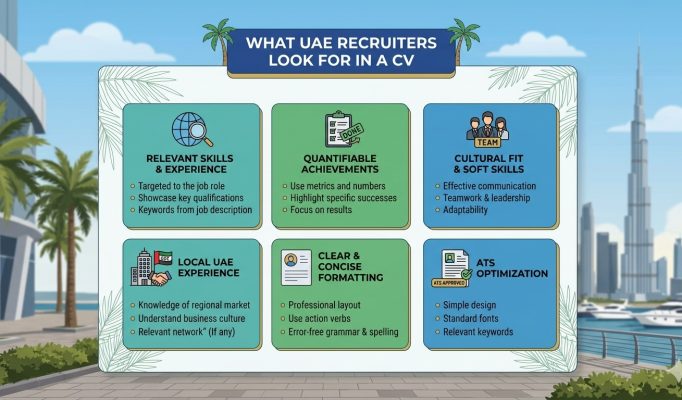
THE UAE RECRUITER CV FORMULA
FIT + EXPERIENCE + SKILLS + ACHIEVEMENTS + CLARITY + RELEVANCE
If these six elements are visible quickly, your CV has a much better chance of getting attention.
01 — MICHAEL PAGE MIDDLE EAST
What does Michael Page look for?
Michael Page’s Middle East guidance says recruiters often scan rather than read CVs and may use AI tools and Applicant Tracking Systems.
Their core test is remarkably simple:
WHAT HAVE YOU DONE?
WHAT VALUE DID YOU ADD?
WHAT IMPACT DID IT HAVE?
They place strong emphasis on:
- Results
- Achievements
- Measurable impact
- Relevant skills
- Keywords
- Clear structure
- Recent experience
Their advice is particularly important for experienced candidates:
Don’t simply tell the recruiter what your responsibilities were.
Show what changed because you were there.
For example:
Weak
Managed a sales team.
Stronger
Managed a 12-member sales team and increased quarterly revenue by 18%.
That second sentence gives the recruiter evidence.
02 — HAYS MIDDLE EAST
Hays asks three important questions:
1. Why are you interested in this job?
2. What value can you bring?
3. What is your current and future potential?
This is an important difference.
A CV should not only describe your past.
It should make the recruiter believe:
“This person can perform this job.”
Hays recommends:
- Tailoring the CV to the role
- Showing achievements
- Quantifying results
- Using relevant technical and soft skills
- Matching relevant keywords from the job description
- Demonstrating continuous development
- Keeping the CV error-free
Hays also recommends using measurable evidence such as teams managed, projects delivered, budgets, clients, cost savings, targets achieved and training delivered.
PAD takeaway:
Don’t just show where you have been. Show what you are capable of doing now.
03 — ROBERT WALTERS UAE
Robert Walters’ guidance is much more direct.
Their advice focuses on:
KEEP IT SIMPLE.
MAKE YOUR POINT QUICKLY.
BE TRUTHFUL.
USE STRONG ACTION WORDS.
AVOID UNNECESSARY JARGON.
They also caution against decorative CV approaches that distract from the content.
PAD takeaway:
Your CV does not need to look expensive.
It needs to look credible.
04 — GULFTALENT
GulfTalent describes the CV as a marketing document.
But there is an important qualification:
Marketing does NOT mean exaggeration.
It means presenting your professional value clearly.
GulfTalent highlights:
- Current role first
- Clear career history
- Relevant skills
- Certifications
- Languages
- Visa status where relevant
- Driving licence where relevant
- Achievements
- Quantified results
- Context about less-known employers
- Concise presentation
GulfTalent also specifically warns candidates against simply copying responsibilities from job descriptions.
The work-experience section should demonstrate:
WHAT YOU ACHIEVED.
PAD takeaway:
Your CV is your professional advertisement — but the product being advertised must be real.
05 — BAYT / GCC RECRUITMENT VIEW
Bayt’s GCC recruiter guidance highlights the reality of initial screening.
Recruiters may spend only a few seconds on the first scan.
They often look first for:
CURRENT JOB TITLE
CURRENT EMPLOYER
LOCATION
VISA / AVAILABILITY INFORMATION
YEARS OF EXPERIENCE
RELEVANT SKILLS
KEYWORDS
Bayt recommends:
- Clear structure
- Recent experience first
- Relevant keywords
- Achievement-focused bullets
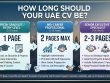
- One page for juniors
- Two pages for mid/senior candidates
PAD takeaway:
The top third of your CV is extremely important.
Don’t waste it with a long generic objective.
06 — CHARTERHOUSE UAE
This is particularly interesting because Charterhouse operates as a recruitment consultancy in the UAE.
Its Middle East CV guidance recommends:
- Recent experience first
- Clear employment dates
- Company and position
- Responsibilities
- Management responsibilities
- Achievements
- Qualifications
- Languages
- IT skills
- Clear presentation
- Quantified achievements
Charterhouse specifically recommends focusing on recent experience and keeping older experience brief.
It also advises candidates to quantify experience through facts, figures, targets, timelines and KPIs.
PAD takeaway:
RECENT + RELEVANT + MEASURABLE
That is a powerful UAE CV combination.
07 — NADIA GLOBAL
NADIA Global has operated in the UAE and GCC recruitment market for decades.
Its current recruitment approach highlights something candidates often overlook:
JOB TITLE ALONE IS NOT ENOUGH.
Recruiters look at:
- Role fit
- Career history
- Skills
- Workplace environment
- Availability
- Salary expectations
- Qualifications
- Practical suitability
NADIA also describes screening candidates against the actual hiring brief rather than simply looking for impressive titles.
Its recruitment process can include licence checks, certification review, practical assessments and background screening for appropriate roles.
PAD takeaway:
Don’t build a CV around a job title.
Build it around:
“Why am I a realistic fit for this particular role?”
08 — EMIRATES GROUP
Now let’s look beyond recruitment agencies.
What does a major UAE employer actually evaluate?
Emirates Group’s recruitment information says candidates may be assessed on:
- Skills
- Qualifications
- Work history
- Languages
- Problem solving
- Decision making
- Communication
- Management capability
- Risk management
- Business thinking
- Ability to meet deadlines
Its recruitment process also includes review followed by video interview and assessment for relevant roles.
PAD takeaway:
A CV gets you into the selection process.
But the information on the CV must be defensible in an interview.
If you write:
Strategic leader
you should be prepared to demonstrate strategic leadership.
If you write:
Increased revenue by 35%
you should be able to explain:
How?
When?
What was your role?
What changed?
THE UAE RECRUITER INTELLIGENCE BUFFET
After comparing these different sources, we can build a practical recruiter checklist.
WHAT THEY LOOK FOR
| Recruiter Signal | Why It Matters |
|---|---|
| Relevant experience | Does your background fit the role? |
| Current role | What can you do today? |
| Achievements | What impact have you created? |
| Numbers | Can you prove the impact? |
| Skills | Can you perform the required work? |
| Keywords | Does your CV match the vacancy? |
| Career progression | Are you developing professionally? |
| Industry knowledge | Do you understand the environment? |
| Location | Where are you currently based? |
| Availability | When could you potentially join? |
| Qualifications | Do you meet the requirements? |
| Certifications | Do you have relevant specialist credentials? |
| Communication | Can you explain yourself clearly? |
| Accuracy | Is the CV credible and error-free? |
| Adaptability | Can your experience transfer to the role? |
This is the information buffet.
You don’t need every item for every job.
You need the items that matter to your target role.
THE 7 THINGS A UAE RECRUITER SHOULD SEE QUICKLY
If we reduce everything to seven points:
1. WHO ARE YOU?
Professional identity.
2. WHAT DO YOU DO?
Current profession / specialisation.
3. HOW MUCH EXPERIENCE DO YOU HAVE?
Relevant years and career level.
4. WHAT HAVE YOU ACHIEVED?
Evidence of impact.
5. WHAT CAN YOU DO?
Relevant skills.
6. WHERE ARE YOU?
Current location and relevant UAE availability information.
7. WHY THIS ROLE?
Your CV should make the connection between your experience and the vacancy obvious.
THE BIGGEST DIFFERENCE: DUTIES vs ACHIEVEMENTS
RECRUITER SEES THIS:
Responsible for customer service.
Nothing special.
Now look at:
Managed customer relationships for 150+ active accounts while maintaining a 94% customer retention rate.
Now the recruiter sees:
Scale + Responsibility + Result
ANOTHER EXAMPLE
BEFORE
Responsible for HR recruitment.
AFTER
Managed end-to-end recruitment for 80+ positions across three business units, reducing average hiring time by 18%.
The second version is more useful.
AND ANOTHER
BEFORE
Managed hotel operations.
AFTER
Managed daily operations across a 220-room property and led a 95-member team across front office, housekeeping and guest services.
Again:
Scale becomes visible.
WHAT ABOUT PEOPLE WHO DON’T HAVE BIG NUMBERS?
This is important.
Not everyone can say:
Increased revenue by 40%.
That’s okay.
You can quantify:
PEOPLE
“Managed a team of 25.”
CLIENTS
“Handled 80 corporate accounts.”
PROJECTS
“Delivered 14 projects annually.”
BUDGET
“Managed an AED 2 million operating budget.”
PROCESS
“Reduced processing time by 30%.”
CUSTOMERS
“Supported 500+ customers monthly.”
TRAINING
“Trained 60 employees.”
LOCATIONS
“Managed operations across four branches.”
Hays specifically highlights these kinds of measurements as valuable evidence.
WHAT RECRUITERS DON’T WANT
❌ Long generic objectives
Seeking a challenging position in a reputed organisation…
This says almost nothing.
❌ Job-description copying
Responsible for all sales activities.
The recruiter already knows what the job requires.
They want to know:
What did YOU achieve?
❌ Decorative CVs
Too many:
- Colours
- Graphics
- Icons
- Charts
- Skill bars
- Unusual fonts
can make information harder to scan.
Robert Walters, Hays and Michael Page all favour clear, simple presentation for most roles.
❌ False UAE positioning
Don’t write:
Dubai, UAE
if you are actually living in Delhi, Mumbai, Kathmandu or Manila.
Instead:
Delhi, India | Open to relocate to UAE
Truth builds credibility.
❌ Unsupported claims
Don’t write:
Exceptional leader
World-class manager
Outstanding sales professional
unless the CV provides evidence.
Show it.
Don’t simply say it.
THE “RECRUITER EYE” TEST
Before sending your CV, ask someone to look at it for approximately 10 seconds.
Then ask:
What is my profession?
How many years of experience do I have?
What is my current role?
What industry am I in?
What are my strongest skills?
What is one achievement you remember?
Where am I currently located?
What UAE role do you think I am applying for?
If they cannot answer these questions quickly:
Your CV needs restructuring.
THE PAD UAE CV FORMULA
After reviewing the different recruitment perspectives:
CLEAR
Can I understand you quickly?
RELEVANT
Does your experience match the vacancy?
PROVEN
Can you demonstrate your capability?
MEASURABLE
Can you show evidence?
CURRENT
Does the CV show what you can do today?
HONEST
Can you defend every important claim?
=
UAE-READY CV
ONE IMPORTANT PAD WARNING
There is no single universal “UAE CV law.”
Different employers, sectors and recruitment organisations may have different preferences.
For example, GulfTalent and Bayt discuss local information such as nationality, visa status and photographs more explicitly, while Michael Page and Robert Walters place greater emphasis on clarity, relevance and professional presentation.
Therefore:
Don’t copy one company’s CV advice blindly.
Understand the common principles and then adapt your CV to:
Employer + Industry + Role + Candidate Situation
THE FINAL UAE RECRUITER CHECKLIST
Before pressing APPLY, ask:
□ Is my current role obvious?
□ Are my most relevant skills visible?
□ Are my achievements stronger than my job duties?
□ Have I used numbers where they genuinely exist?
□ Is my recent experience more detailed than old experience?
□ Have I used relevant keywords from the vacancy?
□ Can an ATS understand my CV?
□ Can a recruiter scan it quickly?
□ Is my location clear?
□ Is my UAE availability truthful?
□ Are my qualifications easy to understand?
□ Is the CV free of spelling and grammar errors?
□ Can I defend everything written in an interview?
If the answer is yes, your CV is doing what it should.
PAD’S BOTTOM LINE
After looking at the advice from multiple UAE recruitment and employer sources, one message keeps appearing:
Recruiters don’t want to know everything you have ever done.
They want to know whether what you have done makes you relevant to what they need now.
So don’t build your UAE CV like an autobiography.
Build it like a professional evidence sheet.
SHOW YOUR ROLE.
SHOW YOUR SKILLS.
SHOW YOUR ACHIEVEMENTS.
SHOW YOUR IMPACT.
SHOW YOUR RELEVANCE.
SHOW YOUR POTENTIAL.
And always remember:
Don’t make your CV impressive.
Make your value obvious.
PAD — Direction Before Decision.
Information compiled from publicly available guidance and recruitment insights from Michael Page Middle East, Hays Middle East, Robert Walters UAE, GulfTalent, Bayt, Charterhouse UAE, NADIA Global and Emirates Group Careers. Recruitment practices can vary by employer, sector and role; candidates should always check the specific vacancy requirements.