
By PAD Media House | UAE Footprint
Publication date: 28 October 2026
Category: Family, Residency & Settling in the UAE
Audience: International families planning to live in the UAE
Introduction: Relocating a Family Is More Than Finding a Job
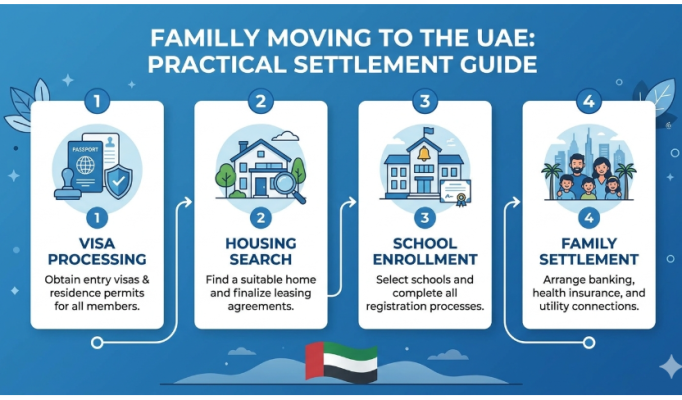
Moving to the UAE for work is an important decision. But when a spouse, children or other family members are involved, the planning becomes much bigger.
A job offer may be the first step, but a family’s successful relocation also depends on suitable accommodation, residence permissions, healthcare, education, everyday expenses and a realistic household budget.
The objective is not simply to reach the UAE. It is to build a comfortable, secure and sustainable life there.
This guide brings the main considerations together in a simple, step-by-step format.
Step 1: Understand Your Family’s Residency Options
Before making travel arrangements, find out which residence arrangements may apply to each family member.
Depending on your circumstances, a family may need to consider:
- The employee’s employment-based residence arrangements.
- Residence sponsorship for a spouse and eligible children.
- The rules and additional conditions that may apply to parents or other relatives.
- The documents required to prove family relationships.
- The validity period and renewal requirements for each residence permit.
Eligibility depends on the applicable immigration rules, the sponsor’s circumstances and the relationship to the person being sponsored.
For example, the UAE Government publishes salary and other eligibility conditions for standard family sponsorship. These conditions should be checked against the latest official guidance rather than assumed to apply identically to every visa category.
Practical tip: Before booking flights for the whole family, confirm the relevant requirements with the Federal Authority for Identity, Citizenship, Customs and Port Security (ICP) or the appropriate immigration authority for your emirate.
Step 2: Prepare the Family Documents
Document preparation can save time and prevent avoidable delays.
Create a separate folder for every family member and keep digital copies of important documents.
Your preparation checklist may include:
- Valid passports.
- Recent passport-size photographs, where required.
- Marriage certificate.
- Children’s birth certificates.
- The sponsor’s employment and residence documentation.
- Salary certificate or other evidence of financial eligibility, where required.
- Accommodation evidence.
- Medical examination documents, where applicable.
- Health insurance documentation.
- Attested or officially translated documents, where required.
The exact list depends on the application and the authority handling it.
Important: Do not assume that a document issued in your home country will automatically be accepted in the UAE. Confirm the applicable attestation, translation and authentication requirements before travelling.
Step 3: Plan Your Accommodation Before the Move
A home is one of the most important parts of family settlement.
Before choosing accommodation, consider:
- How close it is to the workplace.
- Travel time and transport costs.
- Access to schools, nurseries and healthcare.
- The number of bedrooms your family needs.
- The total annual rent and payment arrangements.
- Utility bills and other housing expenses.
- Whether the accommodation meets the requirements for your intended residence applications.
If you plan to live in Abu Dhabi, review the relevant tenancy registration and housing procedures. Requirements and processes may differ in other emirates.
Do not compare properties by rent alone. A cheaper home far from work or school may create higher transport costs and consume valuable family time.
Practical tip: If possible, understand your work location and family requirements before signing a long-term tenancy agreement.
Step 4: Understand Health Insurance and Medical Needs
Healthcare planning should begin before the family relocates.
Find out what medical insurance is provided by the employer and whether it covers dependants. Do not assume that an employee’s insurance automatically covers a spouse or children.
Check:
- Whether each family member requires a separate policy.
- What hospitals and clinics are included in the network.
- Whether regular medicines are covered.
- Whether there are waiting periods or exclusions.
- What expenses may have to be paid personally.
- Whether any pre-existing medical conditions require special attention.
Families with young children, elderly dependants or ongoing medical needs should pay particular attention to coverage and access to suitable healthcare.
Keep prescriptions and relevant medical records available, and check UAE requirements before carrying prescription medicines across the border.
Insurance rules and arrangements can differ by emirate, employment category and policy.
Step 5: Plan Your Children’s Education
If you have school-age children, research education options before deciding where the family will live.
The UAE offers schools following different curricula, including British, American, Indian and other international systems. Availability, fees and admission requirements vary by school and location.
Consider:
- Which curriculum best suits your child’s educational background.
- Whether the school has places available.
- Admission deadlines and required documents.
- Tuition fees and additional school charges.
- School transport and daily travel time.
- Language support and extracurricular activities.
- How your child will transition from the existing school system.
Contact schools directly for current fee schedules, admission requirements and availability.
Do not assume that a school will have a place simply because it offers the curriculum you want.
Practical tip: Shortlist schools and estimate the annual education budget before finalising your family’s relocation plan.
Step 6: Prepare a Realistic Family Budget
A salary that appears attractive for one person may not stretch as far when supporting an entire family.
Before moving, prepare a monthly budget covering the household’s likely expenses.
| Expense category | What to consider |
|---|---|
| Accommodation | Rent, deposits and housing-related charges |
| Utilities | Electricity, water, cooling and internet |
| Food | Groceries, household supplies and occasional dining |
| Transport | Public transport, taxis, fuel or car expenses |
| Education | Tuition, books, uniforms and transport |
| Healthcare | Insurance premiums, co-payments and uncovered expenses |
| Residency | Application, renewal and document-related costs |
| Communication | Mobile plans and internet |
| Family needs | Clothing, activities and other everyday expenses |
| Savings | Emergency funds and future commitments |
These are planning categories, not estimates of actual UAE prices. Costs vary considerably depending on the emirate, location, household size and lifestyle.
Include occasional and annual expenses rather than looking only at monthly bills.
A useful rule: Calculate your likely household expenses first, then decide whether the expected income provides a comfortable margin for savings and emergencies.
Step 7: Set Up Everyday Essentials
Once the family’s residence arrangements and accommodation are in place, organise the practical requirements of daily life.
These may include:
- Opening an appropriate bank account.
- Arranging salary payments.
- Obtaining mobile connections.
- Understanding local transport options.
- Learning how to access nearby healthcare.
- Completing school registration.
- Understanding local tenancy and utility procedures.
- Keeping copies of residence documents and renewal dates.
Use official websites and authorised service providers when completing applications or making payments.
Keep important documents secure and avoid sharing personal information through unverified websites or messages.
Step 8: Think About the Whole Family’s Adjustment
Relocation is not only an administrative process. It is also a major personal change.
A spouse may need time to adjust to a new environment, while children may have to adapt to a different school and social setting.
Before moving, discuss practical questions together:
- Will the spouse work, study or manage the household initially?
- What support will be available during the first few months?
- How will the family stay connected with relatives back home?
- What routines will help children settle into their new environment?
- What happens if the employee changes jobs or the family needs to relocate again?
There is no single approach that works for every family. Planning these matters in advance can make the transition easier.
Step 9: Keep a Backup Plan
Every international move involves uncertainty. Employment arrangements, accommodation, expenses and family circumstances can change.
Before relocating, consider:
- Keeping an emergency fund appropriate to your circumstances.
- Understanding the employer’s benefits and contractual conditions.
- Keeping copies of important employment and residence documents.
- Knowing the renewal and cancellation procedures that may apply.
- Understanding how a change in the sponsor’s residence status could affect dependants.
- Maintaining a practical plan if the job ends or the family needs to return home.
Do not rely on assumptions about grace periods, renewal deadlines or visa validity. Confirm the current rules with the appropriate authority when circumstances change.
Your Family Settlement Checklist
Before moving the whole family to the UAE, ask yourself:
☐ Have I confirmed the applicable residence and sponsorship requirements?
☐ Have I prepared the required family documents?
☐ Have I checked document attestation and translation requirements?
☐ Have I arranged suitable accommodation or a realistic housing plan?
☐ Have I confirmed health insurance arrangements for every family member?
☐ Have I researched schools and estimated education expenses?
☐ Have I prepared a realistic monthly household budget?
☐ Have I considered transport, banking and other daily essentials?
☐ Have we discussed how each family member will adjust to the move?
☐ Do we have an emergency fund and a backup plan?
If several answers are still uncertain, spend more time planning before committing to the full relocation.
Official Sources for Further Information
For current requirements, consult the relevant official authorities:
- UAE Government Portal — family residence visas and sponsorship.
- Federal Authority for Identity, Citizenship, Customs and Port Security (ICP) — residency services and application requirements.
- Abu Dhabi Residents Office — settling in Abu Dhabi, housing and practical relocation information.
- Department of Health – Abu Dhabi — health insurance and healthcare information for Abu Dhabi.
- The relevant education authority and individual schools — school admissions, curricula and current fees.
The applicable authority may differ depending on the emirate and the type of application.
Disclaimer and Publication Date
Published on: 28 October 2026
Information checked: 28 October 2026
This article has been prepared by PAD Media House for UAE Footprint for general informational and educational purposes. It provides a broad overview of matters families may need to consider when planning a move to the UAE.
Residency eligibility, sponsorship conditions, documentation, health insurance, housing procedures, school admissions, fees and other requirements may vary by emirate, visa category, family circumstances and service provider. Official requirements may change.
This article is not immigration, legal, financial, medical or education advice and does not guarantee approval of any application, admission to any school or access to any particular service.
Readers should verify current requirements directly with the relevant UAE government authority, immigration authority, insurer, school, landlord or other authorised provider before making commitments or taking action.
To the fullest extent permitted by applicable law, PAD Media House disclaims liability for losses or consequences arising from reliance on this article. Nothing in this disclaimer excludes or limits liability that cannot lawfully be excluded or limited.
Official references to include on the website
These are the most useful starting points for readers:
- Family residence and sponsorship rules: UAE Government — Family Residence Visa
- General residence visa requirements and documentation: UAE Government — General Residence Visa Provisions
- Moving and settling in Abu Dhabi: Abu Dhabi Residents Office
- General relocation information: UAE Government — Moving to the UAE
- Health insurance requirements in Dubai: Dubai Government — Health Insurance