
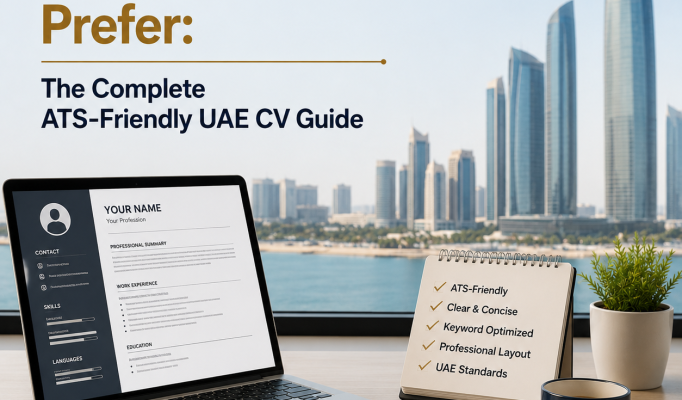
CV Format That Abu Dhabi Employers Prefer: The Complete ATS-Friendly UAE CV Guide
Learn how to create an ATS-friendly CV for Abu Dhabi jobs, including the ideal structure, keywords, work experience, skills, personal details, formatting, mistakes to avoid and UAE recruiter preferences.
Primary Keyword: CV format for Abu Dhabi jobs
Secondary Keywords:
– ATS friendly CV for Abu Dhabi
– UAE CV format
– Abu Dhabi CV format
– CV for UAE jobs
– Abu Dhabi job CV
– ATS friendly resume UAE
– UAE resume format
– how to prepare CV for Abu Dhabi jobs
– CV format for UAE employers
– Abu Dhabi job application CV
—
CV Format That Abu Dhabi Employers Prefer
Your CV is not a design project. It is a professional document designed to get you shortlisted.
If you are planning to work in Abu Dhabi, one of the first questions you may ask is:
«“What CV format do Abu Dhabi employers prefer?”»
You may also find conflicting advice online:
– Should I use a photo?
– Should I mention nationality?
– Should I mention visa status?
– Should my CV be one page or two?
– Should I use colour?
– Should I use a two-column design?
– Is a Europass CV suitable?
– Should I make my CV ATS-friendly?
– Should I use keywords from the job description?
– Should I include my date of birth?
– Should I write “Curriculum Vitae” at the top?
The answer is not as simple as following one fixed “Abu Dhabi CV format.”
There is no single government-prescribed CV template that every Abu Dhabi employer follows.
Different employers, industries, recruitment agencies and applicant-tracking systems may have different preferences.
However, current UAE recruitment guidance shows a strong preference for CVs that are:
Clear + Relevant + Easy to Scan + Professionally Structured + ATS-Friendly + Tailored to the Job
That should be your starting point.
—
1. First Understand What an ATS Is
ATS stands for:
Applicant Tracking System
An ATS is software used by many organisations and recruitment systems to help manage job applications.
Depending on the employer and system, an ATS may help recruiters:
– collect applications
– parse CV information
– identify skills
– search candidate databases
– organise applicants
– filter or rank candidates
– match candidate information with job requirements
This is why a beautifully designed CV can sometimes perform worse than a simple CV.
Imagine this:
CV A
Beautiful graphics
Two columns
Icons everywhere
Skill bars
Text inside boxes
Logos
Charts
Decorative fonts
CV B
Clean single-column document
Clear headings
Normal text
Relevant keywords
Simple bullet points
Quantified achievements
For a human reader, CV A may look more attractive.
For an ATS, CV B may be much easier to interpret.
That is why Plan Abu Dhabi recommends:
«Create a CV for both the machine and the human recruiter.»
The current UAE recruitment guidance from Bayt specifically recommends tailoring CV language to the job description and notes that UAE employers use ATS systems.
—
2. There Is No “Magic UAE CV”
This point is extremely important.
You may see websites advertising:
«“The official UAE CV format”»
or
«“The only CV format accepted in Dubai/UAE.”»
Be careful.
There is no single universal CV design used by every Abu Dhabi employer.
A multinational technology company may use an international ATS.
A hospitality company may prefer a more visually polished CV.
A construction company may focus heavily on project experience and certifications.
A healthcare employer may require professional licensing information.
A finance employer may focus heavily on qualifications, systems knowledge and regulatory experience.
A government or semi-government organisation may use its own recruitment platform.
Therefore:
Your CV should be adapted to the job.
The content is more important than copying a particular template.
—
3. The Recommended ATS-Friendly Abu Dhabi CV Structure
For most professional applications, a strong structure is:
1. Full Name
2. Professional Job Title
3. Contact Information
4. Professional Summary
5. Core Skills
6. Professional Experience
7. Education
8. Certifications / Licences
9. Technical Skills
10. Languages
11. Additional Information where relevant
This structure is simple for both recruiters and parsing systems.
—
4. Start With Your Name — Not “Curriculum Vitae”
At the top:
ANIND BHATTACHARYA
Digital Marketing & Content Strategist
Then your contact details.
There is usually no need to waste valuable space writing:
«CURRICULUM VITAE»
Your name already tells the recruiter what document they are reading.
—
5. Professional Title Is Extremely Important
Don’t simply write:
«Professional»
or
«Job Seeker»
or
«Experienced Employee»
Use a title that reflects the position you are targeting.
Example
Instead of:
Rahul Sharma
Job Seeker
Use:
Rahul Sharma
Senior Accountant | UAE VAT | IFRS | Financial Reporting
Or:
Priya Nair
Digital Marketing Specialist | SEO | Google Ads | Content Strategy
Or:
Mohammed Ali
Civil Engineer | Infrastructure | Project Coordination | AutoCAD
This immediately gives the recruiter context.
—
6. Contact Information
Keep this simple.
Recommended:
Phone: +91 XXXXX XXXXX
Email: professional@email.com
Location: New Delhi, India
LinkedIn: linkedin.com/in/yourname
If you are already in Abu Dhabi:
Location: Abu Dhabi, UAE
If relevant, you may also mention:
Visa Status: UAE Employment Visa / Visit Visa / Golden Visa / etc.
But do not invent or misrepresent your status.
—
7. Should You Mention Nationality?
This is one area where candidates receive conflicting advice.
Some UAE-focused CV guidance recommends including nationality and visa status because recruiters may need to understand the candidate’s location and work eligibility. Bayt’s current UAE guide lists nationality and visa status among commonly included personal details.
However:
«Nationality is not a universal requirement for every CV or every employer.»
If the application system asks for it, provide it accurately.
If the employer requests specific personal information, follow the application instructions.
Don’t fill your CV with unnecessary personal information simply because someone online says:
«“Every UAE CV must contain this.”»
—
8. What About Date of Birth?
Again, don’t treat this as a universal rule.
Some UAE-style CVs include date of birth.
But an ATS-friendly CV should focus primarily on information relevant to the job.
For most professional applications, your:
skills + experience + qualifications + achievements
are much more important than your date of birth.
If an employer or application form specifically requests it, provide accurate information.
Otherwise, consider whether the space could be used more effectively.
—
9. What About a Photograph?
This is another area where UAE advice differs.
Some UAE recruitment guidance considers a professional photograph common in local CVs, while other modern CV guidance recommends omitting it unless requested.
Therefore, Plan Abu Dhabi’s recommendation is:
Don’t treat a photo as an ATS requirement.
A photograph does not make a CV ATS-friendly.
If the employer, recruitment agency or application specifically requests a photograph, provide a professional one.
If not, a clean ATS-focused CV can work perfectly well without one.
If you do include a photo:
– professional headshot
– neutral background
– recent photograph
– appropriate professional appearance
– no selfies
– no holiday photographs
– no heavily edited image
—
10. Your Professional Summary
This is one of the most important parts of the CV.
Don’t write:
«“Seeking a challenging position in a reputed organisation where I can utilise my skills and enhance my knowledge.”»
This sentence appears on thousands of CVs.
It says almost nothing about you.
Instead, answer three questions:
Who are you?
What experience do you have?
What value do you bring?
Example
«Results-driven procurement professional with 7+ years of experience in strategic sourcing, supplier management, contract negotiation and procurement operations. Experienced in managing regional suppliers, reducing procurement costs and supporting cross-functional teams. Seeking a procurement role in Abu Dhabi where strong commercial and supplier-management skills can contribute to operational efficiency.»
Now the recruiter immediately understands:
Profession → Experience → Skills → Value → Target
—
11. Use Keywords — But Don’t Stuff Them
This is where ATS optimisation becomes important.
Suppose the job description says:
«Project Management
Stakeholder Management
Risk Management
Budget Control
Microsoft Project
PMP»
If you genuinely have those skills, they should appear naturally in your CV.
For example:
«Managed project schedules, stakeholder communication, risk registers and budget tracking using Microsoft Project.»
This is better than creating a huge keyword section:
«Project Management | Stakeholder Management | Risk Management | Budget | PMP | Project Management | Risk | Stakeholder»
Important:
Never add a keyword simply because you think the ATS will like it if you don’t actually have that skill.
Your CV must remain truthful.
—
12. How to Find the Right Keywords
Don’t guess.
Take the actual job description.
Highlight:
Job title
Technical skills
Software
Certifications
Industry terminology
Responsibilities
Qualifications
Soft skills
Then compare those requirements with your actual experience.
Create a simple:
JOB DESCRIPTION → MY EXPERIENCE
mapping.
For example:
Job requirement| Your evidence
SAP| Used SAP for procurement operations
Vendor Management| Managed 35+ suppliers
Cost Reduction| Reduced procurement costs by 12%
Negotiation| Negotiated annual supplier contracts
Reporting| Prepared monthly procurement reports
Now you have the foundation of an ATS-friendly CV.
—
13. Professional Experience: This Is Where Most CVs Fail
Many candidates write:
«Responsible for sales.»
«Responsible for customer service.»
«Responsible for managing employees.»
These are responsibilities.
Recruiters want to understand:
What did you actually accomplish?
Compare:
Weak
«Responsible for managing sales activities.»
Stronger
«Managed B2B sales activities across 40+ corporate accounts and consistently delivered against quarterly revenue targets.»
Even better:
«Managed 40+ B2B accounts and increased quarterly revenue by 18% through targeted account development and cross-selling.»
Now the recruiter sees:
Responsibility + Scale + Action + Result
—
14. Use Numbers Whenever You Can
Numbers make experience easier to understand.
Instead of:
«Managed a large team.»
Write:
«Managed a team of 14 sales executives.»
Instead of:
«Increased customer satisfaction.»
Write:
«Improved customer satisfaction scores from 82% to 91% within 12 months.»
Instead of:
«Managed projects.»
Write:
«Coordinated 8 infrastructure projects with combined budgets exceeding AED 12 million.»
Only use numbers that are accurate.
Never manufacture achievements.
—
15. Use Strong Action Words
Instead of repeating:
«Responsible for…»
Use action verbs such as:
– Managed
– Led
– Developed
– Implemented
– Coordinated
– Delivered
– Improved
– Increased
– Reduced
– Analysed
– Designed
– Negotiated
– Supervised
– Executed
– Streamlined
– Optimised
This makes the CV more professional and easier to scan.
—
16. How Much Work Experience Should You Include?
Don’t automatically put every job you have ever had into the CV.
The question should be:
«Does this experience help me qualify for this job?»
If you have 15 years of experience, the CV does not necessarily need 15 years of detailed bullet points.
Older relevant experience can be summarised.
Very old and irrelevant positions may be reduced or removed.
Current UAE CV guidance similarly advises avoiding unnecessary outdated roles and focusing the CV on relevant experience.
—
17. Education
Keep it straightforward.
Example
Master of Business Administration (MBA)
ABC University, India
2021
Bachelor of Commerce (B.Com)
XYZ University, India
2018
Don’t write several paragraphs about your university unless the information is relevant to the job.
For fresh graduates, education may appear earlier because it is one of their strongest qualifications.
For experienced professionals, professional experience normally deserves more space.
—
18. Certifications
Certifications can be extremely important in some Abu Dhabi industries.
Examples:
– PMP
– ACCA
– CPA
– CFA
– CISSP
– AWS certifications
– Microsoft certifications
– NEBOSH
– IOSH
– Professional engineering certifications
– Healthcare licences
– Industry-specific licences
Always write the full certification name where useful.
Example:
«Project Management Professional (PMP) — PMI, 2025»
Not simply:
«PMP»
This can also help with keyword matching.
—
19. Healthcare Professionals Need Special Attention
Healthcare CVs are different.
Depending on the profession and role, professional licensing or eligibility may be important.
For a healthcare applicant, relevant information may include:
– Profession
– Qualification
– Clinical experience
– Specialisation
– Licence status
– Relevant authority/licensing details
– Certifications
– Hospital/clinical experience
Do not use the same generic CV structure for every profession.
—
20. Engineers Should Show Projects
For engineers, simply writing:
«Civil Engineer — 7 years»
is not enough.
Show:
– Project type
– Project size
– Location
– Responsibility
– Software
– Standards
– Team size
– Budget/value where appropriate
– Results
Example
«Project Engineer — Infrastructure Development
Coordinated site activities for a major infrastructure project valued at AED 35 million, supervising subcontractors, monitoring project schedules and supporting quality and safety compliance.»
This is much stronger.
—
21. IT Professionals Should Show Technology Clearly
An IT CV should make technical skills immediately visible.
For example:
Technical Skills
Cloud: AWS, Azure
Programming: Python, Java
Databases: SQL, PostgreSQL
DevOps: Docker, Kubernetes, Jenkins
Security: SIEM, IAM, Network Security
But only list technologies you can actually discuss during an interview.
—
22. Hospitality CVs Need a Different Emphasis
For hospitality roles, recruiters may be interested in:
– Hotel experience
– Property type
– Star category
– Department
– Guest service
– Revenue
– Team size
– PMS knowledge
– F&B experience
– Housekeeping
– Front office
– Food safety
– Customer satisfaction
– Languages
For example:
«Managed front-office operations for a 350-room hotel, supervising a team of 18 and maintaining guest-service standards across check-in, check-out and complaint resolution.»
That’s far stronger than:
«Worked in front office.»
—
23. Skills Section: Don’t Write Everything
A common mistake is creating a giant list:
«Leadership
Communication
Teamwork
MS Office
Hardworking
Honest
Time Management
Problem Solving
Positive Attitude
Fast Learner
Creativity
Responsibility
Adaptability»
This tells the recruiter very little.
Instead, prioritise skills that match the vacancy.
Example — Accountant
Core Skills
– Financial Reporting
– UAE VAT
– IFRS
– Accounts Payable
– Accounts Receivable
– General Ledger
– Bank Reconciliation
– SAP
– Advanced Excel
– Budgeting & Forecasting
Now the section is meaningful.
—
24. Don’t Use Skill Bars
Avoid:
Excel ██████████ 95%
Communication ████████ 80%
Leadership ███████ 75%
These are visually attractive but don’t provide objective information.
Instead:
Advanced Excel — Pivot Tables, Power Query, XLOOKUP, Financial Reporting
That is more informative and ATS-friendly.
—
25. Languages
Language skills can be valuable in Abu Dhabi’s multicultural workplace.
Example:
Languages
– English — Professional
– Hindi — Native
– Arabic — Basic
– Bengali — Native
Be honest about proficiency.
Don’t write:
«Arabic — Fluent»
if you only know basic conversational Arabic.
—
26. Should You Use a Two-Column CV?
For a purely ATS-focused master CV:
Single-column is the safer choice.
Why?
It reduces the risk of information being read in the wrong order or missed by a parsing system.
Two-column CVs can look attractive, but they can introduce unnecessary complexity.
For applications through employer portals, ATS systems and large recruitment platforms, a simple single-column layout is generally the safer approach.
Recent UAE job-seeker discussions also show candidates reporting problems with graphic-heavy and multi-column CVs, although these are individual experiences rather than universal recruiter rules.
—
27. Avoid Graphics, Icons and Infographics
Your CV is not a social-media creative.
Avoid:
 Skill circles Rating bars Decorative icons Large graphics Logos Charts Text embedded inside images Background photographs Heavy colour blocks
Use formatting to improve readability, not decoration.
—
28. Font and Formatting
Use simple professional fonts.
Good options include:
– Arial
– Calibri
– Aptos
– Helvetica
– Times New Roman
Keep the formatting consistent.
For example:
Name: 18–22 pt
Section headings: 12–14 pt
Body: around 10–11.5 pt
Don’t make the body text tiny just to squeeze everything onto one page.
White space is useful.
—
29. How Long Should a CV Be?
There is no universal legal or official limit.
For most candidates:
Fresh graduate
1 page
Early/mid-career
1–2 pages
Senior professional
2 pages, potentially more if genuinely necessary
The key principle is:
«Every line must earn its place.»
Current UAE-focused guidance from Bayt recommends a one-to-two-page CV for most candidates, with fresh graduates generally targeting one page and experienced professionals using two pages when the additional content is relevant.
A two-page CV full of relevant achievements is better than a one-page CV that hides important experience.
—
30. Don’t Put Your Entire Career Into One CV
This is a major strategy change.
You should ideally maintain:
MASTER CV
Your complete career record.
And then create:
TARGETED CV
A version specifically adapted to the job.
For example:
Master CV
↓
IT Version
Finance Version
Project Management Version
Sales Version
Hospitality Version
You don’t need to rewrite your entire career every time.
You adjust:
– Summary
– Keywords
– Skills
– Relevant achievements
– Order of information
—
31. Tailoring the CV Is More Important Than Finding the “Perfect Template”
Imagine two candidates.
Candidate A
Perfect-looking UAE CV template.
But the CV is generic.
Candidate B
Simple ATS-friendly CV.
But it closely matches the actual job requirements.
Candidate B may have the stronger application.
Why?
Because recruitment is not a beauty competition.
The employer wants:
«The right person for this particular position.»
—
32. File Format: PDF or Word?
This depends on the employer’s instructions.
If the employer specifically asks for:
Word (.doc/.docx)
send Word.
If the portal accepts PDF and does not specify otherwise, a clean PDF can preserve your formatting.
But don’t assume:
«“PDF is always best.”»
The safest rule is:
Follow the employer’s application instructions first.
And before uploading:
Open the final file.
Check:
– Page breaks
– Font consistency
– Bullet points
– Contact details
– Links
– Dates
– Spelling
– Formatting
—
33. Your LinkedIn Profile Should Match Your CV
If your CV says:
«Digital Marketing Manager — 8 years»
but LinkedIn says:
«Marketing Executive — 5 years»
a recruiter may notice the inconsistency.
Your:
CV + LinkedIn + job application
should tell the same professional story.
They don’t need to be identical.
But the facts should be consistent.
—
34. The Biggest ATS Mistakes
Avoid:
Text inside imagesATS may not interpret it correctly.
Complex tablesThey can cause parsing issues.
Multiple columnsSingle-column is safer.
Decorative fontsUse standard fonts.
Headers/footers containing critical informationKeep important contact details in the main document body.
Keyword stuffingUse keywords naturally.
Hidden keywordsNever attempt to manipulate an ATS by hiding keywords in white text or elsewhere.
Unnecessary graphicsThey don’t improve your qualifications.
Huge paragraphsRecruiters need to scan quickly.
Generic objective statementsUse a professional summary instead.
—
35. What UAE Recruiters Want to Understand Quickly
When someone opens your CV, they should be able to answer these questions quickly:
Who are you?
Professional title
What do you do?
Specialisation
How experienced are you?
Years + relevant roles
What can you do?
Skills
What have you achieved?
Quantified results
Where are you?
Location
Can you be contacted?
Phone + email
Do you meet the job requirements?
Qualifications + experience + relevant keywords
That’s the real purpose of your CV.
—
36. A Strong ATS-Friendly Abu Dhabi CV Example
RAHUL SHARMA
Senior Procurement Specialist | Strategic Sourcing | Vendor Management | Contract Negotiation
New Delhi, India | +91 XXXXX XXXXX | rahul@email.com | LinkedIn URL
Nationality: Indian | Current Location: India
—
PROFESSIONAL SUMMARY
Procurement professional with 8+ years of experience in strategic sourcing, supplier management, contract negotiation and procurement operations across manufacturing and infrastructure environments. Experienced in managing regional suppliers, negotiating commercial agreements and supporting cost-reduction initiatives. Strong knowledge of SAP, supplier evaluation and procurement reporting. Seeking a procurement opportunity in Abu Dhabi where commercial and supplier-management expertise can contribute to operational efficiency.
—
CORE SKILLS
Strategic Sourcing | Vendor Management | Contract Negotiation | Procurement Operations | Supplier Evaluation | Cost Reduction | SAP | Purchase Orders | Inventory Coordination | Procurement Reporting
—
PROFESSIONAL EXPERIENCE
Senior Procurement Executive
ABC Manufacturing Pvt. Ltd. — New Delhi, India
June 2021 – Present
– Manage procurement activities for raw materials, consumables and operational requirements across multiple business units.
– Manage a supplier portfolio of 45+ vendors and monitor supplier performance, pricing and delivery schedules.
– Negotiated annual supplier contracts resulting in approximately 11% reduction in selected procurement costs.
– Implemented supplier-performance tracking that improved on-time delivery from 86% to 94%.
– Coordinate with finance, operations and warehouse teams to ensure timely purchase-order processing and inventory availability.
– Prepare monthly procurement reports covering spend, supplier performance and cost trends.
Procurement Executive
XYZ Industries — New Delhi, India
July 2018 – May 2021
– Managed purchase orders, vendor communication and procurement documentation.
– Supported supplier negotiations and comparative price analysis.
– Coordinated with warehouse and production teams to maintain material availability.
– Prepared procurement reports and maintained supplier records.
—
EDUCATION
Bachelor of Commerce
XYZ University, India | 2018
—
CERTIFICATIONS
Certified Supply Chain Professional — ABC Institute | 2024
Advanced Excel Certification — XYZ Institute | 2023
—
TECHNICAL SKILLS
SAP | MS Excel | PowerPoint | Procurement Reporting | ERP Systems
—
LANGUAGES
English — Professional
Hindi — Native
—
37. Why This CV Works Better
Notice what is missing.
There are no:
Skill bars Decorative graphics Large photographs Logos Career objective paragraph “References available upon request” section Long personal story Irrelevant hobbiesInstead, the CV provides:
Clear title
→ Professional summary
→ Relevant keywords
→ Experience
→ Achievements
→ Numbers
→ Qualifications
→ Skills
→ Languages
That’s what the recruiter needs.
—
38. Should You Include “References Available Upon Request”?
Usually, there is no need to use valuable CV space for:
«References available upon request.»
If an employer wants references, they can ask.
Instead, use that space for something more valuable.
—
39. Should You Include Hobbies?
Only when they genuinely add value.
You don’t need:
«Watching movies
Travelling
Listening to music
Playing cricket»
These normally don’t strengthen a professional CV.
If you have a genuinely relevant achievement, however, it may be useful.
—
40. What About a “Declaration”?
Many candidates from India are familiar with:
«“I hereby declare that the information given above is true and correct…”»
For most modern professional CVs, this is unnecessary.
Your CV is already expected to contain accurate information.
Use the space for relevant professional information instead.
—
41. The Abu Dhabi CV Formula
At Plan Abu Dhabi, we can simplify the entire concept into this:
CLEAR + RELEVANT + ATS-FRIENDLY + EVIDENCE-BASED
CLEAR
Can a recruiter understand your profile quickly?
RELEVANT
Does the CV match the actual job?
ATS-FRIENDLY
Can the information be easily parsed?
EVIDENCE-BASED
Can you prove your skills through achievements and experience?
—
42. The 10-Second CV Test
Before sending your CV, give it to someone who knows nothing about your career.
Give them 10 seconds.
Then ask:
«“What job do you think this person is applying for?”»
If they cannot answer, your CV needs work.
Then ask:
«“What are this person’s strongest skills?”»
If they cannot answer, your CV needs work.
Then ask:
«“What is their biggest professional achievement?”»
If they cannot find one, your CV needs work.
This is a surprisingly powerful test.
—
43. The 5-Question Abu Dhabi CV Test
Before applying, ask:
1. Is my target job obvious?
2. Are the most important job keywords present naturally?
3. Can the recruiter understand my experience quickly?
4. Have I shown achievements rather than only responsibilities?
5. Can an ATS read the document without difficulty?
If the answer to all five is YES, you have a much stronger CV foundation.
—
44. One CV Cannot Be Perfect for Every Job
This is perhaps the most important lesson.
Suppose you are a mechanical engineer.
You apply for:
Maintenance Engineer
and then:
Project Engineer
and then:
Facilities Engineer
Your underlying experience may be the same.
But your CV emphasis should change.
Maintenance Engineer
Highlight:
Maintenance | Preventive Maintenance | CMMS | Equipment | Downtime | Reliability
Project Engineer
Highlight:
Project Coordination | Planning | Contractors | Budget | Schedule | Site Management
Facilities Engineer
Highlight:
Facilities Management | HVAC | MEP | Preventive Maintenance | Building Operations
Same person.
Different positioning.
—
45. The Final Plan Abu Dhabi Recommendation
Don’t search for:
«“The perfect Abu Dhabi CV template.”»
Search for:
«“The best way to present my experience for this particular Abu Dhabi job.”»
That is a much more powerful approach.
Your CV should not try to impress everyone.
It should make the right employer think:
«“This candidate matches what we are looking for.”»
—
Abu Dhabi ATS-Friendly CV Checklist
Before uploading your CV:
– [ ] My target job title is clear
– [ ] My contact details are easy to find
– [ ] My professional summary is specific
– [ ] My CV is tailored to the vacancy
– [ ] Relevant keywords appear naturally
– [ ] My experience is in reverse chronological order
– [ ] My achievements include numbers where possible
– [ ] My skills match the job description
– [ ] My qualifications are clearly listed
– [ ] My certifications are clearly listed
– [ ] My language skills are accurate
– [ ] My CV uses a simple professional font
– [ ] My layout is clean
– [ ] I have avoided unnecessary graphics
– [ ] I have avoided complicated columns/tables
– [ ] I have checked spelling and grammar
– [ ] My dates are consistent
– [ ] My LinkedIn information is broadly consistent
– [ ] I have followed the employer’s file-format instructions
– [ ] I have opened the final file before uploading
– [ ] Everything written in the CV is truthful
—
Final Message for Abu Dhabi Job Seekers
Your CV is not your autobiography.
It is not a certificate collection.
It is not a graphic design competition.
And it is certainly not a document where you should write everything you have ever done.
Think of your CV as a professional bridge between you and the interview.
The employer has a problem:
«“We need someone who can do this job.”»
Your CV should make it easy for them to see:
«“This candidate has the skills, experience and qualifications we need.”»
That’s the purpose of an effective Abu Dhabi CV.
Remember:
Don’t create one CV and send it everywhere.
Build one strong master CV — then tailor it for the job you actually want.
That is the foundation of an ATS-friendly, recruiter-friendly and Abu Dhabi-ready CV.
—
Important Note
There is no single official CV format mandated for all Abu Dhabi employers. CV expectations can vary by employer, industry, profession, recruitment platform and application system. The recommendations in this guide are practical guidance based on current UAE recruitment sources and ATS-friendly principles, not a government-prescribed template.
Candidates should always follow the specific instructions given by the employer or recruitment platform.