
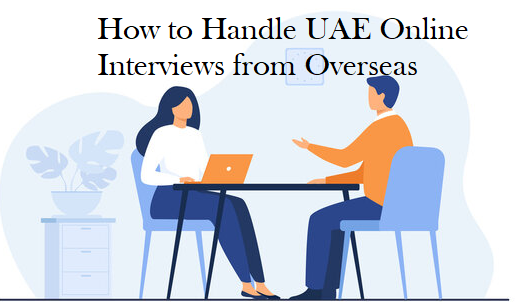
For an overseas candidate, a UAE online interview can be the first real contact with a UAE employer or recruiter.
You may be sitting thousands of kilometres away.
The interviewer may be in Abu Dhabi, Dubai or another UAE location.
There may be no opportunity to meet face-to-face before the first decision is made.
That makes preparation important.
But an online interview is not about having the most expensive camera, the perfect background or memorising impressive answers.
It is about presenting your real professional experience clearly and professionally through a screen.
The simple process is:
PREPARE → PRACTISE → PRESENT → INTERVIEW → FOLLOW UP
1. First Understand the UAE Online Interview Process
An online interview can happen at different stages of recruitment.
A typical process may look like:
Job Application
↓
CV/Resume Screening
↓
Recruiter Contact
↓
Online Screening
↓
HR Interview
↓
Technical / Functional Interview
↓
Hiring Manager Discussion
↓
Further Assessment, if applicable
↓
Offer / Next Steps
Not every company follows the same process.
Some candidates may have only one interview.
Others may have several rounds.
The important point:
Do not assume that an invitation to an online interview means you have already been selected.
It means you have reached another stage of the recruitment process.
Treat it seriously.
2. Before You Accept the Interview
When a recruiter contacts you for an online interview, don’t immediately reply:
“Yes, anytime.”
First understand the basic information.
Check:
- Company name
- Position
- Interview date
- Interview time
- Time zone
- Interview platform
- Interviewer’s name, if provided
- Expected interview duration
- Whether the interview is HR, technical or managerial
- Whether any documents or preparation are required
Why does time zone matter?
If you are outside the UAE, your local time may be different.
Always confirm the UAE time and convert it correctly to your local time.
Simple rule:
Never guess the interview time.
Confirm it.
3. Research the Company
Before the interview, understand the organisation you are speaking with.
At minimum, know:
COMPANY
What does the company do?
ROLE
What position are you applying for?
INDUSTRY
Which sector does it operate in?
REQUIREMENTS
What skills are they asking for?
YOUR CONNECTION
Why is your experience relevant?
You don’t need to memorise the company’s entire website.
You need to understand why you are sitting in that interview.
4. Read the Job Description Again
Don’t prepare only from your CV.
Read the job description carefully.
Look for:
- Required experience
- Technical skills
- Responsibilities
- Qualifications
- Industry knowledge
- Communication requirements
- Leadership requirements
- Specific software or systems
- Location
- Seniority
Then compare it with your own experience.
Create two columns:
| They Need | I Have |
|---|---|
| Client management | 6 years’ experience |
| Team leadership | Managed 15 people |
| Sales development | B2B business development |
| Reporting | Monthly management reporting |
Now your preparation becomes much easier.
5. Prepare Your Professional Introduction
One of the first questions may be:
“Tell me about yourself.”
Don’t start explaining your entire life.
Prepare a short professional introduction covering:
Who you are
↓
What you do
↓
Relevant experience
↓
One or two strengths
↓
Why you are interested in the role
For example:
“I am a finance professional with seven years of experience in financial reporting and management accounting. In my current role, I work on monthly reporting, budgeting and financial analysis. I have also worked closely with management teams to support business decisions. I am now looking for an opportunity in the UAE where I can apply this experience in a broader international business environment.”
Don’t memorise this word-for-word.
Understand your story.
6. Prepare Your Experience Examples
The interviewer may ask:
“Tell me about your previous experience.”
Don’t simply repeat your job titles.
Prepare examples around:
RESPONSIBILITY
What did you handle?
PROBLEM
What challenge did you face?
ACTION
What did you do?
RESULT
What happened?
A simple structure is:
Situation → Action → Result
This helps turn a general statement into a real example.
Instead of:
“I am good at team management.”
Say:
“In my previous role, I managed a team of 12 people. We were facing delays in completing monthly work, so I reorganised the workflow and introduced clearer responsibility allocation. This helped the team complete the process more efficiently.”
Evidence is more powerful than adjectives.
7. Prepare for the Questions You Are Most Likely to Hear
Before the interview, practise answers for questions such as:
- Tell me about yourself.
- Tell me about your previous experience.
- Why are you interested in this role?
- Why do you want to work in the UAE?
- Why are you leaving your current job?
- What are your key strengths?
- What is one area you are working to improve?
- What are your salary expectations?
- When can you join?
- Are you willing to relocate?
- What do you know about our company?
- Why should we consider you?
- Tell me about a challenge you faced at work.
- Tell me about an achievement you are proud of.
You don’t need to prepare a 20-page script.
Prepare key points and examples.
8. Practice Without Memorising
This is one of the most important parts.
There are two very different types of preparation.
BAD PRACTICE
Read answer.
↓
Memorise answer.
↓
Repeat answer.
↓
Forget one sentence.
↓
Panic.
BETTER PRACTICE
Understand the question.
↓
Identify 2–4 key points.
↓
Answer naturally.
↓
Record yourself.
↓
Listen.
↓
Improve.
You should be able to answer the same question in slightly different words each time.
That shows understanding rather than memorisation.
9. Do a Mock Online Interview
Don’t practise only in your head.
Open your laptop.
Turn on your camera.
Sit where you will actually conduct the interview.
Ask yourself questions.
Answer them aloud.
Record yourself if you are comfortable doing so.
Then watch the recording.
Look at:
- Voice
- Speed
- Posture
- Eye contact
- Facial expression
- Background
- Lighting
- Unnecessary movements
- Repeated words
- Long pauses
- Clarity
You may notice things that you never notice when practising silently.
10. Practise Your Voice
Speaking too quickly is common when candidates are nervous.
Especially during an online interview.
Try this:
Question
Pause for a moment.
↓
Think
↓
Answer
↓
Pause
↓
Continue
You don’t have to answer immediately.
A short pause can actually make your answer sound more considered.
11. Test the Technology
Do this before interview day.
Check:
INTERNET
Is your connection stable?
CAMERA
Is your face clearly visible?
MICROPHONE
Can you be heard clearly?
SPEAKERS / HEADPHONES
Can you hear the interviewer?
PLATFORM
Does the meeting link work?
DEVICE
Is your laptop charged?
BACKUP
Do you have a phone or alternative connection available if something goes wrong?
Don’t wait until five minutes before the interview to discover that your microphone isn’t working.
12. Choose the Right Location
You don’t need a luxury office.
You need a quiet and professional environment.
Try to avoid:
- Television noise
- Loud conversations
- Traffic noise
- Crowded rooms
- Constant interruptions
- Pets moving around
- People walking behind you
- Unnecessary background activity
Tell people around you that you have an interview.
Your goal:
The interviewer should be able to concentrate on you—not your surroundings.
13. Camera Position Matters
Place the camera approximately at eye level.
Avoid:
Camera Too Low
The interviewer may see mostly your chin and ceiling.
Camera Too High
Your face may appear at an unnatural angle.
Camera Too Far
You become difficult to see.
Camera Too Close
Your face fills the entire screen.
A natural head-and-shoulders framing is usually sufficient.
14. Lighting
You don’t need professional photography equipment.
But your face should be visible.
If possible:
Light facing you
rather than a strong light directly behind you.
Avoid sitting with a bright window directly behind your head if it makes your face appear dark.
Simple test:
Open your camera before the interview.
Look at the screen.
Ask:
“Can the interviewer clearly see my face?”
If yes, you’re probably fine.
15. Background
Keep it simple.
A clean wall or tidy professional environment is usually enough.
You don’t need an elaborate virtual background.
Avoid:
- Messy rooms
- Unmade beds
- Distracting objects
- People constantly moving behind you
- Excessive decorations
- Anything inappropriate for a professional meeting
Remember:
The background is supporting the interview—not becoming the interview.
16. Dress for the Role
Being at home does not mean dressing casually.
Your clothing should match the professional context of the position.
For many professional interviews, a clean, well-presented business or business-casual appearance is appropriate.
The exact expectation can vary by industry and company.
The rule:
Dress as though you could be meeting the interviewer in person.
17. Your First 30 Seconds Matter
When you join the meeting:
Smile naturally.
Greet the interviewer.
Confirm that you can hear them.
For example:
“Good morning. Thank you for taking the time to speak with me today.”
If the interviewer says:
“Can you hear me?”
Simply respond:
“Yes, clearly. Can you hear me clearly as well?”
Then move forward.
No need for a long opening speech.
18. Presentation Is More Than Appearance
Presentation = How you communicate yourself.
It includes:
- Voice
- Posture
- Listening
- Eye contact
- Facial expression
- Clarity
- Confidence
- Professional language
- Ability to answer directly
You can wear a perfect suit and still give a poor interview.
You can also have a simple setup and give an excellent interview.
Skills come first.
Presentation helps those skills become visible.
19. Don’t Read Your Answers From the Screen
This is particularly important for remote interviews.
Having your CV available is useful.
Having a few preparation notes nearby can also be useful.
But don’t constantly look down and read.
The interviewer may notice.
Better:
Prepare keywords.
For example:
CURRENT ROLE
TEAM – 15
B2B CLIENTS
18% GROWTH
UAE ROLE
Then speak naturally.
20. How to Handle Nervousness
Being nervous is normal.
Especially if:
- This is your first UAE interview
- You are applying from overseas
- You have never had an international interview
- The position is important to you
Don’t try to eliminate nervousness completely.
Instead, control it.
Before joining:
Take a few slow breaths.
Keep water nearby.
Review your key points.
Join early.
Sit comfortably.
Then focus on the conversation, not on the fact that you are being judged.
21. What If You Don’t Understand the Question?
Don’t guess.
Say:
“Could you please repeat the question?”
Or:
“Could you please clarify what you mean?”
That’s completely professional.
A wrong answer caused by misunderstanding is worse than asking for clarification.
22. What If Your Internet Disconnects?
This is one reason to prepare a backup.
If the connection fails:
Don’t panic.
Reconnect as quickly as possible.
If necessary, send a short professional message:
“I apologise for the interruption. My internet connection dropped unexpectedly. I am reconnecting now.”
If the issue continues, communicate with the recruiter using the contact method they have provided.
Technology can fail.
Your professionalism should not.
23. What If You Are Asked About UAE Experience?
If you have never worked in the UAE, don’t pretend.
Say:
“I have not worked in the UAE previously, but I have relevant experience in…”
Then explain the transferable part of your experience.
Honesty matters.
Never manufacture UAE experience, clients, projects or relationships.
24. What If They Ask Why You Want to Work in the UAE?
Don’t make your entire answer:
“Because the salary is better.”
You can explain your professional motivation.
For example:
“I am interested in the UAE because it offers an international business environment and opportunities in my field. I believe my experience in ___ is relevant to this position, and I am interested in developing my career in the region.”
Your personal motivation may be important.
But the interviewer also needs to understand your professional reason.
25. Salary Questions During an Online Interview
If asked:
“What are your salary expectations?”
Don’t panic.
Don’t immediately say:
“Anything is fine.”
And don’t give an unrealistic number simply because you think you should ask high.
Research the UAE market beforehand.
Then provide a realistic expectation and remain open to discussing the complete package.
For example:
“Based on my experience and my understanding of the responsibilities, I would be looking at a package in the range of AED X to AED Y. However, I am open to discussing the overall compensation package.”
Your number should be based on your actual profile and market research.
26. What NOT to Do During a UAE Online Interview
❌ Don’t join late without explanation
Time matters.
❌ Don’t eat during the interview
❌ Don’t smoke during the interview
❌ Don’t keep checking your phone
❌ Don’t interrupt constantly
❌ Don’t talk over the interviewer
❌ Don’t read answers from another screen
❌ Don’t exaggerate your experience
❌ Don’t speak negatively about previous employers
❌ Don’t pretend to know what you don’t know
❌ Don’t ask about salary in the first 30 seconds
❌ Don’t make the entire conversation about relocation
❌ Don’t behave as though the job is already yours
27. What TO Do
BEFORE
Research the company
Study the job description
Prepare your introduction
Prepare experience examples
Research salary expectations
Test technology
Choose your environment
DURING
Join on time
Listen carefully
Answer directly
Give examples
Speak clearly
Maintain professional posture
Ask relevant questions
Be honest
AFTER
Thank the interviewer
Confirm the next step if appropriate
Send a professional follow-up when appropriate
Record what you learned
Prepare for the next round
28. What Questions Can You Ask the Interviewer?
At the end, you may hear:
“Do you have any questions for us?”
Don’t automatically say:
“No.”
Prepare two or three sensible questions.
For example:
“Could you tell me a little more about the main priorities for this role?”
“What would success look like in the first six months?”
“Could you explain what the next stage of the recruitment process would be?”
These questions show that you are thinking about the role, not just the offer.
29. The Complete Overseas Interview Preparation Checklist
24–48 HOURS BEFORE
☐ Research company
☐ Read job description
☐ Review CV
☐ Prepare professional introduction
☐ Prepare experience examples
☐ Prepare common questions
☐ Research salary range
☐ Confirm interview time
☐ Confirm UAE time zone
☐ Check meeting link
☐ Test camera
☐ Test microphone
☐ Check internet
☐ Choose interview location
☐ Select appropriate clothing
30 MINUTES BEFORE
☐ Laptop charged
☐ Phone available as backup
☐ Water nearby
☐ CV available
☐ Notes ready
☐ Camera positioned
☐ Lighting checked
☐ Background checked
☐ Notifications turned off
☐ Quiet environment
5 MINUTES BEFORE
STOP PREPARING.
Don’t try to learn ten new answers.
Take a breath.
Sit comfortably.
Be ready.
30. The UAE Online Interview Process — Infographic
OVERSEAS CANDIDATE
STEP 1
APPLICATION
↓
STEP 2
RECRUITER CONTACT
↓
STEP 3
ONLINE INTERVIEW
↓
STEP 4
TECHNICAL / HR / MANAGERIAL ROUND
↓
STEP 5
NEXT STAGE
↓
STEP 6
OFFER / FURTHER PROCESS
31. The 4P Method
For UAE online interviews from overseas, remember:
1. PREPARATION
Company + Role + Questions + Technology
↓
2. PRACTICE
Speak + Record + Review + Improve
↓
3. PRESENTATION
Appearance + Voice + Posture + Communication
↓
4. PERFORMANCE
Listen + Answer + Explain + Ask
32. The Final PAD Online Interview Formula
BEFORE THE INTERVIEW
KNOW THE COMPANY
↓
KNOW THE ROLE
↓
KNOW YOUR EXPERIENCE
↓
KNOW YOUR NUMBERS
↓
KNOW YOUR EXPECTATION
DURING THE INTERVIEW
LISTEN
↓
THINK
↓
ANSWER
↓
EXPLAIN
↓
STOP
AFTER THE INTERVIEW
THANK
↓
FOLLOW UP
↓
PREPARE FOR THE NEXT STEP
Final PAD Perspective
For an overseas candidate, a UAE online interview can feel like a major step.
But remember one thing:
The interviewer is not expecting you to become a UAE professional overnight simply because you are applying for a UAE job.
You are being considered based on the combination of your experience, skills, communication, suitability and professional potential.
Your responsibility is to make those qualities visible.
Don’t try to create a perfect image.
Create a professional impression.
Prepare your environment.
Prepare your technology.
Prepare your answers.
Practise your communication.
Understand your own experience.
Research the company.
Understand the role.
Then enter the interview calmly.
And if something goes wrong—a technical problem, a difficult question, a moment of hesitation—don’t assume the interview is finished.
Pause. Recover. Continue professionally.
A remote interview is still an interview.
The screen may separate you from the UAE employer.
Your preparation should not.
UAE Online Interview — DO & DON’T
| DO | DON’T |
|---|---|
| Research the company | Join without preparation |
| Know the role | Read the job description for the first time during the interview |
| Test technology | Assume the internet will work |
| Join on time | Join at the last second |
| Dress professionally | Treat it like a casual video call |
| Look toward the camera naturally | Keep watching your own image |
| Listen carefully | Interrupt |
| Give real examples | Give memorised speeches |
| Be honest about experience | Invent UAE experience |
| Ask relevant questions | Ask only about salary and benefits |
| Stay calm after technical problems | Panic |
| Follow up professionally | Send repeated messages asking for results |
Common Search Keywords
Primary keyword:
- How to handle UAE online interviews from overseas
Related keywords:
- UAE online interview from overseas
- UAE remote job interview
- UAE virtual interview
- UAE online job interview tips
- UAE interview preparation
- UAE interview for overseas candidates
- UAE jobs from overseas
- Abu Dhabi online interview
- Abu Dhabi job interview preparation
- UAE video interview
- UAE HR interview
- UAE recruiter interview
- online interview tips for UAE jobs
- how to prepare for UAE interview
- remote interview UAE jobs
- UAE interview questions and answers
- UAE job interview do and don’ts
- how to present yourself in online interview
- UAE interview practice
- international candidate UAE interview
- UAE career preparation
PAD takeaway
Prepare. Practise. Present. Perform.
Your location may be outside the UAE.
Your professionalism should already be ready for the UAE.