

UAE Footprint | A practical settlement guide by PAD Media House
Publication date: 28 October 2026
Information checked: 28 October 2026
Location covered: Abu Dhabi, United Arab Emirates
Moving to Abu Dhabi involves many decisions: where to live, how to reach work, how to manage household expenses and how to get around the city.
One important question is whether you should rely on public transport and taxis or buy a car.
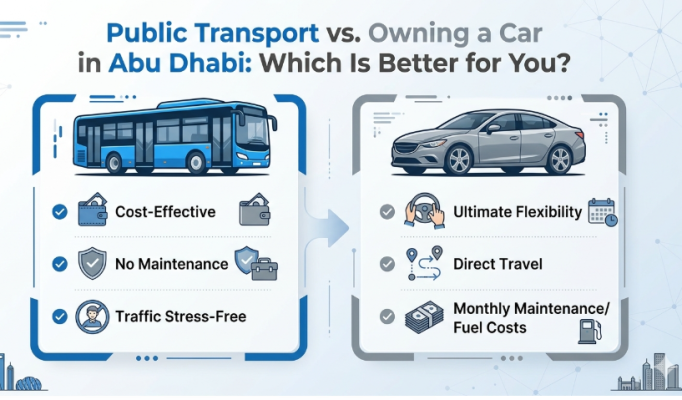
The answer depends on your salary, workplace, family size, accommodation, daily travel and personal preferences. A car offers greater independence, but it also brings ongoing expenses beyond the purchase price. Public transport can be economical, although it may not be convenient for every route or schedule.
This guide explains the main options to help you plan your transportation budget before moving to Abu Dhabi.
1. Understanding Public Transport in Abu Dhabi
Abu Dhabi has an extensive public bus network serving the city and surrounding areas. Taxis are also available for direct journeys, while on-demand services operate in selected areas.
The best option depends on where you live and where you need to travel.
Official transport information is available through Abu Dhabi Mobility and the UAE Government public transport guide.
Public buses and Hafilat cards
Abu Dhabi uses the Hafilat smart card system for bus payments. Passengers generally tap their card when boarding and when leaving the bus, allowing the fare to be calculated according to the journey.
Published standard bus fares include:
| Item | Published fare |
|---|---|
| Hafilat anonymous card | AED 10 |
| Local bus journey | AED 2 |
| Regional journey | AED 2 + AED 0.05 per kilometre |
| Weekly pass | AED 30 |
| Monthly pass | AED 80 |
These are the published fares shown on Abu Dhabi Mobility’s Hafilat information pages. Check the official service before travelling, as fare rules and pass eligibility may change. Intercity services may have different charges and conditions.
What does this mean for a new resident?
If your accommodation is close to a suitable bus route and your workplace is accessible by bus, public transport can help you keep commuting expenses low.
Before signing a rental agreement, check the nearest bus stops, routes, service times and the walking distance between your accommodation and the stop.
A lower rent may not represent a saving if reaching work requires expensive taxi journeys every day.
2. What Does a Taxi Cost in Abu Dhabi?
Taxis are useful when you need a direct journey, are carrying shopping, travel with children or cannot conveniently reach your destination by bus.
According to Abu Dhabi Mobility’s published taxi tariff:
| Taxi charge | Daytime | Night-time |
|---|---|---|
| Starting fare | AED 5.00 | AED 5.50 |
| Per kilometre | AED 1.82 | AED 1.82 |
| Waiting time | AED 0.50 per minute | AED 0.50 per minute |
| Minimum trip fare | AED 12 | AED 12 |
| Booking fee | AED 4 | AED 5 |
Daytime is listed as 6:00 am–10:00 pm, and night-time as 10:00 pm–6:00 am. Airport taxi tariffs have a different starting fare. The actual amount depends on distance, waiting time, booking method and applicable charges. Check the latest tariff before travelling.
Official taxi information and booking options are available through Abu Dhabi Mobility.
When are taxis a good choice?
Taxis may suit you if:
- You work from home or travel only occasionally.
- Your workplace is not conveniently connected by bus.
- You need transport for shopping, appointments or evening outings.
- You are new to Abu Dhabi and have not yet settled on a long-term routine.
However, using taxis for every journey can become expensive. Calculate your likely weekly travel rather than judging affordability from a single short ride.
3. Should You Buy a Car in Abu Dhabi?
Owning a car can make daily life more convenient, particularly if your workplace is far from public transport, your working hours are irregular or you have family responsibilities.
However, the purchase price is only one part of the cost.
Main expenses of owning a car
| Expense | What to consider |
|---|---|
| Purchase or finance | Initial payment, loan instalments and financing costs, if applicable |
| Insurance | Premium depends on the vehicle, driver and policy |
| Fuel | Depends on monthly kilometres, vehicle efficiency and fuel prices |
| Registration | Registration and renewal charges |
| Vehicle inspection | May be required according to the vehicle’s age and applicable rules |
| Maintenance | Servicing, tyres, battery, brakes and unexpected repairs |
| Parking | Residential, workplace, visitor and paid public parking |
| Road tolls | Applicable charges when using tolled roads |
| Depreciation | The vehicle may lose value over time |
The UAE Government explains that vehicle registration involves the applicable documentation, insurance, inspection requirements and registration process. Check the current requirements with the relevant authority before purchasing a vehicle.
Official guidance: UAE Government — Registering Vehicles.
Remember the hidden costs
A car that appears affordable to purchase may become expensive to maintain.
For example, a used vehicle may have a lower purchase price but need new tyres, repairs or additional maintenance. A financed vehicle may also create a fixed monthly commitment even when you use it less than expected.
Before buying, calculate the total cost of ownership—not just the monthly instalment.
4. Fuel Prices: A Monthly Expense to Watch
Fuel prices in the UAE can change monthly.
For October 2026, the announced prices were:
| Fuel type | Price per litre |
|---|---|
| E-Plus 91 | AED 4.21 |
| Special 95 | AED 4.28 |
| Super 98 | AED 4.40 |
| Diesel | AED 4.80 |
These are October 2026 prices, not guaranteed future prices. The UAE reviews fuel prices under its monthly pricing mechanism.
Example: Calculating a fuel budget
Suppose your car uses 8 litres of petrol per 100 kilometres and you drive 1,000 kilometres in a month.
Your estimated fuel consumption would be:
1,000 km × 8 litres ÷ 100 = 80 litres
At AED 4.28 per litre, using the October 2026 Special 95 price:
80 litres × AED 4.28 = AED 342.40 per month
This is an illustration, not a prediction of your actual bill. Real consumption depends on the vehicle, traffic, driving style, air-conditioning use and journey distances.
For future budgets, check the latest monthly fuel prices and use your own vehicle’s expected fuel consumption.
5. Parking in Abu Dhabi: An Expense to Include
Parking costs can affect your decision to own a car, especially if you commute to a busy commercial area.
Abu Dhabi’s MAWAQiF system regulates public parking in designated areas.
Published public parking tariffs include:
| Parking type | Published tariff |
|---|---|
| Standard parking | AED 2 per hour |
| Standard parking, daily maximum tariff | AED 15 |
| Premium parking | AED 3 per hour |
The official MAWAQiF page lists the general paid parking period as 8:00 am to midnight, with parking free on Sundays and public holidays under the published rules. Specific areas, permits and parking conditions may differ, so always follow the signs and current rules at the location.
Official information: Abu Dhabi Mobility — MAWAQiF.
Questions to ask before renting a home
- Is dedicated parking included in the rent?
- Is the parking space reserved for your apartment?
- Will you need to pay for parking near your workplace?
- Are visitor parking arrangements available?
- Are there any restrictions or permit requirements in your residential area?
A home with suitable parking may be more convenient for a car owner, while someone relying on buses may prefer accommodation close to a reliable route.
6. Car Insurance and Registration
Before driving a car in the UAE, you must meet the applicable licensing, insurance and registration requirements.
Insurance prices are not the same for everyone. They can vary according to the vehicle’s value and specifications, the driver’s record, the policy type and the insurer.
When comparing quotations, check:
- Whether the policy is third-party or comprehensive.
- What damage and risks are covered.
- The excess or deductible you may need to pay when making a claim.
- Whether roadside assistance is included.
- Any exclusions, limits or additional conditions.
Do not select a policy based only on its lowest premium. Read the terms and compare what is actually covered.
You should also budget for registration and any inspection or renewal requirements applicable to your vehicle.
7. Public Transport vs. Owning a Car: Which Is Better?
The right choice depends on your circumstances.
| Your situation | Option worth considering |
|---|---|
| You live near a suitable bus route and work nearby | Public transport |
| You are new to Abu Dhabi and learning the city | Public transport with occasional taxis |
| You work from home most days | Public transport or taxis, depending on your needs |
| You work shifts or finish late at night | Compare your actual route and timings; taxis or a car may be more practical |
| Your workplace is far from bus services | Consider a car or a mixed transport arrangement |
| You have children and frequent family commitments | Compare the convenience and full cost of a car with other options |
| You travel only occasionally | Public transport and taxis may be sufficient |
| You regularly travel between distant locations | A car may offer greater flexibility |
These are general guidelines, not universal rules. Your route, work schedule, family needs and budget should determine the decision.
8. An Illustrative Monthly Transport Budget
Instead of assuming that a car is always expensive or public transport is always convenient, compare realistic monthly expenses.
Option A: Public transport
Potential costs include:
- A Hafilat card and applicable pass or journey fares.
- Occasional taxi journeys.
- Additional transport for destinations not conveniently served by buses.
A published AED 80 monthly Hafilat pass may be useful for eligible travel, but you should confirm its coverage and suitability for your routes before budgeting around it.
Option B: Owning a car
Potential costs include:
- Monthly finance payments, if applicable.
- Fuel.
- Insurance, allocated across the year.
- Registration and inspection costs, allocated across the year.
- Maintenance and repairs.
- Parking and applicable road tolls.
The total varies considerably between drivers and vehicles. A paid-off, fuel-efficient car with included parking can have a very different cost from a financed vehicle with substantial daily travel.
Practical tip: Make a 30-day estimate using your expected home-to-work journey, weekly shopping, family travel and other regular trips. Compare the total cost of each option before making a decision.
9. A Smart Strategy for Someone Moving to Abu Dhabi
If you are relocating for a new job, consider avoiding an immediate car purchase unless your circumstances make one essential.
A practical approach is:
Step 1: Confirm your workplace.
Find out the exact office location and your expected working hours.
Step 2: Shortlist accommodation.
Check bus access, walking distances, taxi availability and parking arrangements.
Step 3: Estimate your commute.
Calculate the expected monthly cost of buses, taxis or driving.
Step 4: Settle into your routine.
If practical, use public transport and taxis initially while learning the city.
Step 5: Reassess after your first month.
Once you understand your daily travel needs, decide whether buying a car would provide enough additional convenience to justify the expense.
This approach can help you avoid taking on a financial commitment before you understand your actual needs.
10. Final Recommendation
There is no single answer for everyone moving to Abu Dhabi.
Public transport may be a sensible starting point for a single professional whose home and workplace are well connected. Taxis can fill gaps when buses are inconvenient. A car may be worth the additional cost for people with long commutes, irregular working hours or substantial family travel.
The most important decision is not whether owning a car is considered a sign of comfort or success. It is whether the choice fits your lifestyle and financial priorities.
Choose your accommodation and transport together. A suitable home near work or a reliable bus route can sometimes save more money than you might expect.
Official Sources and Further Reading
The following official sources provide information on fares, services and vehicle requirements:
- Abu Dhabi Mobility — Public Bus Fares
- Abu Dhabi Mobility — Hafilat Smart Cards
- Abu Dhabi Mobility — Taxi Fares
- Abu Dhabi Mobility — MAWAQiF Parking
- UAE Government — Public Transport
- UAE Government — Vehicle Registration
- Emirates News Agency — October 2026 Fuel Prices
Disclaimer
Published on 28 October 2026. This article has been prepared by PAD Media House for general informational and educational purposes, using the official sources listed above and other publicly available information available on the publication date. Fares, fuel prices, parking rules, insurance terms, registration requirements and transport services may change. Costs and individual requirements may vary. Readers should verify current information with the relevant official authority, transport operator, insurer or service provider before making travel, vehicle or financial decisions. This article does not constitute legal, insurance or financial advice. To the fullest extent permitted by applicable law, PAD Media House disclaims liability for loss or consequences arising from reliance on this article, without excluding any liability that cannot lawfully be excluded or limited.