

UAE Footprint | A knowledge initiative by PAD Media House
Publication date: 28 October 2026
Policy information checked: 28 October 2026
Route covered: India to Abu Dhabi, UAE
Applicable pets: Domestic dogs and cats
Moving to Abu Dhabi can be an exciting new chapter for your family. But if your dog or cat is part of that family, relocating requires careful preparation.
Before booking a flight, pet owners need to understand the UAE’s import requirements, vaccination rules, microchip identification, veterinary documents, airline conditions and arrival procedures.
A missed document or an expired permit can delay travel or prevent a pet from entering the UAE.
This guide explains the main steps for relocating a dog or cat from India to Abu Dhabi, based on official guidance available on the date shown above.
Important: Requirements depend on the animal, its vaccination history, the route and the applicable country-risk classification. Confirm the requirements for your individual pet with the UAE Ministry of Climate Change and Environment (MOCCAE), India’s Animal Quarantine and Certification Services (AQCS) and your airline before making final arrangements.
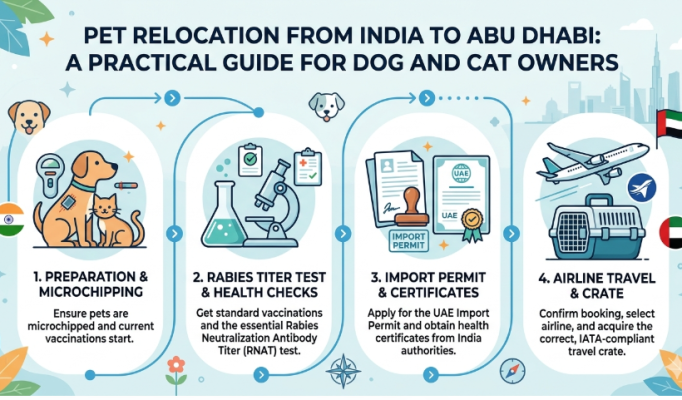
1. Step One: Check Whether Your Pet Can Enter the UAE
The first step is to check whether your pet meets the UAE’s import conditions.
For ordinary personal relocation, the UAE generally allows an individual to import up to two dogs, two cats, or one dog and one cat per year, subject to the applicable rules and exceptions.
Some dog breeds are prohibited from entering the UAE. The official list includes breeds such as:
- American Pit Bull Terrier
- American Staffordshire Terrier
- American Bully
- Staffordshire Bull Terrier
- Japanese Tosa
- Dogo Argentino
- Brazilian Mastiff
- Tibetan Mastiff
- Cane Corso
- Bullmastiff
- Boerboel
- Bully Kutta
- Presa Canario
This is an illustrative selection, not the complete legal list. Breed names, classifications and exceptions can matter, so consult the current MOCCAE list before arranging transport.
Official source: MOCCAE’s pet import service and its current import conditions.
2. Step Two: Apply for the UAE Pet Import Permit
A UAE pet import permit must be obtained before the animal enters the country.
The permit is issued through MOCCAE’s official digital services.
The usual process is:
- Register or sign in to the official service.
- Select the pet import service.
- Provide the required details for the animal and importer.
- Upload the requested documents and information.
- Pay the applicable fee.
- Download and check the issued permit.
Each pet must meet the relevant conditions. Do not assume that a permit for one animal covers another.
How long is the import permit valid?
The validity period needs particular attention.
As checked on 28 October 2026, MOCCAE’s current pet import service information states that the permit is valid for 90 days from the date of issue. However, the Abu Dhabi Residents Office information page still refers to a 30-day validity period.
Because the official pages are inconsistent, check the expiry date printed on your actual permit and confirm the applicable validity directly with MOCCAE before finalising your flight.
Do not travel using an expired permit.
Official sources:
- MOCCAE — Import of Pets (Cats and Dogs)
- Abu Dhabi Residents Office — Relocating with Pets
3. Step Three: Get Your Pet Microchipped
A permanent microchip is a key requirement for importing dogs and cats into the UAE.
The microchip provides a unique identification number that can be scanned by authorised personnel.
Before proceeding, ask your veterinarian to:
- Check whether your pet already has a compatible microchip.
- Record the complete microchip number.
- Ensure the number appears correctly on the vaccination record and other required documents.
- Check that the number on the health certificate matches the actual chip.
If your pet has not been microchipped, arrange this with a registered veterinarian and confirm the required identification standard with the relevant authorities.
Important: Do not leave microchip verification until the day of departure. A mismatch between the chip and the paperwork can create problems at the border.
4. Step Four: Complete the Required Vaccinations
The UAE requires dogs and cats to have the vaccinations applicable to their species and import circumstances.
Vaccinations for dogs
The MOCCAE requirements include:
- Rabies
- Canine distemper virus
- Canine parvovirus
- Infectious canine hepatitis
- Leptospirosis, subject to the applicable provisions
Vaccinations for cats
The MOCCAE requirements include:
- Rabies
- Feline panleukopenia
- Feline rhinotracheitis
- Feline calicivirus
The vaccination record should contain the information required by the authorities, including the vaccine name, manufacturer, batch number and vaccination date.
The rabies vaccination must meet the applicable age, validity and timing conditions. MOCCAE specifies that the animal must be at least 12 weeks old when initially vaccinated against rabies.
Animals arriving from countries classified as low risk must generally be at least 12 weeks old. Those arriving from high-risk countries must generally be at least 15 weeks old.
These minimum ages do not mean every animal of that age is immediately eligible to travel. Other requirements, including rabies vaccination timing and testing where applicable, must also be satisfied.
Practical advice: Give your veterinarian the current UAE import requirements before starting or updating the vaccination schedule. Do not rely on a routine domestic vaccination record without checking whether it meets the UAE’s conditions.
5. Step Five: Check Whether a Rabies Antibody Titre Test Is Required
A rabies antibody titre test measures the level of antibodies against rabies in the animal’s blood.
Under MOCCAE’s rules, a test is required for animals imported from countries classified as high risk, subject to the applicable conditions.
The specified minimum result is 0.5 IU/ml.
MOCCAE’s published conditions state that:
- When rabies vaccination is being given for the first time, or the vaccination has lapsed, at least 21 days must pass after vaccination before the relevant testing.
- When the animal has a valid booster vaccination, the rules may allow the test to be performed without waiting a further 21 days.
- The test must be conducted by a laboratory approved under the applicable requirements.
The published validity period for the titre-test result is 365 days, provided the rabies vaccination remains valid and the conditions for relying on the result continue to be met.
What about pets travelling from India?
Do not assume that a titre test is either unnecessary or automatically sufficient. The applicable test requirement depends on the UAE’s current country-risk classification and the pet’s vaccination history.
Before scheduling the blood test, ask MOCCAE or your approved pet-relocation veterinarian to confirm the current classification applicable to India and the testing protocol for your pet.
Plan early: If a test is required, the laboratory process and vaccination timing may affect your intended departure date.
6. Step Six: Arrange Parasite Treatment
MOCCAE’s published requirements specify preventive treatment for internal and external parasites during the 14 days before shipment.
The treatment must be recorded in the animal’s health certificate or vaccination document, as applicable.
Ask the veterinarian to record:
- The treatment date
- The product or medication used
- The relevant details required by the official certificate
Do not estimate the treatment window yourself. Arrange the timing with the veterinarian so the documentation meets the applicable import conditions.
7. Step Seven: Prepare the Veterinary Health Certificate
Your pet must travel with the required official veterinary health documentation from India.
The certificate must meet the UAE’s import conditions and be issued or endorsed by the appropriate competent veterinary authority, as required.
A routine health note from a private clinic may not, by itself, replace the official export documentation.
The health certificate should identify the animal correctly and confirm the required health information. The microchip number must match the animal’s identification record.
Ask AQCS and your veterinarian to confirm the current certificate format, examination process and any endorsement requirements for the planned route.
Important timing rule
India’s AQCS website states that its export certificate for pets is valid for 10 days from the date of issue or examination.
This makes timing important: arrange the required examination and certificate close enough to departure to remain within the applicable validity period.
The exact process should be confirmed with the AQCS office handling your export.
8. Step Eight: Complete India’s Export Clearance
India has its own export documentation process for pets leaving the country.
According to the official AQCS export guidance, the documents and items requested can include:
- The pet for examination
- Veterinary health certificate
- Microchip certificate
- Vaccination records
- Copy of the owner’s passport
- Copy of the owner’s air ticket
- Airway bill if the pet travels as cargo
- UAE import permit and any other importing-country requirements
- Two suitable photographs of the pet
- An authorisation letter if a representative submits the documents on the owner’s behalf
AQCS states that originals and photocopies should be provided and advises pet owners to arrange an appointment in advance.
Its published guidance asks for documents to be submitted with the pet to the quarantine office seven days before embarkation for the required clearance process.
Because export procedures and forms can change, contact the relevant AQCS office before visiting and confirm the process for your travel date.
Official source: Animal Quarantine and Certification Services, Government of India — Export of Pets.
9. Step Nine: Confirm Airline Rules Before Paying for the Ticket
UAE import approval does not automatically mean that every airline will accept your pet on every route.
Airlines have their own requirements for:
- Whether pets may travel in the cabin, as checked baggage where offered, or as manifested cargo
- Breed and weight restrictions
- Carrier or crate dimensions
- Temperature and animal-welfare restrictions
- Booking deadlines and available capacity
- Connecting flights and transit conditions
- Required veterinary documents
- Charges and payment arrangements
MOCCAE requires pet transport to comply with the applicable International Air Transport Association (IATA) conditions.
Contact the airline directly and confirm the arrangements for the complete journey from India to Abu Dhabi, including any connecting airports.
Ask the airline these questions
- Can my particular breed travel on this route?
- Must my pet travel as manifested cargo, or is another approved option available?
- What crate dimensions and construction standards apply?
- Are connecting flights permitted?
- What documents must be presented before boarding?
- What are the booking deadlines and total charges?
- Where and when will I collect my pet at the destination?
Obtain confirmation before purchasing a non-refundable ticket or paying for a crate that may not meet the airline’s specifications.
10. Step Ten: Prepare the Travel Folder
Keep all original documents organised in a secure folder and retain accessible digital copies.
Your checklist should include, where applicable:
- Valid UAE pet import permit
- Microchip certificate and number
- Original vaccination record or pet passport
- Rabies vaccination details
- Rabies antibody titre-test report, if required
- Veterinary health certificate
- Parasite-treatment details
- AQCS export clearance or other required export documents
- Owner’s passport and travel details
- Airline booking confirmation and airway bill, if applicable
- Transit documents, if required
- Any additional document requested by the authorities
Check the names, dates, identification numbers and route details carefully. If your itinerary changes, confirm whether the documents or approvals need to be updated.
11. What Happens When Your Pet Arrives in Abu Dhabi?
On arrival, the animal is subject to the applicable entry checks.
Authorities may verify:
- The import permit
- The microchip identification
- Vaccination records
- The official veterinary health certificate
- Any required rabies antibody test
- Compliance with other import conditions
The animal must satisfy the requirements before it can be released.
Do not assume that every pet will be released immediately or that no inspection will take place. If the documents are incomplete, the identification does not match, or the pet does not satisfy the conditions, additional procedures may be necessary.
MOCCAE’s published service includes an arrival inspection and an electronic release process after compliance is verified.
Is quarantine compulsory?
The Abu Dhabi Residents Office states that the UAE does not generally impose a routine quarantine period on compliant incoming pets.
However, this should not be interpreted as a guarantee that every animal will be released immediately. Authorities may take further action when required documents are missing, requirements are not met, or health concerns arise.
12. What Are the Official UAE Import and Release Fees?
The MOCCAE service information available on 28 October 2026 lists the following federal fees:
| Service | Published fee per animal |
|---|---|
| Pet import permit | AED 200 |
| Dog release request | AED 500 |
| Cat release request | AED 250 |
These are the listed government service fees, not the complete cost of relocating a pet.
Your total budget may also include:
- Microchipping, vaccination and veterinary examinations
- Rabies antibody titre testing, if required
- India’s export clearance and related services
- Airline or cargo charges
- An approved travel crate
- Pet-relocation assistance, if used
- Any additional documentation, transport or handling costs
Ask each service provider for an itemised quotation and confirm government fees through the official MOCCAE service before payment.
13. Register Your Pet After Settling in Abu Dhabi
Import clearance is not necessarily the end of the administrative process.
Abu Dhabi City Municipality announced in September 2026 that cat and dog owners should use the Animal Ownership service through TAMM to register their pets and keep the information updated.
The municipality’s published guidance says registration requires a microchip and completion of the applicable process through an approved veterinary clinic or establishment. Owners may also be asked for information such as recent photographs and tenancy details.
After arrival:
- Find an approved veterinary clinic.
- Ask about the current pet-registration procedure.
- Confirm that the microchip and vaccination records are correctly recorded.
- Keep your contact and residential details up to date.
- Maintain your pet’s vaccinations and routine veterinary care.
Check the latest TAMM requirements, as registration procedures may change.
14. A Practical Relocation Timeline
There is no single timeline that suits every pet, particularly if a titre test is required. Use this sequence as a planning guide, not a substitute for official deadlines.
Stage 1 — Before booking:
Check breed eligibility, import conditions, airline rules and the applicable country-risk classification.
Stage 2 — Early preparation:
Check the microchip, vaccination history and whether testing is required. Allow enough time for any necessary vaccination or laboratory procedures.
Stage 3 — Before departure is finalised:
Apply for the import permit and confirm its actual expiry date. Secure airline acceptance and arrange the crate.
Stage 4 — Before travel:
Complete parasite treatment within the required period, arrange the official veterinary certificate and complete AQCS procedures according to the confirmed instructions.
Stage 5 — At departure and arrival:
Carry the required original documents, comply with airline procedures and present the documents for UAE entry inspection.
Stage 6 — After arrival:
Complete any applicable local pet-registration requirements and arrange veterinary care.
15. Final Checklist Before Your Pet Leaves India
Before departure, confirm every item below:
- The breed is permitted under current UAE rules.
- The animal meets the minimum age and vaccination requirements.
- The microchip is present and the number matches all relevant documents.
- The rabies antibody titre test has been completed if required.
- Required vaccinations are valid and properly documented.
- Parasite treatment has been recorded within the required period.
- The UAE import permit is valid on the planned arrival date.
- The official veterinary health certificate is valid.
- AQCS export requirements have been completed.
- The airline has confirmed acceptance and the travel arrangement.
- The travel crate meets the airline’s specifications.
- All original documents are ready.
- The destination inspection and collection process has been confirmed.
Conclusion: Plan the Move Around Your Pet’s Needs
A successful pet relocation is not just about getting a dog or cat onto a flight. It is about ensuring that the animal can travel safely, that the paperwork is correct and that the owner is ready for the process on both sides of the journey.
Start with the official rules, allow time for testing and documentation, and confirm the arrangements with the authorities and airline before committing to a departure date.
Your pet is part of your family. Give its journey the same care and planning you give your own relocation.
Official Sources for Verification
The article is based on the following official sources available at the time of review:
- UAE Ministry of Climate Change and Environment (MOCCAE) — Import of Pets (Cats and Dogs).
- Abu Dhabi Residents Office — Relocating with Pets.
- Government of India, Animal Quarantine and Certification Services — Export of Pets.
- MOCCAE — Official pet-import conditions.
- Abu Dhabi City Municipality — Pet registration through TAMM, announcement dated 4 September 2026.
Disclaimer
Published on 28 October 2026. This article has been prepared by PAD Media House for general informational and educational purposes, using the official sources identified above as available on the publication date. Import conditions, permit validity, fees, vaccination and testing requirements, airline policies and export procedures may change. Requirements can vary according to the animal, its history, the route and the applicable country-risk classification. Readers should verify the current requirements directly with MOCCAE, AQCS, the relevant authorities and their airline before making arrangements or travelling. This article does not constitute veterinary, legal or professional relocation advice and does not guarantee entry or release of any animal. To the fullest extent permitted by applicable law, PAD Media House disclaims liability for loss or consequences arising from reliance on this article, without excluding any liability that cannot lawfully be excluded or limited.