
One Page or Two? What UAE Recruiters Actually Want
One of the most common questions candidates ask before applying for a UAE job is:
“How many pages should my CV be?”
The simple answer is:
Keep it short — but don’t make it too short.
For most UAE job applications:
1 page can work very well for students, fresh graduates and early-career professionals.
2 pages is generally appropriate for experienced professionals, managers and senior candidates when the additional information is relevant and useful.
Current guidance from major recruitment organisations including Michael Page Middle East, Robert Walters UAE, GulfTalent and Bayt consistently points towards a one-to-two-page CV.
But there is an important point many candidates miss:
The objective is not to fill two pages. The objective is to use the available space to prove your suitability.
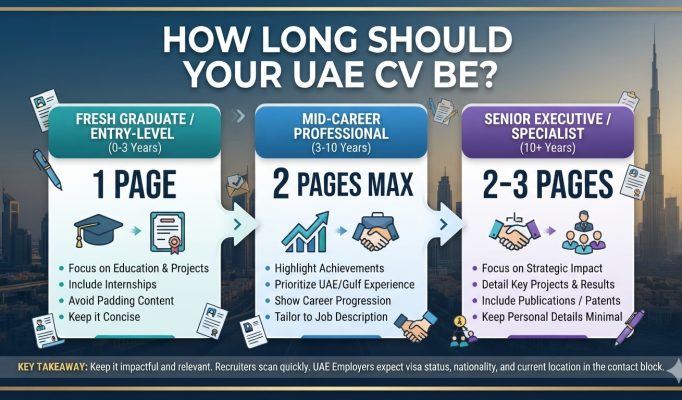
1. The UAE CV Rule in One Table
| Your Career Stage | Practical CV Length |
|---|---|
| Student / Fresh Graduate | 1 page |
| 0–3 years | 1 page, sometimes 2 |
| 3–7 years | 1–2 pages |
| 7–12 years | Usually 2 pages |
| 12+ years | Usually 2 pages, highly selective |
| Senior Manager / Specialist | 2 pages, if justified |
| Executive / Leadership | 2 pages is usually a strong target |
These are guidelines, not laws.
A candidate with 15 years of highly relevant experience does not automatically need three or four pages.
GulfTalent explicitly recommends keeping a professional CV to 1–2 pages even for candidates with decades of experience, while Robert Walters similarly recommends a maximum of one to two pages depending on experience and relevance.
2. Why Do Recruiters Prefer Short CVs?
Because recruiters are not reading your CV like a book.
They are trying to answer questions quickly:
Who is this candidate?
What does this person do?
How much relevant experience do they have?
What have they achieved?
Do they match this vacancy?
Should I move them to the next stage?
Michael Page’s Middle East guidance says recruiters scan CVs quickly, often with ATS or AI-supported tools, and recommends making the document clear, relevant and easy to understand.
Bayt’s GCC recruiter guidance similarly says the initial CV scan can be very short, making the first section and recent experience particularly important.
So your CV has a job:
Get the recruiter interested enough to continue.
3. But Does Short Mean “Very Little Information”?
Absolutely not.
This is where many candidates misunderstand the advice.
A short CV should not mean:
Name
Job title
Company
Two lines of experience
Education
Done.
If you have meaningful experience, you need to show it.
The trick is to remove unnecessary information, not valuable information.
4. Your Achievements Deserve Space
This is one of the most important principles for a UAE CV.
Compare these two statements.
Weak
Responsible for managing sales and achieving targets.
Stronger
Managed a 12-member sales team across three territories and increased quarterly revenue by 18%.
The second statement takes only one line or two.
But it tells the recruiter much more.
It shows:
- Responsibility
- Team size
- Geographic scope
- Commercial impact
- Measurable result
Hays specifically recommends using quantifiable evidence such as sales growth, clients managed, projects delivered, budgets, teams supervised, cost reductions and other measurable outcomes.
Michael Page also recommends an action + result approach rather than simply listing duties.
5. Your Current Role Deserves More Attention
Here is another principle that candidates often overlook.
Your current or most recent role is usually the most important part of your CV.
Why?
Because it tells the recruiter:
“This is what the candidate is capable of doing now.”
Michael Page recommends placing greater emphasis and information on more recent jobs. Hays also encourages candidates to demonstrate their current capability and future potential.
Therefore, don’t give every job in your career exactly the same amount of space.
6. Think of Your CV as a Pyramid
Your CV should not give equal space to everything you have ever done.
Think about it like this:
CURRENT ROLE
Most relevant achievements
↓
PREVIOUS 1–2 ROLES
Important achievements
↓
EARLIER CAREER
Selected relevant highlights
↓
OLD / IRRELEVANT EXPERIENCE
Minimal information or remove
This makes your CV easier to scan.
7. A Practical Example
Imagine a candidate with 12 years of experience.
They have worked for four companies.
A poor approach would be:
Company 1 – 10 bullet points
Company 2 – 10 bullet points
Company 3 – 10 bullet points
Company 4 – 10 bullet points
Result:
40 bullet points.
The recruiter may stop reading.
Instead:
Current Role
5–6 strong bullets
Previous Role
4–5 strong bullets
Earlier Role
3–4 relevant bullets
First Role
1–3 selected points
Now the CV tells the career story without becoming a career encyclopedia.
8. What Should Go on Page 1?
For an experienced candidate, Page 1 should ideally answer the most important questions quickly.
PAGE 1
Name
Professional title
Contact details
Location / mobility information
Professional summary
Core skills
Current role
Most important achievements
Possibly the beginning of the previous role
The recruiter should be able to understand your professional identity without reaching page 2.
9. What Can Go on Page 2?
Page 2 can contain:
- Remaining experience
- Earlier relevant roles
- Education
- Certifications
- Languages
- Relevant additional information
But don’t treat Page 2 as a dumping ground.
Every section should still earn its space.
10. A Two-Page UAE CV Example
Imagine:
Sara Khan
Marketing Manager | Digital Marketing | Brand Growth
Dubai, UAE | +971 XX XXX XXXX | email@example.com
PROFESSIONAL SUMMARY
Marketing professional with 9+ years of experience across digital marketing, brand management and customer acquisition. Experienced in managing multi-channel campaigns, leading marketing teams and improving customer engagement across B2B and B2C environments.
CORE SKILLS
Digital Marketing | Brand Strategy | Performance Marketing | CRM | Content Strategy | Team Leadership | Analytics
MARKETING MANAGER
ABC Group | Dubai, UAE | 2022–Present
- Lead a 7-member marketing team across digital, content and campaign activities.
- Increased qualified leads by 31% over 18 months through campaign optimisation.
- Managed annual marketing budgets of approximately AED 2.5 million.
- Improved campaign conversion rate from 3.2% to 5.1% through testing and audience segmentation.
- Developed quarterly marketing strategies aligned with commercial objectives.
- Manage relationships with external agencies and technology partners.
PREVIOUS ROLE
XYZ Corporation | Abu Dhabi, UAE | 2018–2022
- Managed digital campaigns across multiple customer segments.
- Increased website-generated enquiries by 24%.
- Supported product launches and integrated marketing campaigns.
- Managed agency relationships and campaign reporting.
Then Page 2 continues with earlier relevant experience, education, certifications and languages.
Notice something important?
The current role gets more space.
Why?
Because it represents the candidate’s current capability.
11. What If You Have 20 Years of Experience?
Don’t try to put every achievement from the last 20 years into the CV.
A recruiter does not need your entire professional autobiography.
Instead, focus on:
Recent experience
Relevant experience
Leadership
Major achievements
Industry expertise
Technical / professional skills
Certifications relevant to the target role
Older experience can be compressed.
For example:
Earlier Career | 2003–2010
Held progressive roles in sales and business development across FMCG and retail sectors.
That may be enough if those early roles are no longer central to your target position.
12. Should You Mention Every Job?
No.
You should be honest about your career history, but you don’t necessarily need to describe every old position in detail.
The question is:
Does this information help demonstrate that I can do the job I am applying for?
If yes — keep it.
If not — reduce it.
13. What About Achievements That Cannot Be Measured in Money?
Not every professional achievement is about revenue.
You can quantify:
- Team size
- Number of projects
- Number of clients
- Locations covered
- Budget managed
- Processes improved
- Time saved
- Cost reduced
- Customer satisfaction
- Employee retention
- Projects delivered
- Training programmes completed
- People trained
- Accounts managed
- Market expansion
- Targets achieved
Hays provides a broad range of examples of measurable evidence beyond sales or revenue.
For example:
Instead of:
Trained new employees.
Try:
Trained and onboarded 35 new employees across three departments.
That is much stronger.
14. Don’t Stretch Your CV to Two Pages
This is critical.
If you have only one page of genuinely useful information:
Keep it one page.
Do not add:
- Huge personal statements
- Repeated skills
- Long career objectives
- Unnecessary hobbies
- References
- School-level details
- Every course you ever attended
- Decorative graphics
just to make the document two pages.
Michael Page’s current guidance is very clear: every line should add value.
15. Don’t Compress Everything to One Page Either
The opposite mistake is also common.
A candidate with 12 years of experience sometimes tries to force everything into one page.
The result can be:
- Tiny fonts
- Very narrow margins
- Dense paragraphs
- Too many abbreviations
- Missing achievements
- Difficult-to-read sections
That is not a better CV.
Readability matters.
A clean two-page CV is better than a crowded one-page CV.
16. The “Current Role + Achievement” Rule
For experienced candidates, PAD recommends thinking about the CV in this order:
CURRENT ROLE
What am I responsible for today?
↓
CURRENT ACHIEVEMENTS
What have I delivered?
↓
RELEVANT PREVIOUS EXPERIENCE
What proves I can do this role?
↓
SUPPORTING QUALIFICATIONS
What education/certifications strengthen my profile?
This creates a much stronger professional story.
17. The 10-Second Test
Before sending your CV, open it on a laptop or phone.
Look at it for approximately 10 seconds.
Can you immediately see:
Name?
Profession?
Experience level?
Current role?
Core skills?
Major achievements?
Location?
Target role?
If yes, your CV is doing its job.
If not, shorten and reorganise it.
Michael Page recommends testing the CV from the recruiter’s perspective and keeping it easy to scan.
18. The PAD Rule: “Short but Strong”
For UAE Career 59, we can simplify the entire article into one principle:
SHORT
Remove information that doesn’t help.
STRONG
Keep information that proves your value.
CURRENT
Give more attention to what you are doing now.
RELEVANT
Match your experience to the job.
MEASURABLE
Use numbers wherever they genuinely exist.
19. So, How Long Should Your UAE CV Be?
Fresh Graduate
1 page
Early Career
1 page
Mid-Career
1–2 pages
Experienced Professional
2 pages
Senior / Specialist / Manager
Usually 2 pages
But remember:
Experience does not automatically justify extra pages. Relevant experience does.
20. Final Answer
If someone asks:
“Should my UAE CV be one page or two?”
The best answer is:
If you are early in your career, aim for one page. If you have substantial relevant experience, two pages are perfectly reasonable. Don’t add a second page simply because you have space, and don’t force a 15-year career into one page just to follow a rule.
A strong UAE CV should be:
Short enough to scan.
Detailed enough to prove value.
Focused enough to remain relevant.
Current enough to show what you can do today.
And most importantly:
Every line should earn its place.
Frequently Asked Questions
Is one page better than two pages in the UAE?
Not necessarily. One page works well for early-career candidates, while two pages are appropriate for many experienced professionals. Relevance and clarity matter more than page count.
Is a three-page CV acceptable in the UAE?
It can occasionally be justified by highly complex careers, but for most candidates it is better to stay within two pages. If your third page contains information that could be removed or condensed, remove it.
Should an experienced candidate include achievements?
Absolutely.
Achievements can be one of the most valuable parts of the CV because they demonstrate actual impact rather than simply describing responsibilities.
Should my current job have more information?
Usually, yes. Your current role is strong evidence of what you can do today, so it deserves more emphasis than much older positions.
How many bullet points should I use per job?
There is no universal UAE rule. A practical approach is to use more bullets for your current/recent roles and fewer for older positions. Every bullet should be relevant and ideally demonstrate responsibility, capability or achievement.
Should I include my entire career history?
Not necessarily in detail. Older and less relevant experience can be compressed, particularly when it no longer contributes meaningfully to your target role.
What if I don’t have measurable achievements?
Look beyond revenue. Team size, projects, customers, budgets, time saved, process improvements, training, targets and other measurable outcomes can also demonstrate value.
What is more important: CV length or CV quality?
CV quality.
A focused two-page CV is better than a weak one-page CV, and a strong one-page CV is better than a padded three-page CV.
PAD Perspective
At Plan Abu Dhabi, we don’t believe a candidate should try to make a CV longer simply to look more experienced.
Your CV is not your autobiography.
It is your professional introduction.
It should make the recruiter want to know more about you.
Keep it short.
Show your value.
Highlight your achievements.
Give more weight to your current capability.
And remove everything that does not help your application.
PAD — Direction Before Decision.