

PlanAbudhabiadminEdit Profile
Four Pathways Into Two of the World’s Most Dynamic Economies
Plan Abu Dhabi | Future Economy Series – Part 5
The future is not only about finding a job.
It is about finding your position in an economy that is changing rapidly.
For millions of students, young professionals, skilled workers, entrepreneurs and investors around the world, an important question is becoming increasingly relevant:
Should I study, work, build a business or invest in Abu Dhabi or Dubai?
There is no single answer.
The right pathway depends on your education, skills, experience, financial capacity, risk appetite and long-term ambition.
But one thing is becoming increasingly clear.
Abu Dhabi and Dubai are not standing still.
They are building different versions of the future.
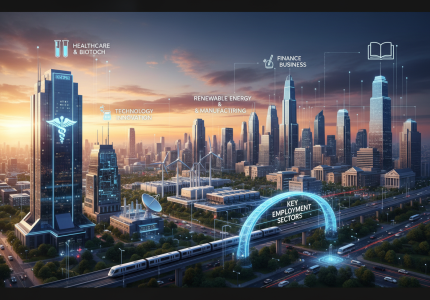
And that transformation is creating opportunities across employment, higher education, entrepreneurship, investment, technology, finance, manufacturing, tourism, healthcare, logistics, sustainability and the wider knowledge economy.
So perhaps the conversation should not simply be:
“Abu Dhabi or Dubai?”
The more important question is:
“Where do I fit into the future they are building?”
FROM FINDING A JOB TO FINDING YOUR POSITION
For an earlier generation, moving to the Gulf often meant one primary objective:
Find a job.
That model is changing.
Today, people can enter an economy through several different doors:
STUDY → WORK → BUILD → INVEST
And these pathways do not have to remain separate.
A student can study, gain experience and eventually build a company.
A professional can work, develop expertise and later become an entrepreneur.
An entrepreneur can build a company and attract investment.
An investor can identify an emerging sector and participate in its growth, subject to the applicable regulations, risks and due diligence.
The future economy is therefore not simply creating jobs.
It is creating an ecosystem of participation.
1. STUDY — BUILD THE CAPABILITY BEFORE CHASING THE OPPORTUNITY
Education remains one of the strongest ways to prepare for the future.
But the question is no longer simply:
“Which degree should I study?”
A better question is:
“Which capability will this education help me build?”
Abu Dhabi and Dubai are expanding their economies around sectors that require specialised knowledge and practical skills.
These include:
- Artificial intelligence
- Data science
- Cybersecurity
- Engineering
- Advanced manufacturing
- Energy and sustainability
- Healthcare and life sciences
- Finance and FinTech
- Logistics and supply chain
- Tourism and hospitality
- Digital business
- Entrepreneurship
- Research and innovation
This creates an important opportunity for international students.
Instead of choosing an education simply because a degree sounds attractive, examine the relationship between:
Degree → Skills → Industry → Experience → Career
A degree should become a platform for capability.
Ask yourself:
- What industries are expanding?
- What skills will those industries need?
- Which universities and programmes provide practical exposure?
- Can I obtain internships or industry projects?
- Can I build a portfolio while studying?
- Will my skills remain relevant as technology changes?
The objective should not simply be to graduate.
The objective should be to become useful to a growing economy.
2. WORK — ENTER THROUGH SKILLS, NOT HOPE
Employment will remain one of the biggest opportunity pathways.
But competition will also increase.
As Abu Dhabi and Dubai become more technology-driven, internationally connected and specialised, employers will increasingly need people who can contribute from the beginning.
That means the future candidate cannot rely only on:
“I have a degree.”
A stronger proposition is:
“I have a professional qualification, relevant digital skills, industry knowledge and evidence that I can perform.”
This is where the hybrid professional becomes increasingly important.
Think about the difference:
Accountant + Analytics
Engineer + AI
Marketer + Data + AI
Hospitality Professional + Revenue Technology
Healthcare Professional + Digital Health
Finance Professional + FinTech
Supply Chain Professional + Data
The future does not necessarily require you to abandon your profession.
It may require you to upgrade it.
ABU DHABI: A DIFFERENT EMPLOYMENT OPPORTUNITY MAP
Abu Dhabi’s economic transformation is increasingly visible beyond hydrocarbons.
Official economic data shows that non-oil activities accounted for 54.7% of Abu Dhabi’s total GDP in 2024, while the emirate continues developing advanced manufacturing, technology, space, renewable energy, healthcare, financial services, logistics and other sectors.
The industrial economy is also expanding, with industrial exports reaching AED 262 billion in 2025, including AED 92 billion in medium- and high-technology exports.
These are more than economic statistics.
They indicate the kinds of capabilities a changing economy increasingly needs.
For professionals, this can create opportunities in areas such as:
- Advanced engineering
- Manufacturing
- Industrial technology
- Energy transition
- AI and advanced computing
- Financial services
- Healthcare and biotechnology
- Logistics
- Tourism
- Infrastructure
- Research and innovation
This means Abu Dhabi’s emerging economy is not only creating opportunities for traditional professionals.
It is increasingly creating opportunities for people who can connect traditional industries with new technology.
That intersection may become one of the most important career spaces of the next decade.
DUBAI: THE GLOBAL CITY OPPORTUNITY
Dubai’s opportunity map is different.
Dubai 2040 focuses strongly on the future development of the city, while the wider economic agenda—including the Dubai Economic Agenda D33—aims to expand economic scale, competitiveness, business activity and international connectivity.
Dubai’s opportunity ecosystem therefore spans:
- International business
- Trade
- Tourism
- Aviation
- Finance
- Real estate
- Technology
- Entrepreneurship
- Hospitality
- Logistics
- Creative industries
- Professional services
- Digital economy
- Urban development
Dubai is particularly interesting for people who want to operate in an internationally connected business environment.
The city increasingly functions as a platform connecting:
Businesses + Capital + Talent + Consumers + Global Markets
That creates opportunities for professionals who understand international business—not simply their own profession.
3. BUILD — FROM EMPLOYEE TO ENTREPRENEUR
This may become one of the biggest changes in the opportunity landscape.
The question for the next generation will not always be:
“Which company will hire me?”
Sometimes the better question will be:
“What problem can I solve?”
Both Abu Dhabi and Dubai are developing entrepreneurial ecosystems designed to attract founders, startups, technology companies and international businesses.
Abu Dhabi’s Hub71 ecosystem, for example, reported that startups within its community had raised more than US$2.7 billion and generated approximately US$1.5 billion in revenue by the end of 2025.
In 2025 alone, Hub71 startups raised approximately US$599 million.
And international entrepreneurs are already participating in this ecosystem.
Hub71’s 2026 Cohort 18 received 2,453 applications from 112 countries, with all 27 selected startups headquartered outside the UAE at the time of selection.
The message for international founders is powerful:
You do not necessarily have to be born in an ecosystem to participate in it.
But entrepreneurship is not a shortcut.
A business still has to move through:
Problem → Product → Customer → Revenue → Execution → Capital
A good location cannot rescue a weak business model.
WHAT COULD YOU BUILD?
The opportunity is not limited to technology startups.
Technology
AI, cybersecurity, SaaS, data, automation and digital platforms.
Healthcare
HealthTech, biotechnology, medical services and healthcare solutions.
Energy
Clean technology, energy efficiency, sustainability and industrial solutions.
Tourism
Travel technology, experiences, hospitality solutions and destination services.
Logistics
Supply-chain technology, warehousing, transportation and trade solutions.
Education
EdTech, professional training, skill development and lifelong learning.
Finance
FinTech, financial infrastructure, wealth technology and business services.
Industry
Manufacturing technology, industrial services, engineering and supply-chain solutions.
But some of the most interesting opportunities may appear between sectors.
AI + Healthcare
AI + Finance
Technology + Tourism
Technology + Manufacturing
Education + Technology
Energy + Technology
Finance + Entrepreneurship
The next generation of businesses may not fit neatly into one industry.
They may exist at the intersection of several.
4. INVEST — PARTICIPATE IN THE GROWTH
Investment is the fourth pathway.
But this is also where people need the greatest discipline.
Investment should never be presented as:
“Come here and make money.”
The better question is:
“What is growing, why is it growing, what risks exist, and does the opportunity fit my objectives?”
Abu Dhabi and Dubai are developing investment opportunities across multiple areas, including:
- Businesses
- Startups
- Financial markets
- Real estate
- Infrastructure
- Technology
- Manufacturing
- Tourism
- Healthcare
- Energy
- Logistics
Abu Dhabi’s financial ecosystem is expanding rapidly.
ADGM reported more than 13,000 active licences by Q1 2026, alongside significant growth in assets under management, funds and financial institutions.
The emirate is also developing major infrastructure and public-private partnership opportunities.
Dubai, meanwhile, continues to strengthen its global financial and business ecosystem, with institutions such as DIFC playing an important role.
For investors, therefore, the strategic question is not simply:
“Where should I buy?”
It is:
“Which sectors are being built for the next decade?”
Opportunity and risk must always be considered together.
THE FOUR PATHWAYS ARE CONNECTED
This is where the opportunity becomes particularly interesting.
Imagine a 20-year-old student.
Year 1
Studies AI, engineering, finance, healthcare or another future-facing discipline.
Year 2
Builds projects and develops practical skills.
Year 3
Completes an internship and begins building a professional network.
Year 4
Graduates and enters the workforce.
Years 5–8
Builds professional experience.
Years 8–12
Identifies a market problem.
Years 12–15
Starts a company.
Later
Builds the company, attracts investment and expands internationally.
The journey is no longer necessarily:
Study OR Work OR Business OR Investment
It can become:
STUDY → WORK → BUILD → INVEST
That is the potential of a future economy ecosystem.
ABU DHABI OR DUBAI?
There is no permanent winner.
And there does not need to be one.
The two cities are developing different strengths.
| Your Objective | Abu Dhabi | Dubai |
|---|---|---|
| Advanced industry | Strong | Growing |
| Energy & sustainability | Strong | Growing |
| Finance | Strong | Strong |
| Technology | Strong | Strong |
| Startups | Strong | Strong |
| Global business | Strong | Very strong |
| Tourism | Growing strongly | Very strong |
| Hospitality | Strong | Very strong |
| Logistics & trade | Strong | Very strong |
| Urban development | Major opportunity | Major opportunity |
| Research & innovation | Strong | Growing |
| International entrepreneurship | Strong | Very strong |
| Infrastructure | Major opportunity | Major opportunity |
This is not a ranking.
It is an orientation map.
The right destination depends on the person.
A student may find one ecosystem better aligned with a particular programme.
An engineer may find another better aligned with a particular industry.
An entrepreneur may need a different ecosystem from an investor.
And a business may eventually operate across both.
THE MOST VALUABLE INVESTMENT MAY BE YOURSELF
There is another investment that is often forgotten.
Human capital.
One person may spend years searching for a job while adding very little new capability.
Another person may spend the same period learning:
- AI
- Data
- Communication
- Industry knowledge
- Digital tools
- Business fundamentals
- Leadership
- Financial literacy
- Problem-solving
Over time, the second person may become far more valuable to an employer, customer, partner or investor.
That is why the future opportunity conversation should begin with:
Skills.
Not visas.
Not job titles.
Not salaries.
Not social-media promises.
Skills.
FOR STUDENTS: START BEFORE GRADUATION
If you are still studying, don’t wait until graduation to prepare for the market.
Build five things.
1. Academic Foundation
Understand your profession deeply.
2. Digital Capability
Learn the technologies transforming your industry.
3. Communication
Learn to explain your ideas clearly and confidently.
4. Practical Experience
Projects, internships, research, competitions, freelance work and portfolios can demonstrate what you can actually do.
5. Global Awareness
Understand where industries are moving and which economies are creating demand.
Your degree may open the door.
Your capability determines what happens after you enter.
FOR PROFESSIONALS: DON’T START AGAIN — ADD ANOTHER LAYER
An experienced professional does not necessarily need to restart their career.
They may simply need to add another layer.
An engineer does not necessarily need to become a programmer.
But learning automation, analytics or AI may significantly increase professional relevance.
A hospitality professional does not need to become a data scientist.
But understanding revenue analytics, digital distribution and AI can create a stronger profile.
A finance professional does not need to become a software engineer.
But understanding FinTech and data can create a powerful combination.
The principle is simple:
Don’t abandon your profession. Upgrade it.
FOR ENTREPRENEURS: SOLVE A PROBLEM FIRST
Before asking:
“How do I start a business in Abu Dhabi or Dubai?”
Ask:
“What problem am I solving?”
Then investigate:
- Market demand
- Competition
- Regulation
- Licensing
- Capital requirements
- Customer acquisition
- Partnerships
- Talent
- Technology
- Scalability
A business location should support the business model.
The business model should not exist simply because the location is attractive.
FOR INVESTORS: STUDY THE FUNDAMENTALS
Don’t invest because someone says:
“This market is booming.”
Study the fundamentals.
Ask:
- What is driving demand?
- What is the long-term strategy?
- What infrastructure is being developed?
- Which industries are receiving investment?
- What regulatory framework applies?
- What is the downside risk?
- What is the investment horizon?
- What due diligence is required?
There is no opportunity without risk.
The objective is not to eliminate risk.
It is to understand it before making a decision.
THE REAL OPPORTUNITY: BEING EARLY IN A CHANGING ECONOMY
Abu Dhabi and Dubai are already developed economies.
That is precisely what makes their transformation interesting.
The opportunity is not about waiting for development to begin.
It is about participating while new layers are being added.
Factories.
Financial centres.
Technology ecosystems.
Research.
Healthcare.
Tourism.
Infrastructure.
New urban districts.
Startups.
Digital businesses.
Global investment.
New skills.
New professions.
New consumer behaviour.
The economies are becoming more complex.
And complex economies need people who can solve increasingly complex problems.
A NEW GENERATION NEEDS A NEW STRATEGY
The next generation should not ask only:
“Where can I get a job?”
Ask:
“Which economy is creating demand for my skills?”
Don’t ask only:
“Which university should I attend?”
Ask:
“What capabilities will I graduate with?”
Don’t ask only:
“Which business should I start?”
Ask:
“Which problem can I solve better than others?”
Don’t ask only:
“Where should I invest?”
Ask:
“Which long-term economic transformation am I investing behind?”
These are bigger questions.
And potentially much more valuable ones.
ABU DHABI + DUBAI: TWO DIFFERENT VISIONS, ONE GLOBAL OPPORTUNITY
Abu Dhabi Economic Vision 2030 and Dubai 2040 are not identical plans.
They should not be.
Their histories are different.
Their economic structures are different.
Their development journeys are different.
Their urban priorities are different.
Their strengths are different.
Their ambitions are different.
And that difference is valuable.
Abu Dhabi is building a diversified future economy with major emphasis on industry, finance, technology, energy transition, healthcare, logistics, tourism and knowledge.
Dubai is continuing to build a globally connected city and business ecosystem around international commerce, tourism, finance, technology, entrepreneurship, urban development and connectivity.
These different visions can create complementary opportunities.
For the global individual, that means something important:
You do not necessarily have to choose between two competing stories.
You could study in one ecosystem.
Build experience in another.
Develop a business that operates across both.
Or invest according to where a particular opportunity makes sense for your objectives.
The question is not always:
“Which city wins?”
Sometimes the answer is:
“How can I participate in both?”
THE PAD OPPORTUNITY FRAMEWORK
At Plan Abu Dhabi, we believe opportunity should be understood through a simple chain:
ECONOMY
Where is the economy going?
↓
INDUSTRY
Which sectors are expanding?
↓
SKILLS
What capabilities will those sectors need?
↓
PEOPLE
Who can develop those capabilities?
↓
OPPORTUNITY
Where can they study, work, build or invest?
This is the bridge between economic vision and individual opportunity.
THE DECISION MATRIX
Before making a major move, ask yourself where you are today.
If you are young and building your foundation:
STUDY
Build knowledge + skills + experience.
If you already have professional capability:
WORK
Enter the market and continue upgrading.
If you have expertise and a strong business idea:
BUILD
Solve a problem and create value.
If you have capital and investment knowledge:
INVEST
Participate carefully in sectors and assets that fit your objectives.
And if you are ambitious enough?
You may eventually combine all four.
STUDY → WORK → BUILD → INVEST
THE REAL QUESTION
The future of Abu Dhabi and Dubai will not be created only by governments.
It will be created by:
Students who learn.
Professionals who adapt.
Entrepreneurs who build.
Investors who understand.
Companies that innovate.
Researchers who discover.
Workers who upgrade their skills.
And millions of people around the world who decide that they want to participate in the next chapter.
So perhaps the most important question is not:
“Should I choose Abu Dhabi or Dubai?”
It is:
“What can I become that the future economy will need?”
Because the greatest opportunity is not simply to arrive in a developed economy.
It is to arrive prepared enough to create value inside it.
THE PAD FUTURE ECONOMY FORMULA
EDUCATION
SKILLS
EXPERIENCE
ADAPTABILITY
ENTREPRENEURIAL THINKING
FINANCIAL AWARENESS
=
OPPORTUNITY
And that is where the real journey begins.
ABU DHABI 2030. DUBAI 2040.
Different visions.
Different strengths.
Different opportunities.
One message for the next generation:
DON’T WAIT FOR THE FUTURE.
PREPARE FOR IT.
The future economy is not something that will suddenly appear in 2030 or 2040.
It is being built today.
The industries are being built today.
The infrastructure is being built today.
The companies are being built today.
The technology is being developed today.
The skills are being demanded today.
And the people who will benefit most tomorrow may be the ones preparing themselves today.
Study.
Work.
Build.
Invest.
But whichever path you choose, understand the economy you are entering.
Because opportunity does not simply belong to the place you move to.
Opportunity belongs to the value you are capable of creating there.
Plan Abu Dhabi — Future Economy Series | 2026
Plan Abu Dhabi is an information and opportunity platform. Readers should independently verify current regulations, eligibility requirements, education options, employment conditions, licensing requirements and investment risks before making decisions.
The economy of tomorrow is being built today.
Your future should be built today too.