
Why Abu Dhabi and Dubai are building different futures — and why healthy competition could make the region stronger
Plan Abu Dhabi | Future Economy Series – Part 2
—
Two Cities. Two Visions. One Region.
When people talk about Abu Dhabi and Dubai, the conversation often becomes a competition.
Which city is better?
Where are salaries higher?
Where should you work?
Where should you invest?
Where should you study?
But perhaps we are asking the wrong question.
The more interesting question is:
Why are Abu Dhabi and Dubai building their futures differently?
Abu Dhabi and Dubai are not trying to become identical cities.
They have different histories.
Different economic foundations.
Different geographic characteristics.
Different development journeys.
Different cultural identities.
Different priorities.
Different generations to prepare for.
And different ideas about what their cities should look like in the future.
That is precisely what makes their development so interesting.
Abu Dhabi 2030 and Dubai 2040 should not be viewed as two competing plans. They are two different approaches to building the future.
—
Abu Dhabi: Building the Future from Strength
Abu Dhabi’s development story begins from a very different foundation.
Its economy has historically been strongly connected to energy and natural resources.
That provided enormous financial strength — but it also created a responsibility.
The question became:
How do you use today’s strength to build tomorrow’s diversified economy?
Abu Dhabi Economic Vision 2030 is therefore strongly focused on economic diversification, private-sector development, knowledge, innovation and building industries capable of competing globally.
The transformation can be seen in the growth of non-oil activities.
In 2024, non-oil sectors accounted for 54.7% of Abu Dhabi’s GDP, while the non-oil economy grew 6.2%.
That tells us something important.
Abu Dhabi is not abandoning its traditional strengths.
It is building new strengths around them.
Energy remains important.
But alongside energy we increasingly see:
– Advanced manufacturing
– Financial services
– Artificial intelligence
– Technology
– Healthcare
– Life sciences
– Tourism
– Logistics
– Space
– Renewable energy
– Entrepreneurship
Abu Dhabi’s approach can therefore be described as:
«Use the strength of today to build the economy of tomorrow.»
—
Dubai: Building a City for the Next Generation
Dubai’s story is different.
It did not build its global identity primarily around large oil reserves.
Instead, Dubai developed itself as a centre for:
– Trade
– Aviation
– Tourism
– Real estate
– Logistics
– Finance
– International business
– Entrepreneurship
Its location became an economic asset.
Its infrastructure became an economic asset.
Its international connectivity became an economic asset.
And its ability to attract people from around the world became another economic asset.
Dubai 2040 therefore focuses heavily on how the city itself should evolve.
The Dubai 2040 Urban Master Plan looks at urban development, quality of life, transportation, housing, economic centres, green areas and sustainable growth.
The objective is not simply to build more buildings.
It is to build a city capable of accommodating the next generation.
Dubai is essentially asking:
«What should one of the world’s most connected cities look like in 2040?»
That is a very different question from Abu Dhabi’s central economic-diversification challenge.
—
This Is Where Healthy Competition Becomes Powerful
Imagine two students preparing for the future.
One is studying engineering.
Another is studying business.
They don’t need to study the same subject to succeed.
In fact, their differences can make both stronger.
The same applies to Abu Dhabi and Dubai.
Abu Dhabi can push Dubai.
Dubai can push Abu Dhabi.
Competition can encourage:
– Faster innovation
– Better infrastructure
– Better services
– More investment
– Greater international connectivity
– Better business environments
– More attractive career opportunities
– Higher standards
– Greater efficiency
And ultimately, people and businesses benefit.
This is healthy competition.
Not rivalry.
—
Different History, Different Strategy
A city’s future cannot be separated from its history.
Abu Dhabi’s identity has been shaped by:
– Energy
– Natural resources
– Government institutions
– Large-scale development
– Cultural heritage
– Strong financial capacity
– Strategic planning
Dubai’s identity has been shaped by:
– Maritime trade
– Commerce
– Entrepreneurship
– International migration
– Aviation
– Tourism
– Real estate
– Global business
Their development strategies naturally reflect those histories.
Abu Dhabi asks:
How can we diversify and build globally competitive industries?
Dubai asks:
How can we continue developing one of the world’s most connected and attractive cities?
Both questions are important.
—
Different Stages of Development
Another important difference is the stage of development.
Abu Dhabi has enormous land resources and a relatively lower population density compared with Dubai.
This provides opportunities for large-scale industrial, energy, infrastructure and technology projects.
Dubai, meanwhile, has developed into a densely connected global metropolitan economy.
Its challenge is therefore different:
How do you continue growing while making the city more sustainable, liveable, connected and efficient?
This is one reason Dubai 2040 places so much emphasis on urban planning.
The city needs to accommodate future growth without losing the qualities that made it successful.
—
Heritage and Modernisation Can Exist Together
One of the most fascinating aspects of both cities is that modernisation does not necessarily mean abandoning heritage.
Abu Dhabi continues to develop major cultural and heritage destinations alongside its modern economic ambitions.
Dubai, meanwhile, continues to preserve and promote areas connected to its historic trading and maritime identity while building a highly modern global city.
This creates an important lesson for the next generation:
Progress does not have to mean forgetting the past.
A successful future can be built by combining:
Heritage + Innovation
Culture + Technology
Tradition + Entrepreneurship
Identity + Globalisation
This balance will become increasingly important as cities around the world compete for talent, investment and visitors.
—
The New Generation Is Changing the Question
Previous generations often asked:
«Where can I find a good job?»
The new generation increasingly asks:
«Where can I build my career?»
«Where can I learn?»
«Where can I create a company?»
«Where can I innovate?»
«Where can I live well?»
«Where can I connect with the world?»
This changes how cities must compete.
A young technology professional may care about startup ecosystems.
A university student may care about education and research.
An entrepreneur may care about access to capital.
A family may care about schools, healthcare and quality of life.
An investor may care about infrastructure and market access.
A hospitality professional may care about tourism growth.
Therefore, there is no single definition of the “best” city.
The right city depends on the opportunity you are looking for.
—
Abu Dhabi and Dubai Are Creating Different Opportunity Maps
This is where the difference becomes particularly useful.
Abu Dhabi’s Opportunity Map
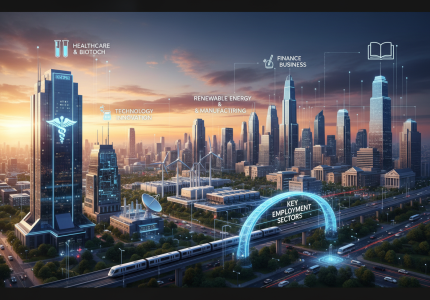
Abu Dhabi’s economic transformation creates strong opportunities around:
Energy & Energy Transition
Advanced Manufacturing
AI & Technology
Finance
Healthcare & Life Sciences
Logistics
Space
Infrastructure
Tourism
Research & Innovation
The emirate’s economic diversification strategy is increasingly creating opportunities across both traditional and emerging sectors.
—
Dubai’s Opportunity Map
Dubai’s future is strongly connected with:
International Business
Tourism
Aviation
Real Estate
Finance
Logistics
Technology
Entrepreneurship
Retail
Hospitality
Creative Industries
Urban Development
Dubai’s 2040 planning framework adds another dimension: the city itself is becoming an important part of the economic strategy.
—
And There Is Another Important Difference: Time
Abu Dhabi’s headline economic milestone is 2030.
Dubai’s urban planning horizon is 2040.
But these dates should not be interpreted as finish lines.
A vision is not:
«“We will build everything by this date.”»
It is more like:
«“This is the direction in which we want our economy and society to move.”»
The years provide milestones.
The transformation continues beyond them.
—
What Happens When Two Different Visions Grow Side by Side?
Something interesting can happen.
Abu Dhabi may become increasingly strong in areas such as:
Industry + Energy + Technology + Finance + Research
while Dubai continues to strengthen:
Business + Tourism + Aviation + Trade + Real Estate + Global Connectivity
But there will also be enormous overlap.
Both will need:
– AI specialists
– Engineers
– Healthcare professionals
– Financial experts
– Entrepreneurs
– Data scientists
– Cybersecurity specialists
– Hospitality professionals
– Project managers
– Skilled technicians
– Researchers
– Educators
That creates a larger regional opportunity ecosystem.
—
For Workers: Don’t Choose a City Before Choosing a Career
This is one of the biggest messages Plan Abu Dhabi should give young professionals.
Don’t start with:
«“Should I go to Abu Dhabi or Dubai?”»
Start with:
«“What do I want to become?”»
Then ask:
Which industry is growing?
Which city has the stronger ecosystem for that industry?
What qualifications do I need?
What skills are employers looking for?
What experience should I build before coming?
This approach is much more powerful than simply chasing vacancies.
—
For Students: Choose the Future, Not Just the Degree
The same applies to higher education.
A student shouldn’t simply choose:
«“I want a degree in business.”»
The better question is:
«“Which part of the future economy do I want to participate in?”»
Business + AI?
Finance + Data?
Engineering + Automation?
Healthcare + Technology?
Hospitality + Digital Transformation?
Energy + Sustainability?
These combinations may become increasingly valuable.
The future belongs not only to specialists.
It belongs to people who can connect different disciplines.
—
For Entrepreneurs: Look for Problems, Not Just Markets
The next generation of entrepreneurs should also think differently.
Abu Dhabi and Dubai are developing rapidly.
Rapid development creates problems that need solutions.
And problems create businesses.
For example:
– Smart-city solutions
– AI applications
– Logistics technology
– Sustainable construction
– Healthcare technology
– Education technology
– Tourism technology
– Financial technology
– Food technology
– Energy efficiency
– Digital services
The entrepreneur who understands the direction of development can identify opportunities before they become obvious.
—
For Investors: Understand the Strategy Behind the Project
A new building is not automatically an investment opportunity.
A new hotel is not automatically a good investment.
A new technology company is not automatically successful.
Investors need to understand:
Why is this project being developed?
What larger strategy does it support?
Who will use it?
What demand will support it?
What are the risks?
What is the regulatory environment?
Understanding Abu Dhabi 2030 and Dubai 2040 can therefore help investors understand the larger economic context before evaluating individual opportunities.
—
The Real Competition Is Global
Perhaps the most important point is this:
Abu Dhabi and Dubai are not ultimately competing only with each other.
They are competing with:
Singapore
London
New York
Hong Kong
Riyadh
Doha
Mumbai
Tokyo
Shanghai
and many other cities for:
– Talent
– Capital
– Companies
– Entrepreneurs
– Students
– Tourists
– Researchers
– Global events
That changes the meaning of competition.
If Abu Dhabi becomes stronger, the region benefits.
If Dubai becomes stronger, the region benefits.
If both improve their ecosystems, the region becomes more competitive globally.
—
Two Visions. Many Ideas. One Future.
Abu Dhabi and Dubai don’t need to become the same city.
In fact, they shouldn’t.
The strength lies in their differences.
Abu Dhabi can continue building from its energy, financial strength, land, culture and strategic investment.
Dubai can continue building from its trading heritage, international connectivity, entrepreneurship and urban dynamism.
And both can embrace:
Artificial Intelligence
Sustainability
Innovation
Education
Research
Entrepreneurship
Global talent
New industries
The result could be something much bigger than two successful cities.
It could be a regional ecosystem where different strengths complement each other.
—
Plan Abu Dhabi’s View
At Plan Abu Dhabi, we don’t believe the future should be presented as:
Abu Dhabi vs Dubai
We believe the more useful question is:
Abu Dhabi AND Dubai — what can the future offer?
Two visions.
Different histories.
Different cultures.
Different development stages.
Different priorities.
Different opportunities.
But one rapidly changing region.
For a young professional, student, entrepreneur or investor, that difference is not a problem.
It is an opportunity.
Because when two ambitious cities build different futures side by side, they create more ideas, more choices and potentially more opportunities for the people who are prepared to participate.