
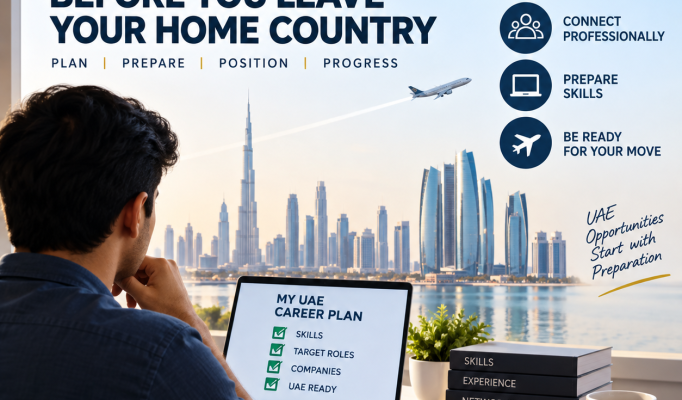
A Complete 6-Month Preparation Framework for International Candidates
If you are planning to build a career in the UAE, the journey should not begin when you land at Dubai International Airport or arrive in Abu Dhabi. It should begin much earlier—ideally several months before you leave your home country.
For an international professional, moving to the UAE is not simply a change of location. It is a career decision, financial decision and personal transition that requires preparation.
Many people start searching for jobs in UAE only after arriving. They then discover that they need more time to understand the market, improve their CV, build professional connections, arrange documentation, manage accommodation and control their expenses.
A more practical approach is to use the six months before relocation as a preparation period.
The goal is not to guarantee a job before travelling. No genuine career strategy can guarantee that. The goal is to arrive in the UAE with a clearer professional direction, stronger skills, better financial preparation, organised documents and a professional network that has already started growing.
—
H2 — WHY SIX MONTHS CAN MAKE A DIFFERENCE
Six months may seem like a long time, but it can disappear quickly when you are preparing for an international career move.
Instead of treating those months as a countdown to departure, think of them as the beginning of your UAE career strategy.
During this period, you can study the UAE job market, identify your target industry, understand what employers are looking for, strengthen your professional profile, develop relevant skills, learn basic AI and digital tools, build your LinkedIn presence and start networking with professionals in your field.
At the same time, you can prepare your finances, documents and personal arrangements so that your relocation does not depend entirely on finding a job immediately.
This preparation gives you something extremely valuable:
time to make better decisions.
—
H2 — MONTH 6: START WITH YOUR CAREER, NOT YOUR SUITCASE
The first step is to decide what you are actually going to the UAE to do.
This sounds obvious, but it is one of the most important parts of the process.
If you simply search for “jobs in Dubai” or “jobs in Abu Dhabi”, you can quickly find hundreds or thousands of vacancies. The problem is deciding which ones are genuinely relevant to you.
Start with your industry, profession, experience and career level.
You may be an engineer looking for project-management opportunities, a hospitality professional targeting hotel operations, a finance professional looking for accounting or financial roles, or a technology professional interested in data, software, AI or cybersecurity.
Your first objective should therefore be to establish a clear professional direction.
Once you know your direction, researching the UAE becomes much easier.
—
H2 — UNDERSTAND THE UAE JOB MARKET BEFORE YOU ENTER IT
The next stage is market research.
Spend time understanding where your profession fits within the UAE economy and which companies regularly employ people with your background.
Look at Dubai and Abu Dhabi separately.
Study company career pages, professional networks and job descriptions. Read multiple vacancies for similar positions rather than relying on one advertisement.
You may begin to notice recurring requirements.
Perhaps employers repeatedly mention a particular software platform. Perhaps a professional certification appears again and again. Perhaps employers are looking for people with experience in a particular industry, project environment or technology.
These recurring requirements provide useful information.
They tell you what the market is asking for—and therefore what you may need to strengthen before you arrive.
This is where a UAE job search becomes more strategic.
You are no longer asking only:
«“Where are the vacancies?”»
You are also asking:
«“What are UAE employers repeatedly looking for in people like me?”»
—
H2 — FINANCIAL PREPARATION SHOULD BEGIN EARLY
A career move to another country should never be based on the assumption that employment will happen immediately.
Your financial preparation should therefore begin alongside your career preparation.
Create a realistic relocation budget that considers your expected travel costs, accommodation, food, transportation, communication, professional expenses and emergency requirements.
Your personal situation will determine how much money you need, so there is no single amount that applies to every international candidate.
The important principle is to create sufficient financial runway for your job search.
If your savings can support you for only a very short period, you may feel pressured to accept the first opportunity available—even if the role, salary or working conditions are not suitable for your career.
Financial planning therefore provides more than security.
It can provide career choice.
A candidate with reasonable financial preparation has more opportunity to evaluate an employment offer carefully instead of making a decision purely because of immediate financial pressure.
—
H2 — DOCUMENTATION: PREPARE BEFORE THE LAST MONTH
Documentation is another area where early preparation can save considerable time.
Your important professional documents should be organised before you travel.
These may include your passport, educational certificates, professional certifications, experience letters, employment records, training certificates, professional references and portfolio or work samples, where relevant.
Keep secure digital copies of important documents as well.
Some professions may involve additional requirements such as professional licensing, document verification, attestation or equivalency.
These requirements can differ depending on the profession and the relevant authority.
A healthcare professional, engineer, teacher and other regulated professional may not follow the same process.
Therefore, do not wait until your departure date to discover that an important document needs additional preparation.
Research the requirements for your profession and target employment market early.
—
H2 — HEALTH AND PERSONAL READINESS ARE PART OF CAREER PREPARATION
An international career move is not only a professional exercise.
Your personal readiness matters too.
Before relocation, consider completing appropriate routine health checks, organising regular healthcare requirements and keeping important medical records and prescriptions accessible.
If you regularly use medication, check the current UAE requirements for carrying that medication into the country and obtain supporting documentation where necessary.
You should also consider practical matters such as insurance arrangements, emergency contacts and access to important personal documents.
The objective is not to create unnecessary anxiety.
It is simply to make sure that your health and personal preparation are not left until the last moment.
A career plan works better when the person behind the plan is prepared too.
—
H2 — MONTH 5: BUILD YOUR PROFESSIONAL IDENTITY
By the fifth month, your attention should increasingly move toward your professional presentation.
Your CV, LinkedIn profile and professional introduction should tell the same story.
If your CV presents you as a finance professional but your LinkedIn profile looks like a general job-seeker profile, an employer may struggle to understand your professional direction.
Think about what you want a recruiter or hiring manager to understand within the first few seconds of seeing your profile.
Who are you professionally?
What industry do you work in?
What experience do you bring?
What are your strongest skills?
What type of role are you targeting?
The objective is not to make your profile sound impressive through complicated language.
It is to make your professional value clear.
—
H2 — LINKEDIN SHOULD BECOME PART OF YOUR UAE CAREER PLAN
Your LinkedIn profile should ideally be prepared months before you travel.
Do not wait until you reach Dubai or Abu Dhabi and then start building your online professional presence.
Your profile should contain a clear professional headline, a useful About section, properly described employment experience, relevant skills, education, certifications and significant achievements.
More importantly, your profile should reflect the type of professional you want to be seen as.
Instead of presenting yourself simply as:
“Looking for a job in UAE,”
present your actual professional identity.
For example, a hospitality professional can position themselves around hotel operations, guest experience and team management.
An engineer can communicate their experience around engineering, project delivery and technical expertise.
A technology professional can highlight software, data, cloud, cybersecurity or AI-related capabilities, depending on their actual experience.
Your LinkedIn profile is not a replacement for a CV.
It is part of your wider professional identity.
—
H2 — BUILD YOUR NETWORK BEFORE YOU NEED IT
Networking should also begin before relocation.
Start identifying professionals working in your target industry and in the UAE.
This may include recruiters, HR professionals, hiring managers, industry specialists, company employees, professional associations and alumni connections.
But networking should not begin with a request for employment.
Sending a stranger a message saying “Please give me a job” is unlikely to create a meaningful professional relationship.
Instead, begin by following relevant professionals, understanding their work, participating in useful conversations and learning about the industry.
Over time, your network can become a source of market information, professional insight and introductions.
The principle is simple:
«Build professional relationships before you need them.»
—
H2 — MONTH 4: START RESEARCHING TARGET EMPLOYERS
By this stage, you should begin creating a focused list of companies.
Instead of applying to every vacancy that appears online, identify organisations where your professional background could genuinely be relevant.
Study their businesses, industries, locations and career pages.
Look at the types of roles they recruit for and the skills they repeatedly request.
This process can help you understand the difference between simply searching for UAE jobs and researching the actual employers behind those jobs.
For someone targeting Dubai, this could mean studying companies across sectors such as technology, finance, hospitality, real estate, logistics, aviation and professional services.
For someone targeting Abu Dhabi, research could include organisations operating across areas such as energy, engineering, finance, healthcare, technology, infrastructure and advanced industries.
The objective is not to limit yourself to one city.
It is to understand where your career profile fits best.
—
H2 — MONTH 3: IDENTIFY YOUR SKILLS GAP
After several months of research, you should now have a clearer picture of what employers are asking for.
This is the right time to compare the market with your own profile.
Look at your existing skills, qualifications and experience and compare them with the recurring requirements you have identified in UAE vacancies.
Perhaps your technical skills are strong but your digital capabilities need development.
Perhaps your experience is good but you lack an important industry certification.
Perhaps you have the required technical background but need stronger communication, presentation or management skills.
This is your skills gap.
The purpose of identifying the gap is not to collect as many certificates as possible.
It is to concentrate your remaining preparation time on skills that can genuinely improve your professional value.
—
H2 — SKILLS DEVELOPMENT SHOULD BE PRACTICAL
A certificate can be useful, particularly where a qualification or professional certification is relevant to your industry.
But a certificate alone does not prove that you can perform a job.
Use the preparation period to develop skills that you can actually demonstrate.
If you are in marketing, strengthen areas such as digital marketing, analytics, content strategy and AI-assisted workflows.
If you work in finance, consider strengthening Excel, financial analysis, data tools or relevant financial systems.
If you are an engineer, focus on the technical tools, project-management capabilities and industry knowledge relevant to your target role.
If you work in hospitality, explore revenue management, customer-experience systems, hotel technology and operational leadership.
The best preparation is not necessarily the one that produces the largest collection of certificates.
It is the one that makes you more capable of doing the work.
—
H2 — AI BASICS ARE NOW PART OF CAREER PREPARATION
You do not need to become an AI engineer to begin understanding Artificial Intelligence.
Basic AI knowledge is becoming relevant to professionals across many industries.
The starting point should be simple.
Understand what Generative AI is, what common AI tools can do, where they can improve productivity, how AI-generated information should be checked and what the risks of using AI at work can be.
Then connect AI to your own profession.
A marketer can explore AI for research and content workflows.
A finance professional can explore AI-assisted analysis.
A hospitality professional can explore customer insights and operational applications.
An engineer can explore documentation, analysis and productivity applications.
The important question is not:
“Do I know AI?”
It is:
«“Do I understand how AI is changing the work I do?”»
That is the level of AI literacy every professional should begin developing.
—
H2 — MONTH 2: MOVE FROM PREPARATION TO TARGETED JOB SEARCH
With two months remaining, your preparation should begin moving toward active job applications in UAE.
Your CV should now be aligned with your target roles.
Your LinkedIn profile should be complete.
Your target-employer list should be developing.
Your professional network should be growing.
Your skills-development work should be visible in your professional story.
Now you can begin applying to relevant vacancies rather than waiting until you arrive.
The purpose is not to send hundreds of applications.
The purpose is to identify opportunities where your experience and skills genuinely match the employer’s requirements.
You should also begin preparing for interviews.
Research the companies you apply to and practise explaining your experience through real examples.
An employer will want to understand not only what you have done, but how you think, communicate, solve problems and contribute to an organisation.
—
H2 — MONTH 1: FINAL PREPARATION BEFORE YOU LEAVE
The final month should be about bringing everything together.
Your career strategy should be clear.
Your CV should be ready.
Your LinkedIn profile should be active.
Your important documents should be organised.
Your financial plan should be in place.
Your professional network should already exist.
Your target companies should be identified.
Your skills-development priorities should be clear.
Your basic AI knowledge should be developing.
And your job-search strategy should already be underway.
At this point, the objective is no longer to build everything from scratch.
It is to make sure that the preparation you started six months earlier is ready to travel with you.
—
H2 — THE SIX-MONTH UAE CAREER ROADMAP
The six months can therefore follow a simple progression.
Month 6: Decide your career direction and understand the UAE job market.
Month 5: Build your CV, LinkedIn profile and professional identity.
Month 4: Start networking and research target employers.
Month 3: Identify your skills gap and begin focused skills development and AI learning.
Month 2: Begin a targeted UAE job search, applications and interview preparation.
Month 1: Complete your financial, documentation, health and relocation preparation.
These activities should not be treated as isolated monthly tasks. They should continue to overlap.
Your networking continues.
Your LinkedIn continues.
Your skills development continues.
Your employer research continues.
Your job search gradually becomes more focused.
—
H2 — DON’T CONFUSE RELOCATION WITH CAREER PREPARATION
Buying a flight ticket is relocation preparation.
Building your professional identity is career preparation.
Finding accommodation is relocation preparation.
Understanding your target industry is career preparation.
Collecting documents is relocation preparation.
Developing the skills employers need is career preparation.
The two processes need to happen together.
Moving to the UAE without preparing your career can leave you trying to build everything at the same time.
Preparing before you leave allows you to separate the tasks and deal with them systematically.
—
H2 — THE PAD WAY OF THINKING ABOUT A UAE CAREER
PAD believes that an international career move should begin with information and preparation, not assumptions.
There is no guaranteed shortcut to employment.
There is no single CV that works for everyone.
There is no universal salary.
And there is no single city or industry that is right for every professional.
Your preparation should therefore begin with understanding your own career profile and then understanding where that profile fits within the UAE employment ecosystem.
Research first.
Prepare second.
Connect third.
Develop continuously.
Then make the move.
—
H2 — PAD ACTION PLAN
If the UAE is part of your future career plan, start six months before your intended relocation.
Begin by defining the profession and industry you want to target. Study the UAE job market and identify the employers that operate in your field. At the same time, prepare your CV and build a professional LinkedIn profile that clearly communicates your experience.
Then start networking with professionals and recruiters without making every interaction a request for a job.
Use the information you collect from the market to identify your skills gap. Invest the next few months in developing practical skills and building basic AI knowledge relevant to your profession.
Alongside all of this, create a realistic financial plan and organise your important documentation. Take care of appropriate health and personal preparations before departure.
By the final month, you should have a clear target, a professional profile, a growing network, relevant skills, organised documents and a realistic financial runway.
You may not have a job yet.
But you will have something important:
a plan.
—
H2 — THE FINAL PAD TAKEAWAY
The biggest mistake an international candidate can make is thinking that their UAE career begins when they arrive in the UAE.
It doesn’t.
It can begin six months earlier.
It begins when you decide what you want to do.
It develops when you understand the UAE employment market.
It becomes visible through your CV and LinkedIn profile.
It becomes stronger through networking and skills development.
It becomes more future-ready through AI and digital knowledge.
And it becomes sustainable through financial and personal preparation.
You cannot control when an employer will say yes.
But you can control how prepared you are when the opportunity arrives.
«DON’T ARRIVE IN THE UAE TO START PREPARING FOR YOUR CAREER.
PREPARE FOR YOUR UAE CAREER BEFORE YOU LEAVE HOME.»
—
PLAN ABU DHABI
WORK • STUDY • BUSINESS
PAD is an information platform providing research-driven information and awareness about opportunities connected with Abu Dhabi and the UAE.
PAD is not a recruitment, placement, visa or business agency.
Disclaimer: Information relating to employment, immigration, documentation, health, finance and UAE regulations can change and may depend on individual circumstances. This article is intended for general awareness and career planning. Readers should verify current requirements with the relevant official authorities and qualified professionals before making decisions.