

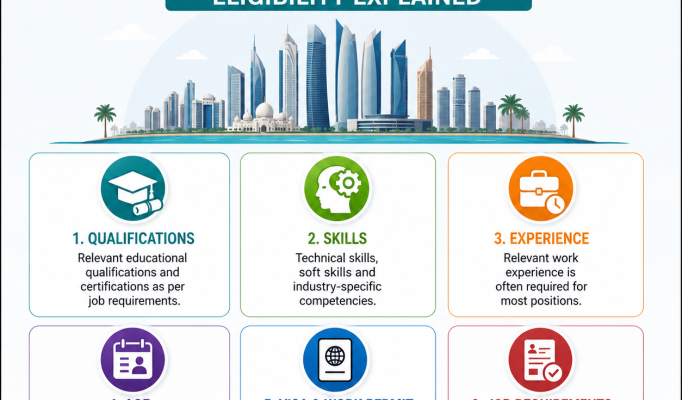
Who Can Work in Abu Dhabi? Eligibility Explained: Qualifications, Skills, Experience, Age, Visa & Job Requirements
Thinking about building a career in Abu Dhabi?
One of the first questions people ask is:
“Am I eligible to work in Abu Dhabi?”
The answer is not simply yes or no.
Thousands of professionals, skilled workers, fresh graduates and experienced employees from different countries compete for jobs in Abu Dhabi every day. But eligibility depends on several factors — including your age, qualifications, professional skills, experience, licensing requirements, visa/work-permit status and, most importantly, the requirements of the individual job.
This guide explains the eligibility picture in a simple and practical way.
«Important: Being legally allowed to work does not automatically mean you qualify for every job. You must satisfy both the UAE’s employment requirements and the employer’s requirements for the position.»
—
1. Who Can Work in Abu Dhabi?
Abu Dhabi’s workforce includes:
– UAE nationals
– GCC nationals
– Expatriate professionals
– Skilled workers
– Technicians
– Administrative and support staff
– Healthcare professionals
– Engineers
– IT and technology professionals
– Hospitality and tourism employees
– Construction workers
– Finance and accounting professionals
– Sales and marketing professionals
– Teachers and education professionals
– Drivers and logistics workers
– Other eligible foreign workers
For expatriates, however, there is an important legal requirement:
You must have the appropriate legal status and work permit to work.
The UAE Government states that working without the required work permit is illegal. For private-sector employment, the employer normally initiates the formal employment and work-permit process.
—
2. The First Eligibility Test: Are You Legally Allowed to Work?
Before thinking about your CV, salary or job title, understand the legal side.
For most expatriates seeking private-sector employment, the journey involves:
Job Offer
↓
Employment Contract
↓
Work Permit
↓
Residence/Work Visa Process
The UAE Government’s current guidance states that a formal job offer is part of the private-sector employment process, followed by the employment contract, work permit and work-visa procedures.
In simple words:
You cannot simply arrive in Abu Dhabi and start working for a company because you have found a vacancy.
The employment must go through the appropriate legal process.
—
3. Minimum Age: Can a Young Person Work?
For the standard work permit to an adult worker, the UAE Government states that the worker must generally be at least 18 years old.
There are separate permits and rules for younger workers, including juvenile and student training/employment permits under specific conditions.
Therefore:
18+
→ Standard employment route
Under 18
→ Only specific permitted categories and conditions may apply
For most international job seekers planning a conventional career in Abu Dhabi, the practical starting point is therefore 18 years or older.
—
4. Do You Need a University Degree?
No — not for every job.
This is one of the biggest misconceptions about working in Abu Dhabi.
A university degree can be essential for some professions, useful for others and unnecessary for certain skilled or operational roles.
Current Abu Dhabi listings across major job portals show opportunities at very different qualification and experience levels.
For example, live listings include roles for:
– Senior professionals
– Engineers
– Healthcare workers
– Administrative employees
– Technicians
– Drivers
– Hospitality workers
– Sales professionals
– IT professionals
– Entry-level/fresh graduate candidates
Think of qualifications in three broad categories:
Category A — Degree normally important
Examples:
– Engineers
– Accountants
– Finance professionals
– Doctors
– Nurses
– Teachers
– Lawyers
– Senior IT professionals
– Management professionals
Category B — Diploma/technical qualification may be sufficient
Examples:
– Technicians
– Skilled trades
– Certain hospitality positions
– Certain maintenance roles
– Technical support positions
Category C — Skills and experience may be more important
Examples can include:
– Drivers
– Some operational roles
– Certain sales positions
– Certain service positions
– Selected hospitality and support roles
But never assume.
Always check the exact vacancy.
—
5. Does Experience Matter?
Very often — and sometimes a lot.
This is where many international job seekers misunderstand the Abu Dhabi market.
A candidate may say:
«“I have the qualification.”»
But the employer may be asking:
«“Do you have the experience to perform this job?”»
Current Abu Dhabi vacancies demonstrate a very wide range of experience requirements.
Examples found across current listings include:
0–3 years
1–3 years
2–5 years
5–10 years
10+ years
depending on the role.
For example, current listings include junior roles alongside senior positions requiring extensive experience.
This creates a simple rule:
Qualification gets you considered.
Relevant experience gets you shortlisted.
Demonstrated results help you get selected.
—
6. Can Freshers Get Jobs in Abu Dhabi?
Yes — but the strategy is different.
A fresher should not compete for a job advertised for someone with five or ten years of experience.
Instead, search specifically for:
– Graduate roles
– Trainee positions
– Internships
– Junior positions
– Entry-level roles
– Assistant positions
– Graduate development programmes
Major job portals do list entry-level and fresh-graduate opportunities, although the number of such positions is naturally smaller than the total market.
Fresher formula:
Education + Skills + Internship/Project + Communication + Professional CV + Right Targeting
A fresher should focus on becoming job-ready, not simply “degree-ready.”
—
7. Can Experienced Professionals Work in Abu Dhabi?
Absolutely.
In fact, experienced professionals form a major part of Abu Dhabi’s recruitment market.
Current recruitment listings from firms such as Michael Page and Robert Walters show opportunities across:
– Finance
– Banking
– Technology
– Human Resources
– Engineering
– Energy
– Construction
– Healthcare
– Property
– Sales & Marketing
– Legal
– Public-sector related organisations
– Management and executive roles
For senior professionals, however, the competition is also stronger.
A senior candidate is not competing only on:
Years of experience
but increasingly on:
Relevant experience + leadership + industry knowledge + measurable achievements + technical capability + regional/international exposure.
—
8. Do You Need UAE Experience?
Not always.
This is another major misconception.
There are Abu Dhabi vacancies that accept or seek candidates with international experience. Recruitment firms such as Michael Page explicitly work with candidates from the GCC and around the world, while Robert Walters states that it recruits professionals across a wide range of disciplines for Abu Dhabi.
However, some employers specifically mention:
– UAE experience
– GCC experience
– Abu Dhabi experience
– Local market knowledge
– UAE driving licence
– Knowledge of UAE regulations
So the correct answer is:
«UAE experience is not a universal legal requirement, but it can be a strong employer preference for particular roles.»
—
9. Skills Can Matter as Much as Qualifications
A degree alone does not make a candidate job-ready.
Recruiters increasingly look at the combination of:
Hard Skills
Technical knowledge specific to your profession.
Soft Skills
– Communication
– Teamwork
– Problem-solving
– Adaptability
– Leadership
– Time management
Digital Skills
Depending on the profession:
– Microsoft Office
– Data analysis
– CRM
– ERP
– AI tools
– Cloud technologies
– Digital marketing
– Industry-specific software
Robert Walters’ career guidance highlights the importance of auditing and balancing hard and soft skills when preparing for employment.
Michael Page similarly advises candidates to demonstrate their skills and experience clearly and to make their CV relevant to the role.
—
10. Professional Licensing: The Hidden Eligibility Requirement
Some careers have an additional layer.
You may have:
Degree + Experience
and still not be legally permitted to practise the profession until you obtain the relevant approval or licence.
This is particularly important in regulated professions.
Examples include certain:
– Healthcare professionals
– Teachers
– Engineers or regulated technical professions, depending on the role
– Legal professions
– Other licensed occupations
The UAE Government specifically notes that some sensitive professions require local professional examinations or approval from the relevant authority.
Therefore ask:
“Is my profession regulated?”
If yes:
“Which Abu Dhabi authority regulates it?”
“Do I need a licence?”
“Do I need an exam?”
“Do my qualifications need attestation or recognition?”
This check should happen before you spend months applying.
—
11. Do Foreign Educational Certificates Need Attestation?
For expatriates, educational documentation can become important during employment and work-permit processing.
The UAE Government states that degree certificates obtained outside the UAE need to be attested, and its employment guidance also notes that authenticated academic qualifications may be required depending on the job level.
Don’t wait until the last minute.
If your profession depends heavily on your qualification, organise your documents early.
Keep:
– Degree certificate
– Diploma
– Mark sheets/transcripts where relevant
– Experience certificates
– Professional certificates
– Passport
– Other profession-specific documents
in an organised digital and physical file.
—
12. Does English Matter?
In many Abu Dhabi workplaces, yes.
But there is no single rule saying that every worker must have a particular English score.
The actual requirement depends on:
– Job
– Employer
– Industry
– Customer interaction
– Seniority
– Job responsibilities
For example, communication expectations can be very different for:
Software Engineer
versus
Hotel Front Office Executive
versus
Construction Technician
versus
Healthcare Professional
Some jobs may additionally require Arabic or another language.
Current Abu Dhabi listings demonstrate this variation; for example, some administrative/academic roles specifically mention Arabic and English proficiency.
The practical rule:
If your job requires communication, your communication ability becomes part of your employability.
—
13. Do You Need a Driving Licence?
Only when the job requires it.
A driving licence is not a universal requirement for working in Abu Dhabi.
But for:
– Drivers
– Field sales
– Certain logistics roles
– Site-based jobs
– Some technical service roles
– Certain field operations
it can become an essential requirement.
Current Abu Dhabi job listings show driver roles requiring specific driving experience and, in some cases, a valid UAE driving licence.
Never assume:
“I can drive” = “I qualify for a driving job.”
The employer may require:
specific licence category + experience + local driving knowledge + other conditions.
—
14. Can Women Work in Abu Dhabi?
Yes.
Women work across Abu Dhabi’s professional and business sectors, including:
– Healthcare
– Education
– Hospitality
– Aviation
– Finance
– Technology
– Retail
– Marketing
– Government-related organisations
– Professional services
– Entrepreneurship
The important question is not simply gender.
It is:
Does the candidate meet the requirements of the position and applicable employment rules?
Job portals also feature vacancies specifically open to female candidates as well as general vacancies.
—
15. Can People From Outside the UAE Apply?
Yes.
International recruitment is a normal part of Abu Dhabi’s employment market.
Recruitment firms such as Michael Page state that they source candidates from the GCC and around the world, while Robert Walters describes its Abu Dhabi operation as placing professionals across multiple industries.
But there is a major difference between:
Applying from outside Abu Dhabi
and
Being legally employed in Abu Dhabi
You may apply from your home country.
If selected, the employer must complete the appropriate employment and work-permit process.
—
16. Can Someone Already in Abu Dhabi Change Jobs?
Yes, but the legal process still matters.
The UAE Government states that the same basic job-offer procedures apply to workers already in the country who are seeking new employment or moving between companies.
Your current visa/status, existing employment relationship and work-permit circumstances can affect the process.
Therefore:
Never resign, cancel a visa or start another job based only on a verbal promise.
Get the formal employment process properly documented.
—
17. What Do Abu Dhabi Recruiters Actually Look For?
This is where our research across job portals and recruitment agencies becomes particularly useful.
Across current Abu Dhabi vacancies and recruiter guidance, the same broad themes repeatedly appear:
1. Relevant qualifications
Not necessarily the highest qualification.
The right qualification.
2. Relevant experience
Not simply the number of years.
Relevant experience.
3. Technical capability
Can you actually perform the job?
4. Communication
Can you explain your knowledge and work effectively?
5. Industry knowledge
Do you understand the environment in which you will work?
6. Professional presentation
Is your CV clear and credible?
7. Evidence of achievement
Can you demonstrate what you have actually delivered?
8. Adaptability
Can you work in a multicultural and changing environment?
9. Availability and location
Depending on the vacancy, employers may prefer candidates already in Abu Dhabi/UAE or those able to relocate.
10. Legal eligibility
Can the employer legally employ you for the position?
Michael Page’s Middle East recruitment guidance specifically recommends proactive job searching, a properly checked CV, networking/referrals and strong interview preparation.
—
18. The “5-Layer Eligibility Test”
Plan Abu Dhabi recommends that every candidate perform this test before applying.
LAYER 1 — LEGAL
Can I legally be employed in Abu Dhabi?
↓
LAYER 2 — EDUCATION
Do I have the required qualification?
↓
LAYER 3 — EXPERIENCE
Do I have the required relevant experience?
↓
LAYER 4 — SKILLS
Can I actually perform the job?
↓
LAYER 5 — PROFESSIONAL
Can I demonstrate my value through my CV, LinkedIn profile, interview and achievements?
If all five are strong:
You are becoming a serious candidate.
—
19. The Job Advertisement Is Your Real Eligibility Test
This is perhaps the most important lesson in this entire article.
Don’t ask:
«“Can Indians work in Abu Dhabi?”»
Ask:
«“Do I meet the requirements of this particular vacancy?”»
For every vacancy, create a simple checklist.
Requirement| My Status
Education|  /
/ 
/ Experience| /
/ Technical skills| /
/ Language| /
/ Certification| /
/ Licence| /
/ Location requirement| /
/ Availability| /
/ Work authorisation| /
/ Then decide:
 Strong Match
Apply.
 Partial Match
Apply if your transferable skills are strong and the missing requirement is not mandatory.
 Poor Match
Don’t waste your time.
Move to a better opportunity.
—
20. Don’t Apply Because the Job Title Sounds Attractive
This is a common mistake.
Suppose you see:
Project Manager — Abu Dhabi
Don’t immediately apply.
Read the requirements.
The employer may want:
– 10+ years’ experience
– Specific engineering background
– PMP
– Major project experience
– Oil & gas experience
– Leadership experience
– Knowledge of specific standards
If you don’t have these, the attractive job title doesn’t make you eligible.
Remember:
Job title attracts you.
Job description qualifies you.
—
21. What Major Job Portals Tell Us About Abu Dhabi’s Market
Our review of major job platforms shows something very important:
There is no single “Abu Dhabi candidate”.
The market ranges from entry-level roles to highly specialised executive positions.
“Bayt’s Abu Dhabi jobs section” (https://reference-url-
“GulfTalent’s Abu Dhabi jobs section” (https://reference-url-
“Naukrigulf’s Abu Dhabi jobs section” (https://reference-url-
Recruitment firms reinforce the same picture. “Michael Page Abu Dhabi jobs” (https://reference-url-
—
22. Who May Face Additional Eligibility Requirements?
Some candidates need additional checks.
Healthcare professionals
May require professional licensing/approval and examinations depending on the profession.
Teachers
May need the appropriate educational qualifications and approvals depending on the employer and role.
Engineers and technical professionals
Certain positions may require specific qualifications, professional registrations, certifications or project experience.
Drivers
Need the appropriate driving licence for the vehicle/job.
Regulated professions
May require approval from the relevant authority.
Certain professions restricted to UAE nationals
Some occupations have nationality-specific restrictions or requirements. The UAE Government specifically notes that certain professions, such as appearing before a judge as a lawyer, are restricted to UAE nationals.
—
23. A Word About Emiratisation
International candidates should understand that some private-sector employers have Emiratisation obligations and certain vacancies are specifically advertised for UAE nationals.
This does not mean expatriates cannot work in Abu Dhabi.
It means:
Always read the vacancy carefully.
If a vacancy says:
“UAE National”
that is a specific eligibility condition.
Current Abu Dhabi listings visibly include roles marked for UAE nationals.
Do not spend time applying for a vacancy when you clearly do not meet a mandatory nationality requirement.
—
24. What About Visa Sponsorship?
For an expatriate hired from outside the country, the employer generally initiates the formal employment/work-permit process.
The UAE Government states that the employer issues the official work offer and then applies for the relevant work permit after the offer is signed and registered through the prescribed process.
Important:
Do not confuse a visit/tourist status with permission to work.
Having permission to enter Abu Dhabi is not the same as having permission to work.
Working without the required work permit is illegal.
—
25. Who Is “Job-Ready” for Abu Dhabi?
Let’s make this extremely simple.
Candidate A
Degree:
Experience:
Skills: 
CV:
Communication:
Not yet job-ready.
Candidate B
Degree:
Experience:
Skills:
CV:
LinkedIn:
Interview preparation:
Job-ready candidate.
Candidate C
Degree:
Technical qualification:
Relevant experience:
Skills:
Licence where required:
Potentially job-ready for suitable skilled roles.
This is why:
«There is no single definition of a “qualified person” for every job in Abu Dhabi.»
—
26. The Abu Dhabi Employability Formula
Plan Abu Dhabi’s simple formula:
Eligibility = Legal Status + Qualification + Relevant Experience + Skills + Job-Specific Requirements
And:
Employability = Eligibility + CV + Communication + Networking + Interview Performance
And finally:
Hiring = Employability + Employer Need + Competition + Timing
You may be eligible.
You may be employable.
But another candidate may still be selected.
That is normal recruitment.
—
27. The 10-Point Abu Dhabi Job Eligibility Checklist
Before applying, ask yourself:
☐ Am I legally eligible to work?
☐ Am I old enough for the relevant employment route?
☐ Do I have the required education or technical qualification?
☐ Do I have the required experience?
☐ Do I have the required technical skills?
☐ Do I have the required professional licence/certification?
☐ Can I communicate effectively for this role?
☐ Is my CV relevant to the vacancy?
☐ Does the vacancy have any nationality-specific requirement?
☐ Can I complete the required employment/work-permit process legally?
If the answer is YES to most of these, you have a reasonable basis to apply.
—
28. The Biggest Mistake: “I Am Eligible for Abu Dhabi, So I Can Get Any Job”
No.
This is where expectations need to become realistic.
Abu Dhabi is not a single job market.
It is a collection of different industries, professions, skill levels and employers.
A person who is eligible for employment may still be:
– underqualified for one job
– overqualified for another
– missing a licence
– lacking required experience
– missing technical skills
– competing against stronger candidates
Therefore:
«Eligibility opens the door. It does not guarantee selection.»
—
29. The Plan Abu Dhabi Rule
Before applying for any job, use this sequence:
READ
Read the entire vacancy.
↓
CHECK
Check qualification, experience, skills and other requirements.
↓
MATCH
Match your profile with the vacancy.
↓
CUSTOMISE
Adapt your CV where appropriate.
↓
APPLY
Apply through a credible channel.
↓
TRACK
Record your application.
↓
PREPARE
Prepare for the interview.
—
30. Final Answer: Who Can Work in Abu Dhabi?
You may be eligible to work in Abu Dhabi if:
 You meet the applicable legal requirements You can obtain the required work permit/authorisation You meet the employer’s qualification requirements You possess the relevant skills and/or experience You satisfy any professional licensing requirements Your documents are genuine and properly prepared You meet any job-specific conditions
But remember:
Being eligible to work is NOT the same as being eligible for every job.
The real question is:
«“Am I the right candidate for this particular vacancy?”»
That is the question every serious Abu Dhabi job seeker should learn to ask.
—
Plan Abu Dhabi’s Final Message
Don’t ask:
“Can I work in Abu Dhabi?”
Ask:
“What can I offer an Abu Dhabi employer?”
Then build your career around that answer.
Qualification → Skills → Experience → Professional Profile → Job Search → Interview → Job Offer → Legal Employment
That is the real journey.
—
Official & Research Sources
For this article, Plan Abu Dhabi recommends using official government sources for legal eligibility and established job portals/recruitment firms for understanding actual employer requirements and market demand.
Government / Legal
– “UAE Government — Employment of Expatriates” (https://reference-url-
– “UAE Government — Job Offers & Employment Process” (https://reference-url-
– “UAE Government — Work Permits” (https://reference-url-
– “UAE Government — Preparing to Work” (https://reference-url-
Job Market / Recruitment Research
– “Bayt” (https://reference-url-
– “GulfTalent” (https://reference-url-
– “Naukrigulf” (https://reference-url-
– “Michael Page UAE” (https://reference-url-
– “Robert Walters UAE” (https://reference-url-
Source methodology: Government sources establish the legal framework; job portals show current vacancy patterns; recruitment firms provide professional recruiter/employer-market insight. Vacancy numbers and individual requirements change frequently, so candidates should always verify the latest advertisement before applying.