
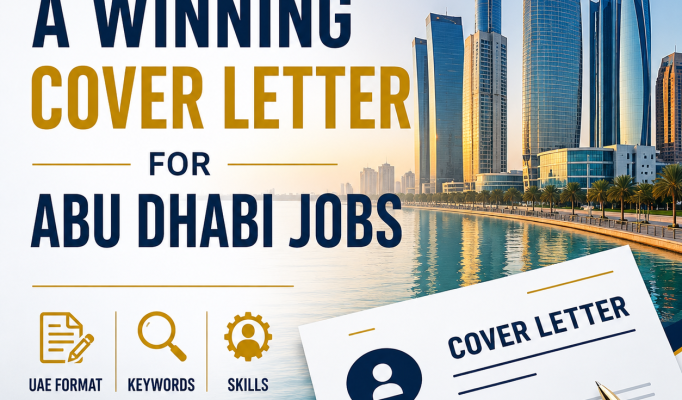
How to Write a Winning Cover Letter for Abu Dhabi Jobs: UAE Format, Keywords, Skills
Primary Key take
cover letter for Abu Dhabi jobs
Secondary Key take
Abu Dhabi job cover letter
UAE cover letter format
cover letter for UAE jobs
how to write a cover letter for a job
cover letter examples for UAE jobs
professional cover letter UAE
cover letter for freshers in UAE
cover letter for experienced professionals
job application letter Abu Dhabi
Search Intent
Informational + Job Application
It is likely preparing to apply for a job and wants to know what to write, what keywords to use and how a professional UAE-style cover letter should look.
Key Structure
1. Introduction — Your CV Is Not the Whole Application
Start with a simple message:
Your CV tells the recruiter what you have done.
Your cover letter tells the recruiter why you are interested in this particular role and why your experience matches the requirement.
Explain that a cover letter should support the CV, not repeat it.
2. What Is a Cover Letter?
Explain in simple language:
A short professional introduction
Written for a specific vacancy
Connects the candidate’s experience with the job requirement
Gives the recruiter a reason to look at the CV
Should normally be concise—around half to one page
3. Is a Cover Letter Required for Abu Dhabi Jobs?
This section is important.
Don’t tell candidates that every employer requires one.
Explain:
Some employers request a cover letter.
Some application portals make it optional.
Some recruiters may not read it.
But when a cover letter is requested—or when there is an opportunity to introduce yourself—it can strengthen the application.
Never send the same generic letter to every employer.
4. UAE/Abu Dhabi Professional Cover Letter Format
Give readers a clean structure:
Candidate Name
Phone | Email | LinkedIn | Current Location
Date
Hiring Manager / Recruitment Team
Company Name
Abu Dhabi, UAE
Subject: Application for [Job Title]
Opening
State the position and your strongest relevant qualification/experience.
Middle Paragraph
Connect your experience and skills with the employer’s requirements.
Achievement / Value Paragraph
Show what you can contribute.
Closing
Express interest in an interview and mention that your CV is attached.
Regards,
Name
5. The Most Important Part — Match the Job Description
This should be one of the main teaching sections of the blog.
Tell candidates:
Don’t start by writing.
Read the job description first.
Look for:
Job title
Required experience
Technical skills
Soft skills
Industry knowledge
Certifications
Software/tools
Responsibilities
Qualifications
Important phrases used repeatedly
Then select the most relevant keywords.
Example
Job description says:
Front Office Operations
Guest Relations
PMS
Check-in / Check-out
Complaint Resolution
Your cover letter should naturally reflect relevant terms such as:
Front Office Operations | Guest Relations | PMS | Check-in/Check-out | Complaint Resolution
But warn candidates:
Do not stuff keywords into the cover letter. Use them naturally and honestly.
6. Skills: Don’t Just List Them — Prove Them
This is another area where the article can become stronger than ordinary cover-letter blogs.
Instead of:
I have excellent communication skills and customer service skills.
Write:
In my previous hospitality role, I handled guest requests, coordinated with housekeeping and resolved service issues while maintaining a high standard of guest communication.
The second version demonstrates the skill instead of simply claiming it.
7. The Winning Formula
I would introduce a simple PAD formula:
JOB + SKILL + EXPERIENCE + ACHIEVEMENT + VALUE
For example:
Front Office Executive + Guest Relations + 4 years’ experience + PMS operations + ability to contribute to guest satisfaction
This gives candidates a simple framework they can use for almost any profession.
8. Three Sample Cover Letters
This will be the heart of the article.
Sample 1 — Experienced Hospitality Professional
Target role: Front Office Executive
Keywords:
Front Office Operations | Guest Relations | PMS | Check-in/Check-out | Complaint Resolution | Upselling | Customer Service
The sample should demonstrate how an experienced candidate connects these skills with actual responsibilities.
Sample 2 — IT Professional
Target role: Cloud Engineer
Keywords:
AWS/Azure | Cloud Infrastructure | Linux | Networking | DevOps | CI/CD | Monitoring | Security
Here we can show how technical candidates should avoid turning the cover letter into a technical CV.
The focus should be:
What I know → Where I used it → What value I can bring.
Sample 3 — Fresh Graduate / Entry-Level Candidate
Target role: Administrative Assistant / Coordinator
Keywords:
MS Office | Documentation | Data Entry | Communication | Coordination | Customer Service | Teamwork
This sample is particularly important for PAD because fresh candidates often write:
“I don’t have experience, so I have nothing to write.”
We should teach them to focus on:
Education
Internships
Projects
Certifications
Practical skills
Communication
Computer skills
Volunteer/college responsibilities
Willingness to learn
Never invent experience.
9. What NOT to Write
A very useful section.
Avoid:
 “Dear Sir/Madam, I need a job.” Extremely long personal stories Copying the entire CV Copying the entire job description Keyword stuffing False experience or qualifications Salary demands in the opening paragraph Generic statements such as “I am hardworking and honest” without evidence Sending the same cover letter to 50 companies
10. Cover Letter + ATS — Important Clarification
I recommend we include this because it connects perfectly with your ATS-friendly CV article.
Explain:
ATS primarily evaluates resumes/CVs, but candidates should still write cover letters using clear job-related terminology when a cover letter is requested.
Don’t make the mistake of saying:
“Your cover letter must be ATS optimized.”
Instead:
Make your cover letter recruiter-friendly, relevant and keyword-aligned.
That’s more accurate.
11. Cover Letter Checklist
Before pressing Apply, ask:
☐ Did I mention the correct job title?
☐ Did I address the employer appropriately?
☐ Did I use relevant keywords from the vacancy?
☐ Did I highlight my strongest matching skills?
☐ Did I provide evidence of my skills?
☐ Did I avoid repeating my entire CV?
☐ Did I keep it concise?
☐ Did I check grammar and spelling?
☐ Did I use the correct company name?
☐ Did I save the document with a professional filename?
Example:
A_B_Cover_
12. Final PAD Message
I think the blog should finish with a strong learning point:
Don’t write a cover letter to tell an employer that you need a job. Write it to show the employer why your skills, experience and motivation match the job they are trying to fill.
And then:
Prepare. Personalise. Apply.