
UAE Footprint | Housing, Renting & Settlement
Information checked: 6 November 2026
Renting a home in Abu Dhabi is an important part of settling into life in the UAE. Whether you are moving into your first apartment, renewing an existing tenancy or dealing with a disagreement over rent, understanding your legal rights can help you make informed decisions.
Rental disputes may involve unexpected rent increases, maintenance delays, security deposits, renewal notices, eviction requests or disagreements about tenancy conditions.
Abu Dhabi has its own legislation governing landlord–tenant relationships. It also has official institutions responsible for rental regulation and dispute resolution.
This guide explains the key legal protections, documentation requirements and official remedies available to tenants, with particular attention to residential accommodation.
1. Understanding Abu Dhabi’s tenancy law
The principal legislation governing ordinary tenancy relationships in Abu Dhabi is Law No. 20 of 2006 concerning the leasing of premises and regulation of landlord–tenant relationships, as amended, including by Law No. 4 of 2010.
The legislation addresses important matters such as:
- Written tenancy contracts.
- Landlord and tenant obligations.
- Rent payments and permitted increases.
- Repairs and property maintenance.
- Renewal and termination notices.
- Grounds for seeking eviction.
- Rental dispute resolution.
The Abu Dhabi Real Estate Centre (ADREC) provides official real-estate regulatory information, while the Abu Dhabi Judicial Department (ADJD) administers the Rental Dispute Settlement Committees.
Important: Abu Dhabi tenancy law should not be confused with Dubai tenancy law. Rent regulations, authorities and complaint procedures differ between the emirates.
The law also contains exclusions for certain categories of accommodation, including specified hotel and tourism properties, some government-related properties and accommodation occupied because of employment conditions.
Tenants in such arrangements should verify which rules apply before relying on the ordinary residential tenancy provisions.
2. Rent increases in Abu Dhabi: What changed in 2026?
Rent increases are among the most common concerns for tenants.
Article 16 of Abu Dhabi Law No. 20 of 2006 establishes a general framework under which the annual rent increase was limited to 5%, while allowing the competent authority to change or cancel that percentage.
Important official update: 3 June 2026
On 3 June 2026, ADREC announced a temporary change to the annual rent-increase percentage from 5% to 0% across residential, commercial and industrial properties in Abu Dhabi.
According to the official announcement:
- The measure applies during the period it remains in force.
- Tenancy renewals are to be processed without an annual rent increase.
- New agreements and renewals are to reference the rental rate in the property’s last registered Tawtheeq contract.
- The measure was announced as temporary and effective until further notice.
Illustrative example
Suppose an apartment’s last registered Tawtheeq annual rent is AED 60,000.
Under the announced 0% measure, a renewal covered by the directive would not ordinarily permit an annual increase to AED 63,000 simply by applying the previous 5% rate.
The relevant reference amount would be AED 60,000, subject to the directive’s application and any subsequent official changes.
Tenant protection: If a landlord or agent requests an increase that appears inconsistent with the measure, ask for the proposed amount and legal basis in writing. Check the latest ADREC announcement before signing or paying the increased amount.
Do not assume that a temporary measure remains unchanged indefinitely.
3. Why Tawtheeq registration matters
Tawtheeq is Abu Dhabi’s official tenancy contract registration system.
A registered tenancy contract helps establish essential information about the rental relationship, including the property, parties, rent and contract period.
For tenants, it is important to verify that the contract information is accurate and that registration or renewal has been completed through the applicable official process.
Documents to retain
Keep copies of:
- The signed tenancy contract.
- Tawtheeq registration and renewal records.
- Rent payment receipts.
- Bank transfer confirmations or cheque records.
- Security deposit receipt.
- Written renewal or amendment notices.
- Emails and messages exchanged with the landlord or agent.
- Maintenance requests and inspection records.
Article 3 of Abu Dhabi’s tenancy law requires tenancy contracts to be in writing. It also recognises that a tenant may prove the rental relationship and its conditions through available evidence.
Practical advice: If you discover that your tenancy is not properly registered, seek guidance from the relevant registration authority. Do not assume that an administrative registration problem automatically eliminates every legal right.
4. Renewal notices: How much advance notice is required?
Article 20 of the tenancy law, as amended by Law No. 4 of 2010, provides rules for renewal and notification.
Where either party does not wish to renew the contract or wishes to amend its conditions, written notice is required:
| Property use | Notice before contract expiry |
|---|---|
| Residential | At least 2 months |
| Commercial, industrial or professional | At least 3 months |
For example, if a residential tenancy expires on 31 December, a party wishing to change the conditions or not renew should ensure the required written notice is given at least two months before expiry.
Article 20 also addresses situations in which a tenant remains in the property after expiry with the landlord’s knowledge and without objection. In those circumstances, the tenancy may be deemed renewed for a similar period on the same conditions.
Important legal distinction
A notice of non-renewal or proposed amendment is not necessarily the same as an enforceable eviction order.
If a landlord seeks eviction, the applicable statutory grounds, notice requirements and dispute procedures must also be considered.
Tenants should not assume that receiving a two-month notice automatically means they must vacate regardless of the legal circumstances.
5. Can a landlord evict a tenant?
Article 23 of Abu Dhabi Law No. 20 of 2006 specifies grounds on which a landlord may seek eviction.
These include certain circumstances involving:
- Non-payment of rent.
- Unauthorised assignment or subletting.
- Occupancy beyond accepted limits.
- Use of the property contrary to agreed conditions.
- Activities harmful to health, public order or other occupants.
- Qualifying demolition, rebuilding or major alteration.
- A landlord seeking to occupy the property personally, subject to legal conditions.
The existence of a statutory ground does not mean every allegation automatically results in eviction.
A dispute may require examination by the competent Rental Dispute Settlement Committee.
Eviction for the landlord’s own residence
Article 23 contains specific conditions for a landlord seeking to occupy the rented premises personally.
These include a requirement for six months’ notice before the tenancy expires, as well as conditions concerning the landlord’s other suitable accommodation and subsequent actual occupation of the property.
If the landlord fails to satisfy the relevant requirements after obtaining possession, the law provides for potential remedies, including reoccupation or compensation in qualifying circumstances.
Eviction for rebuilding or major alteration
The law also sets conditions for eviction connected with certain rebuilding or alteration projects.
These can include the age of the building, necessary official permits, the nature of the proposed work and an evacuation period.
A landlord’s general statement that renovations are planned should not be treated as automatically satisfying every statutory condition.
Tenant protection: Request the legal ground, supporting documents and notice in writing. If the request is disputed, seek guidance from ADJD or a qualified legal professional rather than relying solely on verbal assurances.
6. Maintenance and repair responsibilities
Maintenance disputes can arise when an air-conditioning system fails, water leakage damages an apartment or essential facilities become unusable.
Articles 6–9 and 14 of the tenancy law address the condition of rented premises and repair obligations.
The general legal framework includes:
- The landlord’s obligation to provide premises suitable for the agreed use.
- The landlord’s responsibility for necessary repairs, subject to the law and any applicable agreement.
- The tenant’s responsibility for customary or agreed rental repairs.
- Potential remedies where defects substantially interfere with the property’s use.
What should a tenant do when repairs are delayed?
Step 1: Document the problem. Take dated photographs or videos and record when the defect began.
Step 2: Notify the landlord or property manager in writing. Describe the defect, its effect on the property and the assistance requested.
Step 3: Keep evidence. Retain messages, inspection reports, quotations and responses.
Step 4: Seek official guidance if the landlord does not act. Article 8 provides a mechanism under which a tenant may obtain permission from the competent committee to undertake required repairs and deduct the expenses from rent.
Do not assume you can independently arrange expensive repairs and deduct the amount from the next rent payment without following the applicable legal procedure.
Where the property’s use has been significantly affected, the law may also provide remedies concerning rent reduction or termination, depending on the circumstances.
7. Rent payments: What happens if the landlord refuses payment?
Tenants should continue to comply with their lawful rent-payment obligations even when a dispute arises.
Article 11 of the tenancy law regulates rent payment and addresses situations in which the landlord refuses to accept rent or fails to designate a payment location.
The legislation provides a procedure for depositing rent in the name of the competent committee with a national bank, subject to the prescribed requirements.
This is an important legal safeguard because a tenant who simply stops paying rent may create an additional dispute over non-payment.
Practical approach
If the landlord refuses to accept rent:
- Keep proof that payment was offered.
- Request written payment instructions.
- Preserve relevant correspondence.
- Seek guidance on the legally recognised rent-deposit procedure.
- Retain the deposit confirmation and comply with any required notification.
Do not substitute an informal payment arrangement for the statutory process without checking its legal effect.
8. Security deposits and deductions
Security deposit disagreements often arise at the end of a tenancy.
Common issues include:
- Disagreement over damage to the property.
- Cleaning or repainting charges.
- Outstanding utility payments.
- Alleged unpaid rent.
- Unexplained deductions.
- Delayed return of the deposit.
The outcome depends on the contract, evidence, applicable law and circumstances.
Tenants should avoid assuming that every deduction is automatically unlawful or that a landlord can retain the entire deposit without justification.
Protecting your deposit
Before moving in, document the property’s condition and record any existing defects.
During the tenancy, keep written records of repairs and maintenance.
Before moving out, request a joint inspection where practical and retain photographs of the property’s condition.
Ask for an itemised explanation and supporting evidence for any proposed deductions.
If the parties cannot resolve the disagreement, a qualifying claim may be brought before the competent rental dispute authority.
9. Can a landlord change the tenancy conditions without agreement?
Changes to rent, payment arrangements, occupancy conditions and other contractual terms may create disputes.
Article 20 requires advance written notification where a party wishes to amend tenancy conditions before expiry.
The proposed change must also comply with applicable law.
For example, a written notice proposing a rent increase does not make that increase lawful if it conflicts with a binding rent-increase measure.
Tenants should carefully review renewal documents before signing and compare the proposed conditions with the existing contract.
Practical advice: Do not rely on verbal statements such as “this is the new rule for every building.” Ask for the official basis of any disputed change.
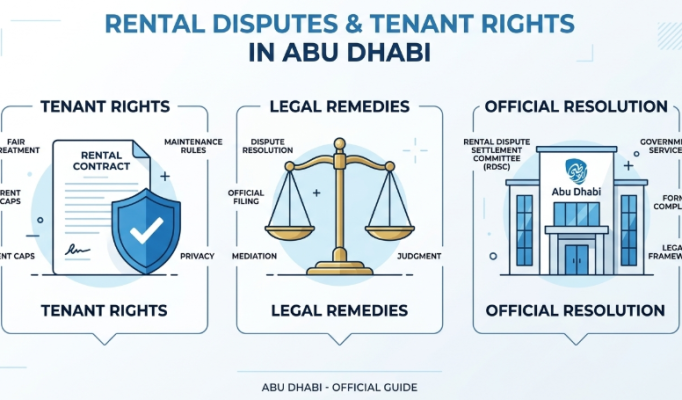
10. Where should tenants report rental disputes?
Two official institutions are especially relevant.
Abu Dhabi Real Estate Centre (ADREC)
ADREC is responsible for important aspects of Abu Dhabi’s real-estate regulatory framework.
For concerns about compliance with the temporary 2026 rent-increase measure, ADREC’s announcement expressly encourages affected tenants and businesses to contact the centre through its official channels.
Official website: adrec.gov.ae
Abu Dhabi Judicial Department (ADJD)
The Rental Dispute Settlement Committees operate under ADJD.
They are competent to hear disputes arising from landlord–tenant relationships governed by Abu Dhabi Law No. 20 of 2006 and to consider relevant interim applications.
Examples of disputes that may require adjudication include:
- Disputed rental amounts.
- Alleged non-payment.
- Eviction claims.
- Repair obligations.
- Contractual disagreements.
- Claims for money or other rights arising from the rental relationship.
The correct route depends on the nature of the dispute and the applicable law.
Important: The Dubai Rental Disputes Center is not the ordinary filing authority for Abu Dhabi rental disputes.
11. How to prepare a rental dispute claim
Before starting formal proceedings, tenants should organise their documents and identify the remedy they are requesting.
Step 1: Identify the issue
Determine whether the dispute concerns rent, renewal, eviction, maintenance, deposit deductions or another contractual obligation.
Step 2: Review the contract and applicable rules
Compare the disputed action with the written tenancy agreement and the relevant provisions of Abu Dhabi law.
Step 3: Gather supporting evidence
Prepare the contract, registration records, payment evidence, notices and correspondence.
Step 4: Request a written resolution
Where appropriate, explain the issue to the landlord or property manager and request a response in writing.
Step 5: Check the official filing service
ADJD provides a service for filing rental claims at first instance.
Its official service documentation identifies the website, authorised law firms and typing centres as available filing channels.
The applicable documents, court fees, translation requirements and procedural steps should be checked through the current service instructions.
Step 6: Follow the formal process
After filing, comply with any notification, hearing, evidence and procedural requirements issued by the competent authority.
ADJD’s official guidance also identifies rental cases heard by the competent committees as exempt from the general mandatory prior referral requirement to reconciliation and mediation centres.
This does not prevent parties from exploring a lawful negotiated settlement where appropriate.
12. What evidence is useful in a rental dispute?
| Dispute type | Useful supporting evidence |
|---|---|
| Rent increase | Existing contract, last registered Tawtheeq rent, renewal proposal, written notices |
| Eviction | Tenancy contract, eviction notice, correspondence, stated legal grounds |
| Maintenance | Photographs, written complaints, inspection reports, quotations |
| Rent payment | Bank transfers, receipts, cheque records, proof of attempted payment |
| Security deposit | Deposit receipt, move-in and move-out photographs, deduction statement |
| Contract amendment | Original agreement, proposed changes, written communications |
Evidence does not automatically establish that a claim will succeed. It helps the competent authority examine the facts.
Tenants should preserve original records and avoid altering documents or presenting incomplete correspondence in a misleading way.
13. Common mistakes tenants should avoid
Mistake 1: Applying Dubai rental rules to Abu Dhabi.
Abu Dhabi has its own tenancy legislation and dispute procedures.
Mistake 2: Assuming the old 5% increase is currently permitted.
ADREC announced a temporary 0% measure on 3 June 2026. Its continued application must be checked against subsequent official updates.
Mistake 3: Ignoring written notices.
Notice dates, delivery evidence and contract expiry dates can be legally significant.
Mistake 4: Stopping rent payments during a dispute.
Non-payment can create separate legal consequences. Use the recognised procedure where a landlord refuses payment.
Mistake 5: Deducting repair costs without proper authority.
Certain remedies require permission from the competent committee.
Mistake 6: Relying only on verbal conversations.
Written evidence can be important in establishing what was agreed, requested or refused.
Mistake 7: Assuming every type of accommodation has identical protections.
Hotel apartments, certain employer-provided housing and other excluded categories may be governed by different arrangements.
14. Frequently asked questions
Can my landlord increase the rent in Abu Dhabi in 2026?
ADREC announced a temporary 0% annual rent-increase measure on 3 June 2026, effective until further notice. Check the latest official ADREC announcements to confirm whether the measure still applies to your proposed agreement or renewal.
Is a two-month notice required for residential tenancy changes?
Article 20 generally requires written notice at least two months before expiry where a party does not wish to renew or wishes to amend the conditions of a residential tenancy.
Can a landlord evict a tenant simply because the rent is below market rates?
A landlord seeking eviction must consider the applicable statutory framework. Article 23 identifies specific grounds for seeking eviction. A claimed difference between current rent and market rent should not automatically be treated as sufficient legal grounds.
Who is responsible for major repairs?
Article 7 generally places necessary repairs on the landlord, excluding customary rental repairs, unless otherwise agreed. The contract and the nature of the repair must be examined.
Can I withhold rent if repairs are not completed?
Do not assume that withholding rent is permitted. Article 8 provides a mechanism involving permission from the competent committee for certain repair-related remedies.
Where can I file a rental complaint?
For qualifying rental disputes under Abu Dhabi tenancy law, the relevant adjudicatory body is the Rental Dispute Settlement Committees under ADJD. For compliance concerns involving ADREC’s rent-increase directive, tenants can also contact ADREC through its official channels.
What if my tenancy contract is not registered?
Keep the written agreement and payment evidence, and seek guidance on registration. Article 3 recognises the tenant’s ability to prove the rental relationship and conditions through evidence.
15. Tenant protection checklist
Before signing, renewing or ending a tenancy in Abu Dhabi:
- Confirm the landlord’s or authorised agent’s identity.
- Read the entire tenancy contract.
- Check the property’s Tawtheeq registration.
- Verify the rent and payment schedule.
- Check the latest official rent-increase measure.
- Record the contract expiry and notice dates.
- Understand maintenance responsibilities.
- Obtain receipts for rent and deposits.
- Keep all important communications in writing.
- Document the property’s condition.
- Review proposed renewal changes carefully.
- Identify the appropriate authority if a dispute arises.
Conclusion
Understanding Abu Dhabi’s rental laws can help tenants protect their interests and respond more effectively when disagreements occur.
The strongest starting points are a properly documented tenancy, awareness of the current rent-increase rules, written communication and careful preservation of payment and maintenance records.
When a disagreement cannot be resolved directly, tenants should use the appropriate official channels rather than relying on informal advice or taking actions that may create additional legal problems.
For people relocating to Abu Dhabi, knowing these procedures is an important part of building a secure and well-informed life in the UAE.
Official legal and regulatory references
The following primary sources form the research basis of this article:
- Abu Dhabi Real Estate Centre (ADREC) — Law No. 20 of 2006 concerning tenancy relationships, as amended, particularly Articles 3, 6–11, 16, 20 and 23–26.
- Abu Dhabi Law No. 4 of 2010 — amendments to tenancy provisions, including Article 20.
- ADREC, 3 June 2026 — Temporary Update to Annual Rental Cap Increase in Abu Dhabi.
- Abu Dhabi Judicial Department (ADJD) — Rental Dispute Settlement Committees.
- ADJD — Official Rental Claim Form and rental claim filing service guidance.
- ADJD Frequently Asked Questions — jurisdiction and exemptions from prior reconciliation and mediation requirements.
Readers should consult the current versions of these official sources before acting.
Legal Disclaimer
This article is published by PAD Media House for general educational and public-information purposes only.
It is not legal advice, does not establish a lawyer–client relationship and does not determine the outcome of any individual rental dispute.
The applicable rights and procedures may depend on the tenancy agreement, property category, facts of the dispute, subsequent amendments to the law and official decisions.
The 0% rent-increase measure announced in June 2026 is temporary and may be amended or withdrawn. Readers should verify its status directly with ADREC.
For individual disputes, consult the Abu Dhabi Judicial Department, Abu Dhabi Real Estate Centre or a qualified UAE legal professional.
Information checked: 6 November 2026.