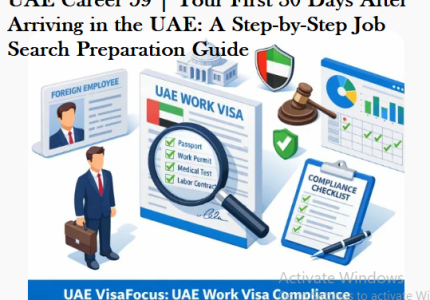

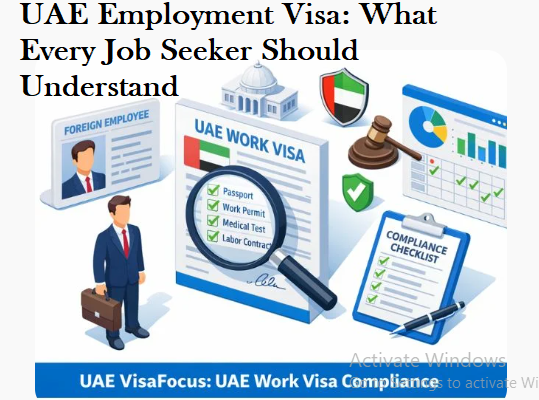
A Step-by-Step Guide to Work Permits, Employment Visas, Jobseeker Visas, Costs and Candidate Safety
PAD | UAE Career 59 | Employment, Immigration & Job Search Awareness
Information checked: 9 October 2026
Introduction: Before accepting a job in the UAE, understand the process
For an international professional, receiving a job offer from a company in Abu Dhabi, Dubai, Sharjah, or another emirate can be an important career milestone.
However, a job offer raises several practical questions.
Who arranges the employment visa? Can you travel to the UAE while searching for work? Can you begin working while your visa is being processed? Who pays the recruitment and visa costs? What should you verify before accepting an offer?
These are not minor administrative details. They can affect your finances, travel plans, legal status, and professional future.
The UAE has formal procedures governing employment, work permits, entry permits, and residence. The exact process depends on the type of employment, the employer, the relevant authority, and the candidate’s circumstances.
This guide explains the general process for international job seekers, particularly those applying from outside the UAE.
Important: This is general information, not individual immigration or legal advice. Immigration requirements, application procedures, eligibility criteria, and fees can change. Always verify the requirements for your specific case with the relevant UAE government authority before making financial or travel commitments.
1. What is an employment visa in the UAE?
The term “employment visa” is commonly used to describe the immigration arrangements that allow a foreign national to enter, reside in, and work in the UAE under the applicable employment framework.
For a standard private-sector job, the process generally involves an employment offer, a work permit, the appropriate entry or status procedure, medical fitness requirements, and residence documentation.
These are related but distinct steps.
| Term | What it means |
|---|---|
| Job offer | A formal proposal describing the employment terms |
| Work permit | Authorisation required for employment under the applicable labour framework |
| Entry permit | Permission to enter the UAE for the specified purpose, where applicable |
| Medical fitness test | A required health screening step in the residence process |
| Residence permit | Authorisation to reside in the UAE under the applicable category |
| Emirates ID | The UAE’s official identity card for residents |
The exact sequence and processing arrangements may differ by case and authority.
For standard private-sector employment, the employer normally initiates the relevant work permit and employment immigration procedures.
Official source: UAE Government — Job offers and the employment process.
2. What is the difference between a jobseeker visa and an employment visa?
This is one of the most important distinctions for candidates applying from abroad.
A. Jobseeker visit visa
The UAE offers a visit visa for people who want to explore employment opportunities without requiring a host or sponsor in the country for that purpose.
According to the official UAE Government guidance, the available validity options are 60, 90, or 120 days, subject to the applicable eligibility and application requirements.
The published eligibility criteria include:
- Meeting the specified professional skill-level criteria, or qualifying under the recognised recent-graduate route.
- Holding a bachelor’s degree or its equivalent.
- Meeting the prescribed financial guarantee requirements.
- Providing the required documents, including the passport copy, photograph, and attested qualification certificate where required.
The graduate route refers to graduates of universities within the approved top-500 classification who graduated within the previous two years. The precise classification and eligibility requirements should be checked against the current official rules.
A jobseeker visa allows the holder to explore employment opportunities. It does not authorise the holder to start working merely because they have received a job offer.
Official source: UAE Government — Jobseeker visit visa.
B. Standard employment visa and work permit
This route applies when a person is being recruited for a job and the employer initiates the appropriate employment procedures.
The employer generally applies for the necessary work permit and, where applicable, the entry permit and residence arrangements.
The candidate must satisfy the applicable requirements, provide the required documents, and complete the relevant formalities.
A candidate should not assume that every employment arrangement follows an identical process. Free-zone employers, government entities, domestic employment, and other categories may have different competent authorities or procedures.
Official sources:
3. Can you travel to the UAE first and search for a job?
Possibly, if you qualify for an appropriate visa or entry permission.
Candidates should distinguish between three situations.
Situation 1: You are applying from your home country.
You can search for vacancies, attend online interviews, contact recruiters, and submit applications without first travelling to the UAE.
If you receive an offer, the employer can explain the appropriate employment and immigration process.
Situation 2: You want to travel specifically to explore job opportunities.
Check whether you qualify for the UAE jobseeker visit visa or another appropriate entry route. Confirm its validity, eligibility requirements, costs, and conditions before applying.
Situation 3: You enter the UAE as a tourist or ordinary visit-visa holder.
A tourist or visit visa does not authorise employment. You must have the appropriate work authorisation before starting work, even if the work is unpaid.
Do not assume that being physically present in the UAE gives you permission to work or that every visit-visa category permits the same activities.
Official sources:
Practical advice
Before booking a flight, calculate your travel costs, accommodation, food, local transport, insurance, and other expenses for the full intended stay.
A jobseeker visa does not guarantee employment. Have a realistic financial plan for the possibility that your search takes longer than expected or you do not secure a suitable position.
4. What is the normal employment process after receiving a job offer?
For a standard private-sector role, the general process can be understood in the following stages.
Step 1 — Receive and review the formal job offer
Check the employer’s identity, job title, salary, benefits, work location, working arrangements, and other relevant employment conditions.
Make sure the position matches what was discussed during the recruitment process.
Step 2 — Verify the offer where applicable
For employers covered by the Ministry of Human Resources and Emiratisation (MOHRE), check the official offer and its reference details through the Ministry’s recognised verification channels.
Employers operating under free-zone or other regulatory arrangements may use a different competent authority. Verify the offer with the authority relevant to your employer.
Step 3 — Confirm the employment contract
Read the contract carefully and check that its terms are consistent with the agreed offer and applicable law.
Do not sign documents you do not understand. Ask for clarification before agreeing to material changes.
Step 4 — Employer initiates the required work permit and immigration process
The employer or authorised representative submits the appropriate application to the relevant authority.
The required documents and approvals depend on the employment category and the applicant’s circumstances.
Step 5 — Complete the applicable entry or status procedure
Depending on your location and visa status, you may need an employment entry permit or another authorised procedure.
Follow the instructions provided by the competent authority and employer.
Step 6 — Complete medical fitness and residence formalities
The process generally includes the required medical fitness screening and other residence formalities. Emirates ID procedures and biometric requirements may also apply.
Step 7 — Confirm that you are authorised to begin work
Do not start working solely because an offer has been issued or an application has been submitted. Confirm that the necessary work authorisation is in place.
Official sources:
- UAE Government — Employment offers and contracts.
- UAE Government — Work permits.
- UAE Government — Preparing to work.
The steps above are a general overview. They should not be treated as a guaranteed processing sequence or timeline for every case.
5. Who pays the employment visa and recruitment costs?
This is a particularly important question for international candidates.
Under the UAE private-sector labour framework, employers are generally responsible for the applicable recruitment and employment costs that the law places on them. These can include recruitment costs, work-permit-related costs, and relevant entry, travel, medical, and residence-processing expenses.
Candidates should not assume that they must pay a recruiter to secure a job.
The exact legal treatment of an expense can depend on its nature and the applicable employment category. If someone asks you to pay a fee, verify the request before transferring money.
Be especially cautious when someone claims that payment is necessary to guarantee:
- A job offer.
- An employment visa.
- A work permit.
- A guaranteed interview or selection.
- Priority processing through an unofficial intermediary.
Official sources:
For questions about a specific charge or employment arrangement, contact the competent labour authority rather than relying on a recruiter’s verbal explanation.
6. What documents should a candidate prepare?
The exact document list depends on the job, employer, authority, and immigration category. The following is a preparation checklist, not a universal application requirement.
| Document | Why it may be needed |
|---|---|
| Valid passport | Identity and immigration processing |
| Passport photograph | Application and identity documentation |
| Academic certificates | Qualification verification where required |
| Attested documents | Required for certain qualifications or occupations |
| Professional licence | Required for regulated professions where applicable |
| Signed employment offer | Employment documentation |
| Previous employment records | May be requested to verify experience |
| Medical fitness documentation | Completed as part of the applicable process |
| Other authority-specific documents | Depends on the employment and immigration category |
Special attention for regulated professions
Doctors, nurses, teachers, and certain other professionals may need approval or a licence from the relevant UAE regulatory authority.
Do not assume that a qualification accepted in your home country automatically satisfies UAE licensing requirements.
Verify the relevant authority, eligibility rules, credential requirements, and any examinations before committing to travel or employment.
Passport validity
A passport validity requirement of at least six months appears in several UAE immigration service requirements. Confirm the precise rule for the visa or entry permit you are applying for.
Official reference: ICP — Visa services.
7. How can you verify a genuine UAE job offer?
A genuine-looking document or LinkedIn profile is not sufficient proof that a job offer is legitimate.
Use a verification process.
First: Confirm the employer.
Check the company’s official website, contact details, business identity, and recognised careers page.
Second: Check the offer details.
Review the job title, salary, work location, benefits, reporting arrangements, and employment conditions.
Third: Verify through the correct authority.
For a MOHRE-regulated private-sector offer, use the Ministry’s official verification channels. For other employment categories, confirm the applicable process with the relevant authority.
Fourth: Contact the employer independently.
Where necessary, contact the organisation using details obtained from its official website rather than relying solely on a phone number or email address supplied by an intermediary.
Fifth: Keep records.
Save the job advertisement, offer letter, contract, employer communications, and any official application references.
Warning signs to investigate
- You are promised a job without a credible interview or assessment process.
- You are asked to pay money to guarantee employment.
- The recruiter uses an email address or identity that cannot be independently verified.
- The salary or job title changes substantially between discussions and documents.
- You are pressured to travel or transfer money immediately.
- You are asked to work on a tourist or visit visa.
A warning sign does not by itself prove fraud, but it is a reason to stop and verify before proceeding.
Official source: UAE Government — Tips to stay safe from labour and visa fraud.
8. What should you check before signing the employment contract?
Do not focus exclusively on the visa. Your employment terms are equally important.
Review:
- Job title and actual duties.
- Basic salary and other salary components.
- Accommodation, transport, meals, or allowances, if offered.
- Working hours and weekly rest arrangements.
- Leave entitlement.
- Probation and termination provisions.
- Health insurance arrangements.
- Work location and reporting structure.
- Contract duration and applicable renewal terms.
- Any conditions that differ from the original offer.
Ask for clarification on anything unclear or inconsistent.
For private-sector employment covered by MOHRE, the official offer and contract process is governed by applicable UAE labour rules. Other employment categories may have different arrangements.
Do not resign from your existing job, make non-refundable travel bookings, or incur substantial relocation expenses solely on the basis of an informal verbal promise.
Wait until you have sufficient written confirmation and understand the applicable employment and immigration steps.
9. What if your employment visa is delayed or refused?
Do not assume that every application will be approved or processed within the same period.
Delays can arise from incomplete documentation, outstanding approvals, eligibility issues, or other case-specific circumstances.
If a delay occurs:
- Ask the employer or authorised representative for the current application status.
- Request the relevant application reference, where available.
- Confirm whether any documents or corrections are outstanding.
- Contact the competent authority if you need independent clarification.
- Avoid making travel or employment decisions based on unverified assurances.
If an application is refused, seek the official reason and ask about the available options. Do not assume that submitting the same application again will resolve the issue.
If you are already in the UAE, carefully check your authorised stay period and any applicable status deadlines. Do not overstay or begin work without the necessary authorisation.
For complex cases, consider advice from a qualified immigration or employment-law professional.
10. What about Green Visas, freelance permits, and remote-work residence?
Not every professional uses the standard employer-sponsored route.
The UAE has additional residence and work-related categories, each with its own eligibility criteria and conditions.
Green residence for work: A self-sponsored residence category available to eligible skilled employees under the applicable requirements. It is not automatically available to every job seeker.
Freelance or self-employment arrangements: These require the relevant authorisation and must satisfy the applicable permit, licensing, and immigration conditions.
Virtual work residence: A separate route for eligible people working remotely for an employer outside the UAE, subject to the programme’s requirements. It is not a substitute for authorisation to take an ordinary local job.
Other specialist residence categories: Certain professionals, investors, and other eligible applicants may qualify under separate rules.
Before choosing any of these routes, check the exact eligibility requirements and whether the category permits the work you intend to perform.
Official source: UAE Government — Residence visas.
11. Frequently asked questions
Can I work in the UAE while holding a jobseeker visa?
No. A jobseeker visit visa is intended to allow eligible applicants to explore employment opportunities. It does not itself authorise employment. You must obtain the appropriate work authorisation before beginning work.
Can I accept a job offer while outside the UAE?
Yes. Candidates can apply and receive an offer from abroad. The employer and candidate then follow the appropriate employment and immigration procedures.
Does every UAE employer use MOHRE?
No. Different employment categories and jurisdictions may involve different competent authorities. Confirm which authority applies to the employer and position.
Does a job offer guarantee an employment visa?
No. The relevant applications, eligibility requirements, documentation, and approvals still apply.
Must I pay an agent to get an employment visa?
Do not assume that you must pay a recruiter or intermediary. Employers are generally responsible for the recruitment and employment costs assigned to them by the applicable labour framework. Verify any requested fee through the relevant official authority.
Can I enter the UAE as a tourist and begin working after receiving an offer?
Not simply on the strength of the offer. A tourist or visit visa does not authorise employment. Follow the required work-permit and immigration procedures before starting work.
How long does the employment visa process take?
Processing time varies according to the application, authority, documentation, and circumstances. Check the current service information for your specific case rather than relying on a general estimate.
12. Official resources every UAE job seeker should save
The following government resources are the starting point for checking current requirements.
- Jobseeker visit visa:
https://u.ae/en/information-and-services/visa-and-emirates-id/residence-visas/jobseeker-visit-visa - Employment offers and contracts:
https://u.ae/en/information-and-services/jobs/employment-in-the-private-sector/job-offers-and-work-permits-and-contracts/expatriates-employment-in-private-sector - Work permits:
https://u.ae/en/information-and-services/jobs/employment-in-the-private-sector/job-offers-and-work-permits-and-contracts/work-permits - Residence visa for working in the UAE:
https://u.ae/en/information-and-services/visa-and-emirates-id/residence-visas/residence-visa-for-working-in-the-uae - Employment preparation:
https://u.ae/en/information-and-services/jobs/employment-in-the-private-sector/preparing-to-work - Employment and visa fraud prevention:
https://u.ae/en/information-and-services/visa-and-emirates-id/tips-to-avoid-labour-and-visa-fraud - MOHRE:
https://www.mohre.gov.ae/ - Federal Authority for Identity, Citizenship, Customs and Port Security (ICP):
https://icp.gov.ae/
The UAE Government portal explains general rules and directs applicants to relevant services. MOHRE and ICP provide services within their respective areas of responsibility. For Dubai-specific immigration services, consult the General Directorate of Residency and Foreigners Affairs — Dubai (GDRFA Dubai): https://www.gdrfad.gov.ae/.
Final message: Verify before you travel, understand before you sign
A UAE job offer can be an important professional opportunity, but candidates should approach the process with preparation and care.
Understand the difference between a jobseeker visa and an employment visa. Check the employer’s identity. Read the offer and contract. Understand who is responsible for the relevant costs. Confirm the applicable work authorisation. Use official government sources when questions arise.
Do not allow excitement about an opportunity to replace verification, and do not let fear prevent you from exploring legitimate opportunities.
Prepare your career with confidence, but handle your employment and immigration decisions with evidence.
That is the foundation of a safer, more informed UAE job search.
PAD | UAE Career 59
An information-led career guidance series for professionals exploring opportunities in the United Arab Emirates.
Publication note: Information checked on 9 October 2026 against the official UAE Government, MOHRE, and ICP resources linked above. Rules, eligibility, procedures, and fees may change. Readers should confirm the latest requirements with the competent authority before applying, paying fees, travelling, or beginning employment. This article is educational and does not replace individual legal or immigration advice.