

By PAD Media House | UAE Footprint
Publication date: 28 October 2026
Information checked: 28 October 2026
Category: Banking, Remittances & Financial Safety
Target audience: UAE residents of all nationalities who need to send money to India
Introduction: Your Money Deserves Careful Handling
For many people living in Abu Dhabi, sending money to India is part of everyday life. It may be for family expenses, education, medical bills, household commitments, savings or other legitimate purposes.
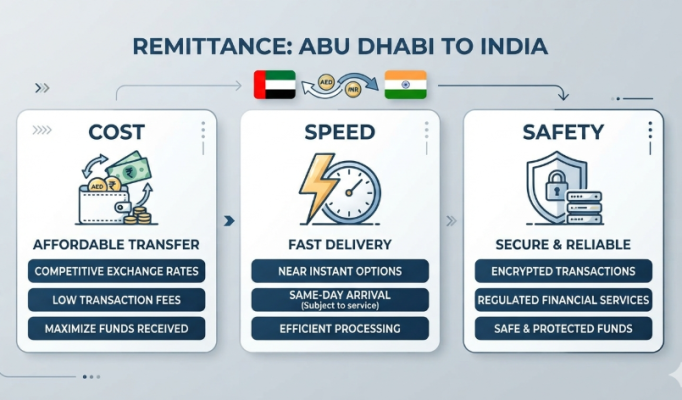
But an international money transfer is more than a simple transaction. The exchange rate, transfer fees, receiving-bank arrangements, processing time and security of the service can all affect the final outcome.
A service advertising a zero transfer fee may not necessarily provide the best overall value. A transfer advertised as instant may also take longer if additional checks are required.
The safest approach is to verify the provider, compare the final amount the recipient will receive, protect your banking information and keep the transaction receipt.
This guide explains the basic process in straightforward language. It is educational information, not a recommendation to use a particular bank, exchange house or money-transfer application.
1. What Are the Main Ways to Send Money?
People in Abu Dhabi can generally explore the following options, depending on their eligibility, the provider’s services and the intended recipient’s circumstances.
Option A: A UAE bank
If you hold an account with a UAE bank, check whether it offers international transfers or a dedicated remittance service for India.
Before transferring, confirm:
- The exchange rate offered for your specific transaction.
- The total transfer fee.
- The amount the recipient is expected to receive in Indian rupees.
- The expected delivery time.
- Any applicable transaction limits.
- Whether additional intermediary or receiving-bank charges may apply.
A bank transfer may be convenient for someone who already uses the bank’s digital banking services.
Option B: A licensed exchange house
Exchange houses provide currency exchange and remittance services. In the UAE, exchange businesses carrying out regulated remittance activities must hold the appropriate authorisation.
Before using an exchange house, verify its current licensing status through the Central Bank of the UAE’s official channels.
Ask for a transaction-specific quotation showing the exchange rate, fee and expected amount payable to the beneficiary.
Do not assume that a familiar brand name, attractive shopfront or social media advertisement is sufficient proof that a particular branch, website or agent is legitimate.
Option C: A remittance application or digital service
Some financial service providers offer online or app-based transfers.
Before registering or sending money, check:
- Whether the service is authorised to offer the relevant service in the UAE.
- Whether you are using its genuine website or official application.
- Which company will actually process the transfer.
- What identification and verification documents are required.
- Whether the service supports your intended Indian bank account and transfer purpose.
- How to contact customer support and report a suspicious transaction.
Important: An application being available for download does not, by itself, establish that its operator is authorised to provide every financial service in the UAE.
2. What Does It Cost to Send Money?
The total cost can include more than the advertised transfer fee.
Consider three elements:
1. Transfer fee: The amount charged for processing the transaction.
2. Exchange-rate difference: The rate offered to you may be less favourable than a reference market rate. This can affect how many rupees your recipient receives.
3. Additional charges: Depending on the transfer route, intermediary banks or other financial institutions may impose additional charges.
The exact charges depend on the provider, transaction, transfer method and receiving arrangements.
How to compare two transfer services
Suppose you want to send AED 1,000.
| Comparison point | Provider A | Provider B |
|---|---|---|
| Amount sent | AED 1,000 | AED 1,000 |
| Transfer fee | Check the live quote | Check the live quote |
| Exchange rate | Check the live quote | Check the live quote |
| Expected INR received | Confirm before payment | Confirm before payment |
| Delivery estimate | Confirm before payment | Confirm before payment |
| Possible additional charges | Ask the provider | Ask the provider |
This is a comparison template, not a live price quotation.
The key question is: How many Indian rupees will actually reach the recipient for the total amount you pay?
Do not select a service based on the phrase “zero fee” alone.
3. How Long Does a Transfer Take?
There is no single delivery time that applies to every transfer from Abu Dhabi to India.
Depending on the provider and transfer route, a transaction may be processed rapidly or may take longer.
Delivery can be affected by:
- The provider’s processing arrangements.
- The receiving bank and payment channel.
- Bank operating hours, weekends and public holidays.
- Incorrect or incomplete beneficiary details.
- Identity verification or compliance checks.
- Additional scrutiny by an intermediary or receiving institution.
- Technical interruptions or other processing issues.
A provider’s advertised delivery time is an estimate unless its applicable terms establish otherwise.
Safety rule: If you need to pay school fees, medical expenses or another urgent bill, confirm the likely arrival time before initiating the transfer. Do not rely solely on an advertisement promising instant payment.
4. Safety First: How to Protect Your Money
This is the most important section of the guide.
A. Use an authorised provider
Before sending money, check the provider’s current authorisation through the Central Bank of the UAE’s official licensing information.
Use the institution’s verified contact details rather than relying on a telephone number, website or payment link sent by an unknown person.
B. Never share your OTP, PIN or password
A legitimate transfer should not require you to disclose your banking password, card PIN or one-time password to an unrelated individual.
Never share these details with someone claiming to be:
- A bank employee.
- An exchange-house representative.
- A customer-support agent.
- A government official.
- A person promising a special exchange rate.
If someone asks you to reveal an OTP or banking credentials, stop the interaction and contact your financial institution through its official channel.
C. Check the beneficiary details carefully
Before confirming the transaction, verify:
- The recipient’s name.
- The account number or other required beneficiary identifier.
- The receiving bank.
- The transfer amount and currency.
- The purpose of the transfer, where requested.
- The expected amount the recipient will receive.
A single incorrect digit or a mistaken beneficiary can cause delays or complications.
Never assume that a transfer can always be reversed once it has been processed.
D. Avoid unofficial agents and informal transfer arrangements
Do not hand cash to an unknown person who promises to deliver an equivalent amount to an Indian bank account.
Avoid informal arrangements that bypass the regulated financial system, including offers that depend on trust alone or promise unusually favourable rates without proper documentation.
Use an appropriately authorised channel and obtain an official transaction record.
E. Beware of fake websites and payment links
Fraudsters may imitate financial institutions using copied logos, similar website names, fake customer-service accounts or fraudulent advertisements.
For protection:
- Access the provider through its verified website or official application.
- Check the website address carefully.
- Do not install remote-access software at the request of an unknown caller.
- Never approve a transaction you did not initiate.
- Do not transfer money to a personal account merely because someone claims it is required to complete your remittance.
F. Keep your transaction receipt
Save the receipt and transaction reference number.
Record the date, amount sent, exchange rate, applicable fees and the expected delivery time.
Ask the recipient to confirm receipt independently.
If the transfer is delayed, contact the provider through its official customer-support channel and use the transaction reference to request an investigation.
5. What Information Might You Need?
Requirements differ between providers and may depend on the amount, transfer purpose and customer profile.
You may be asked for:
- Valid identity documents.
- UAE residency or other identification details, where applicable.
- Your own account or payment details.
- The beneficiary’s correct bank details.
- The purpose of the remittance.
- Supporting information about the source of funds, where required.
Do not submit documents through an unverified link or to an unknown individual.
If the provider requests additional documentation, confirm the request through its official channel before responding.
Do not assume that every customer needs identical documents or that every transfer has the same limits.
6. What If the Money Does Not Arrive?
If the expected delivery time passes and the recipient has not received the money, take the following steps.
Step 1: Check the transaction status.
Use the provider’s official application, website or customer-support channel.
Step 2: Confirm the beneficiary details.
Check whether the account details and receiving bank information were entered correctly.
Step 3: Contact the provider.
Give the transaction reference number and ask for the current status, reason for the delay and expected resolution.
Step 4: Keep written records.
Save the receipt, messages, reference numbers and any complaint acknowledgement.
Step 5: Escalate through official channels if necessary.
First use the provider’s formal complaint process. If the matter remains unresolved, consult the relevant regulator’s current complaint procedure and confirm that your case falls within its jurisdiction.
For UAE-regulated financial institutions, the Central Bank of the UAE provides official information about regulation and consumer-related services.
For questions concerning the receipt of international remittances in India, consult the Reserve Bank of India’s current guidance or contact the receiving bank.
If you suspect fraud, contact your bank or payment provider immediately through its verified emergency or fraud-reporting channel. Prompt reporting may help the institution assess whether any protective action is possible, although recovery is not guaranteed.
7. What Should Families in India Know?
The person receiving the money also has a role in safe remittance handling.
The recipient should:
- Provide accurate bank details directly to the sender.
- Never share banking passwords, PINs or OTPs.
- Confirm receipt through their own bank account or official banking application.
- Report an unexpected or suspicious credit to their bank.
- Keep relevant transaction records.
A sender should never ask a recipient to return money to an unrelated account simply because someone claims that the original transfer was made incorrectly.
If money arrives unexpectedly, or someone asks for a refund through a different account, contact the bank or provider to establish the correct procedure before taking action.
8. Is Sending Money to India Safe?
International remittances are a normal financial service, but no payment method is entirely free from risk.
Safety depends on using an appropriately authorised provider, supplying accurate information, protecting your credentials and understanding the transaction terms.
A regulated provider offers an important layer of oversight, but it does not guarantee that every transaction will be completed instantly or that money lost to fraud can always be recovered.
For that reason, do not make a financial decision based solely on a recommendation from a friend, an online review, a social media post or an attractive promotional rate.
Verify the service and the actual transaction details for yourself.
9. Your Final Safety Checklist
Before pressing Send, check these ten points:
- Have I verified the provider’s current authorisation?
- Am I using its genuine website, application or branch?
- Have I checked the exchange rate for my transaction?
- Do I understand the transfer fee and possible additional charges?
- Have I confirmed the amount the recipient should receive?
- Have I checked the beneficiary’s bank details?
- Have I reviewed the expected delivery time and applicable limits?
- Am I keeping my OTP, PIN and password private?
- Will I receive an official receipt and transaction reference?
- Do I know how to contact the provider if something goes wrong?
If any important detail is unclear, pause and obtain clarification before transferring the money.
Official Sources for Verification
This guide draws on publicly available material from the following official sources:
- Central Bank of the UAE (CBUAE): Licensing information for financial institutions and exchange businesses.
- CBUAE Rulebook: Exchange Business Regulation C 7/2025 and consumer disclosure requirements for remittance and foreign-exchange services.
- UAE Government Portal: General information on banking and licensed money-exchange services.
- Reserve Bank of India (RBI): General guidance on inward remittances and relevant authorised remittance arrangements.
Readers should consult the latest versions of these materials before acting. The applicable rules and service terms may change.
Disclaimer and Publication Date
Published on: 28 October 2026
Information checked: 28 October 2026
This article has been prepared by PAD Media House for UAE Footprint for general informational and educational purposes. It is based on publicly available regulatory and government information identified in the article and checked on the stated information-check date.
It does not constitute financial, banking, legal, tax, investment or other professional advice. PAD Media House does not endorse or guarantee any particular bank, exchange house, remittance application, exchange rate, transfer fee, delivery time or recovery outcome.
Transfer costs, exchange rates, transaction limits, eligibility requirements, processing times, regulatory requirements and provider terms may change. Requirements may vary according to the customer’s circumstances, the transfer method and the receiving institution. Readers must independently verify the provider’s current authorisation, transaction terms and applicable requirements through official sources before sending money.
To the fullest extent permitted by applicable law, PAD Media House disclaims liability for losses, costs, damages or consequences arising from reliance on this article, including those associated with changes in rules, incomplete information, provider practices, transaction errors, delays or fraud. Nothing in this disclaimer excludes or limits any liability that cannot lawfully be excluded or limited.
Our principle is simple: Verify first. Protect your information. Compare the final amount. Keep the receipt. Send only when you understand the transaction.
Official sources to link from the article
These are the key references for the article’s source section. They are official regulatory or government resources, rather than provider advertisements.
- Central Bank of the UAE — Licensing and financial institution register: CBUAE Licensing
- Central Bank of the UAE — Exchange Business Regulation C 7/2025: CBUAE Exchange Business Regulation
- Central Bank of the UAE — Consumer disclosure and transparency requirements: CBUAE Rulebook: Disclosure and Transparency
- UAE Government — Banking and licensed financial institutions: UAE Government Banking Information
- Reserve Bank of India — Remittances FAQ: RBI Remittances FAQ