

UAE Footprint by PAD Media House
Information checked: 28 October 2026
Category: UAE Footprint → Business & Compliance
Starting an online business in Abu Dhabi can offer opportunities for entrepreneurs, freelancers, retailers and international investors. However, before launching a website, opening an online store or selling through social media, it is important to understand the licensing requirements that apply to the proposed business.
An online business may sell physical products, digital products, subscriptions or professional services. Some businesses operate through their own websites, while others use social media or third-party marketplaces. These business models can have different licensing, premises and approval requirements.
Abu Dhabi offers several business licensing routes, including options for eligible online entrepreneurs and companies established in free zones. The right choice depends on the activity, applicant eligibility, ownership structure, operating location and intended customer market.
This guide explains the principal considerations for selecting an e-commerce or online business licence in Abu Dhabi. It is intended to help readers understand the available routes and the questions they should resolve before applying.
1. What Is an E-Commerce Business Licence?
An e-commerce business licence is an economic or commercial licence that authorises a business to conduct the activities specified in its approved licence, including relevant online trading activities where permitted.
In the UAE, online commercial activity is regulated under Federal Decree-Law No. 14 of 2023 on Modern Technology-Based Trade, alongside other applicable commercial, consumer-protection, privacy and sector-specific requirements.
The UAE Government identifies several channels through which modern technology-based trade can take place, including:
- Business websites and online stores.
- Mobile applications.
- Social media platforms.
- Digital marketplaces.
- Online sales of physical goods.
- Digital products and services.
Important: Having a website, social media account or payment gateway does not, by itself, authorise a person to conduct commercial activity. The relevant business activity and required licences or approvals must be established first.
2. What Type of Online Business Do You Want to Start?
Before choosing a licence, define the business model clearly. The word e-commerce can describe several different activities.
A. Online store selling physical products
Examples include clothing, accessories, home products, gifts and other permitted consumer goods.
The proposed licence must cover the relevant trading activity and products. Depending on the goods, additional approvals, import requirements, storage arrangements or product-specific compliance obligations may apply.
B. Digital products and subscriptions
Examples include downloadable products, paid digital resources, online subscriptions and certain software-based offerings.
The appropriate activity depends on what is actually being sold. A digital product business may not fit the same activity classification as a conventional retailer.
C. Online professional services
Examples include permitted consulting, design, content services and other professional services delivered remotely.
The applicant must check whether the proposed professional activity is available under the selected licence and whether any professional qualifications or additional approvals are required.
D. Social media selling
A business may use platforms such as Instagram, Facebook or other social networks to display products, communicate with customers and receive orders.
Using social media instead of a conventional website does not automatically remove licensing requirements. The relevant activity and digital-channel requirements must still be checked.
E. Online marketplace
An online marketplace connects independent sellers with buyers. It may also process orders, charge commissions or provide additional services.
This model is different from an online shop selling only its own products. The proposed activities, commercial relationships and regulatory requirements should be reviewed carefully before selecting a licence.
F. Selling through a third-party marketplace
An entrepreneur may wish to sell products through an established e-commerce platform rather than build an independent website.
The entrepreneur should verify the licence requirements for the actual trading activity, the platform’s seller conditions and any relevant product, import, tax or fulfilment obligations.
The starting point is the business model—not the name of a licence package.
3. Main E-Commerce Licensing Routes in Abu Dhabi
Abu Dhabi offers different licensing routes. The following are starting points for investigation, not a guarantee that a particular applicant or activity will qualify.
Route 1: Abu Dhabi mainland economic licence
The Abu Dhabi Department of Economic Development (ADDED) oversees economic licensing for activities conducted under the emirate’s mainland licensing framework.
A business may need an appropriate commercial licence that includes the relevant online trading activity. Depending on the proposed business, the applicant may need to select a legal form, reserve a trade name, obtain initial approval, provide premises information and secure any additional approvals required for the activity.
This route may be worth investigating for entrepreneurs who want to establish a business under Abu Dhabi’s mainland framework.
What to verify:
- The exact activity required for the proposed online business.
- Whether the activity is available to the applicant.
- The permitted legal form and ownership arrangements.
- Whether a separate online-trading activity must be included.
- Whether premises or a tenancy contract are required.
- Whether additional approvals apply.
- The current application, issuance and renewal fees.
Official applications and licensing information are available through ADDED and the TAMM government services platform.
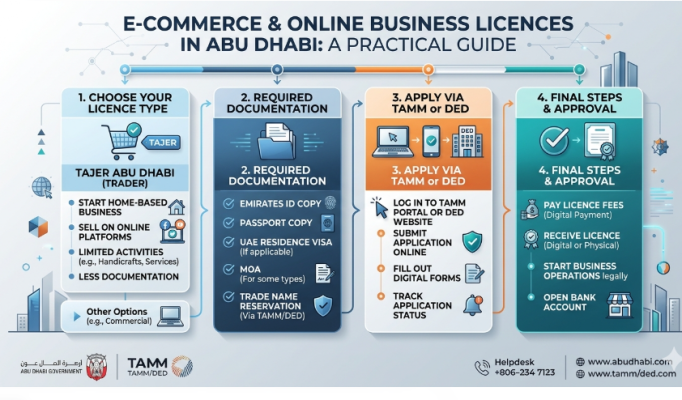
Route 2: Abu Dhabi Trader Licence
ADDED identifies the Abu Dhabi Trader Licence as an electronically issued licence for specified commercial activities available to eligible UAE citizens and residents.
It may be relevant to certain smaller businesses or entrepreneurs who want to investigate an eligible commercial activity without immediately following the conventional premises-based setup route.
However, the Abu Dhabi Trader Licence should not be assumed to be available for every nationality, business model or commercial activity.
Before applying, confirm:
- Whether the applicant meets the current eligibility conditions.
- Whether the intended product or service is included in the permitted activity list.
- Whether the chosen legal form is accepted.
- Whether the intended online selling channels are covered.
- Whether employees, inventory, premises or additional approvals change the requirements.
Do not rely solely on an older article quoting a fixed price or a particular number of permitted activities. Confirm the current package and total payable amount through the official application process.
Route 3: Freelancer Licence
ADDED lists a Freelancer Licence for eligible investors, including citizens and foreigners, to practise specified economic activities remotely without physical office premises.
This route may be relevant to individuals providing approved professional or creative services online.
However, it should not automatically be treated as a general retail or e-commerce trading licence.
Someone offering a permitted digital service and someone importing and selling physical goods are operating different business models. Their activities and licensing needs may not be the same.
Before choosing this route, confirm that the actual service is included in the current permitted activity list and that the licence covers the intended way of operating.
Route 4: Virtual Licence
ADDED describes a Virtual Licence for individuals residing outside the UAE who wish to start a business in Abu Dhabi.
This may be relevant to eligible overseas entrepreneurs exploring an Abu Dhabi business setup.
Eligibility, permitted activities, ownership arrangements, documentation and operating conditions must be confirmed for the applicant’s circumstances.
A Virtual Licence should not be assumed to provide UAE residence, an automatic right to live or work in the country, or unrestricted permission to conduct every type of online business.
Route 5: Abu Dhabi free-zone licence
Abu Dhabi has free zones that offer business setup options for different commercial and professional activities.
Depending on the business model, an entrepreneur may investigate a relevant free-zone authority, such as:
- Masdar City Free Zone.
- KEZAD Group.
- Abu Dhabi Airports Free Zone.
- Creative Media Authority, where the proposed activity falls within its scope.
Free-zone licensing options vary. Some packages may offer flexible workspace arrangements or remote business administration, while other activities may require dedicated facilities or additional approvals.
Before selecting a package, confirm:
- Whether the proposed activity is permitted.
- Whether the package covers the actual business model.
- Whether the company may sell directly to UAE mainland customers and under what arrangements.
- Whether a local distributor, additional approval or other arrangement is required.
- Whether an office, flexi-desk, warehouse or other premises are included or required.
- What the package includes and excludes.
- What the current renewal, visa and additional-service costs are, if applicable.
A free-zone licence does not automatically mean unrestricted permission to conduct every activity throughout the UAE mainland.
The operating arrangements must be checked against the proposed activity and applicable rules.
4. Mainland or Free Zone: Which Should You Consider?
There is no single route that is best for every online business.
| Consideration | Abu Dhabi mainland route | Abu Dhabi free-zone route |
|---|---|---|
| Licensing authority | ADDED and relevant authorities | The selected free-zone authority and relevant regulators |
| Business activities | Must match the approved mainland licence | Must match the free-zone’s permitted activities |
| Intended customers | Consider the intended UAE and international markets | Consider free-zone operating rules and mainland selling arrangements |
| Premises | Depends on the licence, activity and applicable conditions | Depends on the authority, package and activity |
| Ownership and legal form | Depends on the activity and legal form | Depends on the free-zone framework and legal form |
| Additional approvals | May apply to regulated activities | May apply to regulated activities |
| Setup costs | Depend on the activity, structure, premises and approvals | Depend on the authority, package, structure and facilities |
| Best starting point | Confirm the activity and operating requirements with ADDED | Obtain written confirmation from the chosen free-zone authority |
This table is a general comparison, not a legal determination. Individual requirements can differ considerably.
Questions to ask before choosing
- Where will the business be legally established?
- Where will the owner manage the business from?
- Will the business sell only internationally, only in the UAE, or in both markets?
- Will it sell its own products or operate a marketplace for other sellers?
- Will the business import, store or distribute physical goods?
- Does the selected licence permit the proposed activity and sales channels?
- What additional arrangements are needed for mainland sales, if any?
Answering these questions before paying for a licence can help avoid an unsuitable setup.
5. Do You Need a Physical Office for an Online Business?
This is one of the most important questions to resolve before applying.
The fact that a business operates online does not automatically mean that it can operate without physical premises.
ADDED recognises that some businesses can obtain licences to operate online where physical premises are not required. It also lists specific routes, including the Freelancer Licence, that permit eligible activities to be practised remotely without a physical office.
However, the conditions depend on the selected licence and activity.
Situations to investigate
Online professional services
Some eligible activities may be conducted remotely. Confirm whether the chosen licence permits remote operation and whether an approved address or other documentation is still required.
Online retail with physical inventory
A business holding or distributing stock may need appropriate storage or warehouse arrangements. The requirements depend on the products, activity and fulfilment model.
Importing and selling regulated products
Certain products may require additional approvals, import documentation, product registration or other facilities. An online sales channel does not remove these requirements.
Free-zone businesses
A free-zone authority may offer packages with flexi-desks or other workspace options. Confirm whether the package satisfies the requirements of the actual activity and whether separate premises are needed.
Businesses with employees
The proposed staffing arrangements may affect the business setup, premises and immigration-related requirements.
What should you do?
Before signing a lease or purchasing a licence package, ask the relevant authority to confirm in writing:
- Whether dedicated office premises are required.
- Whether a flexi-desk or shared workspace is acceptable.
- Whether the registered address can be used for the proposed activity.
- Whether a warehouse or other approved facility is required.
- Whether the premises arrangement affects staffing or visa eligibility.
Do not assume that a virtual address, home address or flexi-desk is acceptable for every business.
6. Is a Separate TDRA Approval Required?
The Telecommunications and Digital Government Regulatory Authority (TDRA) provides a service called NOC for Practicing E-Activity for individuals and entities wishing to engage in economic activity online through websites, applications or social media accounts.
The UAE Government’s e-commerce guidance also identifies TDRA approval as part of the applicable e-commerce licensing framework.
The TDRA service page lists the following key points:
- The service is available to individuals and businesses.
- Applicants can apply through the TDRA website or smart application using UAE Pass.
- A commercial licence may be attached if available.
- Additional no-objection certificates may be needed for restricted activities.
- For a website-based activity, the published conditions specify an
.aedomain name. - For social media-based activity, applicants must provide account names and links.
- For app-based activity, the application requires the app name and link, or specified information if the app is still under development.
- The published service fee is AED 0.
- The published expected processing time is two working days.
These are the conditions shown on the service page checked for this guide. They should be reconfirmed before applying.
Important website-domain point
TDRA’s published conditions specify an .ae domain for website-based applications. Its FAQ explains that if an applicant’s existing website uses another domain, an .ae domain can be linked to the original website for the application.
An applicant using a .com website should therefore check the current TDRA requirements rather than assume the existing domain is sufficient.
What if you sell only through social media?
The TDRA service specifically refers to online activity through social media accounts as well as websites and applications. Applicants should check the current requirements for their proposed channels and provide accurate account details.
If the account name changes later, TDRA’s published service conditions state that a new application is required.
Practical advice: Confirm the correct sequence of economic licensing and TDRA approval for your particular application. Do not assume that a free-of-charge NOC replaces the required economic licence or any separate approval for a regulated activity.
7. What Documents May Be Required?
The exact documents depend on the applicant, business structure, activity and licensing authority.
The following is a preparation checklist, not a universal official document list.
Applicant information
- Valid identity and contact details.
- Passport and visa or Emirates ID information, where applicable.
- UAE Pass access where required for the online application.
- Information about the proposed owner or shareholders.
Business information
- Proposed business or trade name.
- Description of the intended business model.
- Exact proposed economic activities.
- Preferred legal form.
- Ownership and shareholder information, where applicable.
- Details of the intended operating location.
Online-channel information
Depending on the application, it may be useful or necessary to prepare:
- Website address.
- Proposed
.aedomain, where required. - Social media account names and links.
- App name and link, if applicable.
- A description of the goods or services being offered.
- Details of the intended online sales process.
Additional documentation
Depending on the activity and structure, the authority may request:
- Premises or tenancy documentation.
- Constitutional or incorporation documents.
- Initial approvals.
- Product-specific or sector-specific approvals.
- Additional no-objection certificates.
- Other documents specified during the application.
Always follow the live application checklist issued by the relevant authority. Do not assume that documents accepted for one licence route will automatically satisfy another route.
8. What Is the Cost of an E-Commerce Licence in Abu Dhabi?
There is no single price that safely represents every e-commerce setup in Abu Dhabi.
The total cost may depend on:
- The selected licence route.
- The number and type of approved activities.
- The legal form and ownership structure.
- The licensing authority.
- The business premises or workspace.
- Additional government approvals.
- Immigration or visa services, if required.
- Product registrations or import-related requirements, where applicable.
- Accounting, tax compliance and other ongoing business costs.
- Annual renewal and amendments.
A low advertised package price may not include every service required to launch and operate the business.
How to compare quotations
Ask each authority or provider for a written breakdown showing:
- Initial licence and registration charges.
- Approved activities included.
- Premises or workspace charges.
- Additional approval charges.
- Visa and establishment-related charges, if applicable.
- Renewal fees.
- Charges for adding activities or changing the business structure.
- Any other mandatory costs.
Compare the total cost for your actual business model, not simply the lowest advertised starting price.
This guide does not quote a universal licence price because a figure without the relevant route, activity and inclusions could be misleading.
9. Can a Free-Zone E-Commerce Company Sell Across the UAE?
This question needs particular care.
Free-zone companies operate under the applicable free-zone framework. A business intending to sell directly to UAE mainland customers should confirm the legal and operational arrangements applicable to its activity.
Depending on the circumstances, a business may need a local distributor, additional approvals or another permitted arrangement.
The correct answer can depend on the products, activity, distribution method, contractual arrangements and applicable rules.
Before launching mainland sales, ask the selected free-zone authority and, where appropriate, ADDED to confirm:
- Whether the proposed sales model is permitted.
- Whether a mainland licence, distributor or additional approval is required.
- Whether importing and storing goods changes the requirements.
- Whether fulfilment through a third party affects the arrangement.
- Whether the business can contract directly with the intended customers.
- Which activities must appear on the licence.
Do not rely on the statement that a free-zone company can sell internationally as proof that it can conduct every type of direct mainland transaction without additional arrangements.
10. Can Foreign Entrepreneurs Start an Online Business in Abu Dhabi?
Abu Dhabi welcomes local and foreign investors, but the correct route depends on the applicant’s circumstances and the proposed activity.
Foreign entrepreneurs should investigate:
- Whether they can apply while residing outside the UAE.
- Whether the chosen licence route accepts their residency status.
- The permitted ownership and legal structure.
- Whether the activity has nationality or qualification restrictions.
- Whether a local address, premises or other documentation is required.
- Whether additional approvals apply.
- Whether the business setup offers any residence-visa eligibility and, if so, the applicable conditions.
A business licence and a UAE residence visa are separate matters. Obtaining a business licence does not, by itself, guarantee a residence visa.
Likewise, a licence route available to a UAE resident should not automatically be assumed to be available to a non-resident overseas applicant.
Foreign founders should obtain written confirmation of their eligibility before committing to a particular package.
11. Compliance Responsibilities of an Online Business
Obtaining a licence is only one part of operating an online business.
The UAE’s Modern Technology-Based Trade framework and other applicable laws establish obligations that online traders must consider.
A. Sell permitted products and services
The business must ensure that the products and services it offers are permitted and that any required sector-specific approvals are obtained.
Do not assume that a product can be sold merely because it is available on another website.
B. Provide accurate product information
Online descriptions, prices, specifications, terms and promotional claims should be accurate and should not mislead customers.
C. Protect customer information
Businesses collecting personal information should understand the data-protection requirements applicable to their operations and use appropriate safeguards.
D. Provide appropriate transaction documentation
The UAE Government’s e-commerce guidance identifies digital invoicing as an online trader responsibility. Businesses should establish a process for providing customers with the required transaction documentation.
E. Review advertising requirements
Paid promotions, influencer campaigns and social media advertising may raise additional requirements depending on the advertiser, content, activity and applicable rules.
Check the current requirements of the relevant authorities before launching a promotional campaign.
F. Understand tax obligations
Business owners should separately assess their corporate-tax and VAT obligations.
The applicable requirements depend on factors such as the business structure, taxable activities, revenue, tax status and any relevant exemptions or special regimes.
Do not assume that holding a free-zone licence automatically removes all tax obligations.
G. Check import and product requirements
A business importing or selling physical products may need to consider customs, product conformity, labelling, storage and other requirements relevant to the goods.
H. Maintain business records
Keep appropriate records of licences, approvals, transactions, invoices, supplier arrangements and other required business documentation.
The precise obligations depend on the applicable laws and the business’s circumstances.
12. Important Regulatory Update: E-Commerce Penalties
The UAE has a specific federal legal framework for modern technology-based trade.
Cabinet Resolution No. 200 of 2025 establishes a schedule of administrative violations and penalties for breaches of Federal Decree-Law No. 14 of 2023.
This makes it particularly important for online businesses to review the requirements that apply to their activities and keep their licences, approvals and online operations compliant.
Do not rely on old articles that discuss e-commerce only as a marketing opportunity without addressing legal obligations.
For the applicable provisions and current legal text, consult the UAE Legislation platform and seek qualified advice where necessary.
13. Step-by-Step Checklist Before Applying
Use this checklist to organise your research before paying for a licence.
Step 1: Define the business model.
Decide whether you will sell physical products, digital products, services, subscriptions or operate a marketplace.
Step 2: Identify the exact economic activity.
Do not select a licence based only on its name or advertised package.
Step 3: Confirm applicant eligibility.
Check whether the route accepts your nationality, residency status, legal structure and proposed activity.
Step 4: Compare mainland and free-zone options.
Assess the intended customer market, operating model, premises and additional approval requirements.
Step 5: Confirm office requirements.
Obtain confirmation about registered addresses, workspaces, warehouses and any other required premises.
Step 6: Check TDRA requirements.
Verify whether the NOC for Practicing E-Activity applies, the correct application sequence, the domain requirements and the information required for your website, social media accounts or app.
Step 7: Check additional approvals.
Investigate any product-specific, professional, import, advertising or sector-specific requirements.
Step 8: Obtain a complete written quotation.
Check initial costs, included activities, premises, additional approvals, renewal charges and optional services.
Step 9: Review tax and compliance obligations.
Understand the relevant corporate-tax, VAT, invoicing, consumer-protection, privacy and recordkeeping requirements.
Step 10: Verify everything before launching.
Use the official application and approval processes to confirm that the final licence and other required approvals cover the intended business model.
14. Official Sources to Check Before Applying
The following official sources provide starting points for verifying current requirements:
Abu Dhabi Department of Economic Development (ADDED)
Use its licensing guidance to understand available licence routes, economic activities and business establishment requirements.
TAMM — Abu Dhabi Government Services
Use the relevant live service to review application conditions, document requirements and the current fees displayed for your chosen route.
UAE Government — E-Commerce
Consult the federal overview of e-commerce rules, mainland licensing and free-zone considerations.
Telecommunications and Digital Government Regulatory Authority (TDRA)
Review the NOC for Practicing E-Activity service and its current conditions.
UAE Legislation platform
Consult Federal Decree-Law No. 14 of 2023 and Cabinet Resolution No. 200 of 2025 for the applicable legal framework.
The selected free-zone authority
If considering a free-zone setup, obtain confirmation of permitted activities, premises, package inclusions and mainland-selling arrangements directly from that authority.
The requirements and fees shown by authorities can change. Check the live official information before applying.
15. Frequently Asked Questions
Do I need an e-commerce licence to sell online in Abu Dhabi?
Online commercial activity generally requires the appropriate licence and approvals. The exact requirements depend on the activity, applicant and operating arrangement. Check the current rules with ADDED or the relevant free-zone authority.
Can I sell products on Instagram without a business licence?
Using Instagram or another social media platform does not automatically remove licensing requirements. Confirm the appropriate economic activity and the applicable digital-activity requirements before trading.
Can I start an online business without an office?
Some Abu Dhabi licence routes permit eligible activities to be conducted remotely without dedicated physical premises. Other businesses may require an office, approved address, warehouse or other facilities. Confirm the requirements for the specific activity and licence.
Is the Abu Dhabi Trader Licence suitable for every online business?
No. ADDED identifies this licence for specified commercial activities and eligible UAE citizens and residents. The current activity list and applicant conditions must be checked before applying.
Can a foreign entrepreneur start an online business in Abu Dhabi?
Potentially, depending on the applicant’s circumstances, the selected licence route and the proposed activity. Eligibility and ownership requirements should be confirmed directly with the relevant authority.
Can a free-zone company sell to UAE mainland customers?
The company must check the applicable arrangements for its activity and sales model. A free-zone licence should not be treated as automatic permission for every direct mainland transaction.
Is TDRA approval required for an online business?
The UAE Government’s e-commerce guidance identifies TDRA approval as part of the applicable framework. TDRA also publishes an NOC for Practicing E-Activity service. Confirm the current requirements and application sequence for your circumstances.
How much does an e-commerce licence cost in Abu Dhabi?
There is no single reliable price for every business model. Costs depend on the licence route, activities, premises, approvals and other services. Obtain an itemised quotation from the relevant authority.
Does a business licence automatically provide a UAE residence visa?
No. Business licensing and residence-visa eligibility are separate matters. Check the relevant visa requirements and any conditions associated with the selected business setup.
Can I use the same licence to sell every type of product?
Do not assume so. The approved activities and any product-specific restrictions or approvals must cover the intended goods or services.
Conclusion: Choose the Right Licence Before Launching
Starting an e-commerce business in Abu Dhabi begins with understanding what you intend to sell, who your customers will be and how you plan to operate.
The mainland and free-zone frameworks offer different routes, while specific Abu Dhabi licences may suit particular applicants and activities. Premises, digital-channel requirements, regulated products and mainland sales arrangements also deserve careful consideration.
Before making a payment, confirm the exact activity, eligibility, premises conditions, additional approvals and complete costs through the relevant official authority.
The safest approach is to verify first, obtain written confirmation where necessary, and then commit to the business setup.
Official Sources Consulted
- UAE Government — E-Commerce.
- Abu Dhabi Department of Economic Development — Licensing Requirements.
- Abu Dhabi Department of Economic Development — Establishing Your Business.
- Telecommunications and Digital Government Regulatory Authority — NOC for Practicing E-Activity.
- UAE Legislation — Cabinet Resolution No. 200 of 2025.
Disclaimer
Information checked on 28 October 2026. This article is for general educational and informational purposes only. It is not legal, immigration, tax or financial advice, and it does not guarantee licence eligibility, approval, cost or processing time. Licensing rules, fees, permitted activities and approval requirements may change. Readers should verify the latest requirements directly with ADDED, TAMM, TDRA, the relevant free-zone authority and other competent regulators, and seek qualified professional advice where appropriate.