
UAE Footprint | A knowledge initiative by PAD Media House
Publication date: 28 October 2026
Policy information checked: 28 October 2026
Location: United Arab Emirates
Starting a small business in the UAE can involve many decisions: choosing a licence, opening a bank account, hiring employees, managing expenses and finding customers.
But there is another responsibility every business owner needs to understand: corporate tax.
Whether you operate a consultancy, marketing agency, technology startup, trading company or another eligible business, it is important to understand how corporate tax works, when registration is required, how taxable income is calculated and whether your business may qualify for Small Business Relief.
This guide explains the essentials in simple language, using information published by the UAE Ministry of Finance and the Federal Tax Authority (FTA).
Important: Corporate tax is a legal obligation, and individual circumstances matter. This article provides general information, not a personal tax calculation or professional tax advice.
1. What Is Corporate Tax in the UAE?
Corporate tax is a federal tax on the taxable income of businesses and other persons covered by the UAE Corporate Tax Law.
The regime applies to financial years beginning on or after 1 June 2023.
Broadly, the rules cover:
- UAE companies and other relevant legal entities.
- Businesses operated by individuals when they meet the applicable conditions.
- Certain foreign companies operating in the UAE through a permanent establishment or otherwise falling within the rules.
- Companies established in UAE free zones, subject to the specific free-zone tax provisions.
A common misunderstanding: Registering a business in a free zone does not automatically exempt it from corporate tax.
Free-zone businesses must assess their status under the corporate tax rules, including whether they meet the requirements to be treated as a Qualifying Free Zone Person.
2. What Are the UAE Corporate Tax Rates?
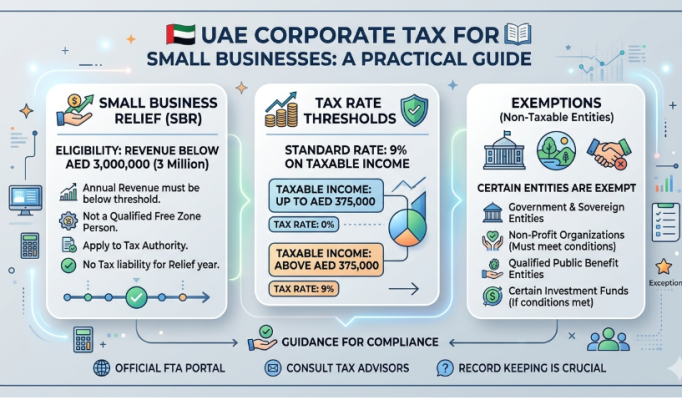
For businesses subject to the standard corporate tax regime, the rates are:
| Taxable income for the tax period | Corporate tax rate |
|---|---|
| Up to AED 375,000 | 0% |
| Above AED 375,000 | 9% on the portion exceeding AED 375,000 |
The threshold relates to taxable income, not annual sales or total revenue.
Example: A small consultancy
Suppose a consultancy has taxable income of AED 500,000 for its tax period.
Assuming the standard corporate tax rules apply and no special relief or adjustment changes the calculation:
- First AED 375,000: 0% = AED 0
- Remaining AED 125,000: 9% = AED 11,250
Illustrative corporate tax: AED 11,250.
This is a simplified example. Actual taxable income must be calculated under the applicable law and may differ from the profit shown in the accounts.
What if your taxable income is AED 300,000?
Under the standard rate structure, the corporate tax rate on that amount would be 0%.
However, you should not automatically conclude that the business has no registration or filing obligations. Tax compliance requirements can apply even when no corporate tax is payable.
3. Revenue and Profit Are Not the Same
This is one of the most important concepts for a new business owner.
Revenue is the income earned from business activities before deducting business expenses.
Accounting profit is generally the difference between recognised income and expenses under the applicable accounting standards.
Taxable income is calculated from accounting income after making the adjustments required by the corporate tax law.
Example
Imagine a marketing business records:
| Item | Amount |
|---|---|
| Annual revenue | AED 900,000 |
| Eligible business expenses, for illustration | AED 650,000 |
| Accounting profit before tax | AED 250,000 |
The business has AED 900,000 in revenue but AED 250,000 in accounting profit.
Its taxable income may differ from AED 250,000 depending on the applicable tax adjustments.
The owner must therefore maintain proper records instead of calculating corporate tax simply as a percentage of sales.
Which expenses can be deducted?
In principle, legitimate expenses incurred to earn taxable business income may be deductible, subject to the law and applicable restrictions.
Examples may include eligible:
- Employee salaries.
- Office rent.
- Software subscriptions.
- Professional services.
- Marketing costs.
- Business travel.
- Other operating expenses.
Personal expenses are not automatically deductible. Mixed personal and business expenses may need to be apportioned, while certain expenses are subject to specific limitations or tax adjustments.
Keep invoices, contracts, payment records and supporting documents for business expenses.
4. Small Business Relief: What Does It Mean?
The UAE provides a relief mechanism designed to simplify corporate tax compliance for eligible smaller businesses.
It is called Small Business Relief.
When an eligible business elects to use this relief for a particular tax period, it is treated as having no taxable income for that period.
This can mean that no corporate tax is payable for that period under the relief.
However, it is important to understand the eligibility conditions and the continuing compliance obligations.
The AED 3 million revenue threshold
A resident taxable person may elect for Small Business Relief when its revenue is AED 3 million or less in the relevant tax period and in every previous tax period, subject to the other conditions.
The relief has been extended to tax periods ending on or before 31 December 2029.
This extension was announced by the Ministry of Finance on 7 August 2026.
The threshold is based on revenue, not taxable profit.
Example A: A business with AED 1.2 million revenue
Suppose a qualifying UAE-resident business has:
- Revenue of AED 1.2 million in the current tax period.
- Revenue below AED 3 million in every previous tax period.
- No disqualifying group or free-zone status.
It may be eligible to elect for Small Business Relief, subject to all applicable conditions.
Example B: A business with AED 2.8 million revenue
A business with revenue of AED 2.8 million may also satisfy the revenue condition if revenue in every previous tax period was AED 3 million or less.
It must still meet the remaining eligibility requirements and make the election in its tax return.
Example C: A business that previously exceeded AED 3 million
Suppose a business earned AED 3.4 million in a previous tax period but only AED 2 million in the current period.
It cannot qualify for Small Business Relief under the current rule because revenue exceeded AED 3 million in a previous tax period.
A fall in current-year revenue does not, by itself, restore eligibility.
Who cannot elect for Small Business Relief?
The relief is not available to:
- A Qualifying Free Zone Person.
- A member of a multinational enterprise group with consolidated group revenue exceeding AED 3.15 billion.
Other applicable requirements must also be satisfied.
Important: Small Business Relief is an optional election, not an automatic exemption. The business must make the election for each eligible tax period.
5. Does Small Business Relief Mean You Can Ignore Corporate Tax?
No.
This is one of the most important points for entrepreneurs.
Even if a business qualifies for Small Business Relief, it may still need to:
- Register for corporate tax.
- Obtain a Corporate Tax Registration Number.
- File its corporate tax return.
- Make the Small Business Relief election in the relevant return.
- Maintain supporting records.
- Meet other applicable compliance requirements.
The FTA has specifically reminded businesses eligible for Small Business Relief that they must still fulfil their registration, filing and recordkeeping obligations.
Remember: Relief from paying corporate tax is not the same as exemption from tax administration.
6. What About Companies in a UAE Free Zone?
Many entrepreneurs choose a free zone because of its business setup options, ownership arrangements or location.
However, the corporate tax position must be assessed separately.
A UAE free-zone company is generally within the corporate tax framework. A company that meets the conditions to be a Qualifying Free Zone Person may benefit from a 0% rate on qualifying income.
The rules also provide for a 9% rate on taxable income that does not meet the definition of qualifying income.
Qualifying status depends on meeting the applicable conditions, including requirements relating to qualifying income, substance, transfer pricing and other compliance matters.
An important distinction
A Qualifying Free Zone Person cannot elect for Small Business Relief.
Therefore, a free-zone company should not assume it can combine the qualifying-free-zone tax regime with Small Business Relief.
Before selecting a free zone, understand the activities you will conduct, the customers you will serve, the type of income you expect and the conditions attached to the applicable tax regime.
7. Who Needs to Register for Corporate Tax?
Registration requirements depend on the type of taxable person and the applicable rules.
UAE companies and other legal entities
UAE-incorporated companies and other relevant legal entities generally need to register for corporate tax, including eligible free-zone entities.
The FTA has issued category-specific registration deadlines. For example, a resident legal entity incorporated, established or otherwise recognised in the UAE on or after 1 March 2024 generally must apply for registration within three months of incorporation, establishment or recognition.
Other deadlines apply to other categories, including certain foreign businesses and entities established before that date.
Do not assume the three-month deadline applies to every business. Check the FTA’s registration timeline for your entity type and circumstances.
Individuals conducting business
For a natural person conducting a business or business activity in the UAE, corporate tax registration generally becomes relevant when the person’s business revenue exceeds AED 1 million in a calendar year, subject to the applicable rules.
Certain types of personal income are excluded from this calculation, including salary, private investment income and real estate investment income, subject to the definitions and conditions in the law.
The registration deadline for a resident natural person who meets the conditions is generally 31 March of the following Gregorian calendar year.
A person who is unsure whether their activity constitutes a business for corporate tax purposes should check the FTA’s guidance or consult a qualified tax adviser.
What about a freelancer?
Do not assume that all freelancers have the same tax position.
The answer may depend on the legal form of the activity, the licence or registration used, the revenue generated and whether the individual falls within the applicable rules for natural persons.
Check your specific circumstances before deciding that registration is unnecessary.
8. How Do You Register?
The FTA provides an online corporate tax registration service through its EmaraTax platform.
The general process is:
- Create or access your EmaraTax account.
- Create or select the relevant taxable-person profile.
- Choose corporate tax registration.
- Complete the application.
- Upload the required documents.
- Review the information and submit the application.
- Monitor the application and respond to any requests for further information.
The documents requested depend on the type of applicant. They may include:
- Trade licence or other registration documents.
- Certificate of incorporation or relevant company agreement.
- Passport and Emirates ID details for relevant owners and authorised signatories.
- Proof of authority for the person submitting the application.
- Other documents requested by the FTA.
The FTA currently lists corporate tax registration as a free service through EmaraTax.
Use the official service rather than relying on unofficial websites that charge to submit a basic application without explaining what additional service they provide.
9. When Must You File a Corporate Tax Return?
Taxable persons generally must file their corporate tax return within nine months from the end of the relevant tax period.
The same general deadline applies to paying the corporate tax due for that period.
Example: A business with a 31 December year-end
Suppose a company’s tax period ends on 31 December 2026.
Its general filing and payment deadline would be 30 September 2027.
A business with a different financial year-end will have a different deadline.
The actual deadline must be calculated from the company’s applicable tax period and any relevant special rules.
What if the company qualifies for Small Business Relief?
It must still file the required tax return and make the relief election for the relevant tax period.
Do not assume that a zero tax liability means a return is unnecessary.
10. What Records Should a Small Business Keep?
Good recordkeeping is essential even when the business is small or expects no corporate tax to be payable.
The FTA states that relevant tax records and documents should generally be retained for at least seven years following the end of the relevant tax period.
Depending on the business, useful records include:
- Sales invoices and revenue records.
- Purchase invoices and expense receipts.
- Bank statements.
- Customer and supplier contracts.
- Payroll records.
- Asset purchases and disposals.
- Loan and liability records.
- Ownership information.
- Financial statements and accounting ledgers.
- Documents supporting any relief or exemption claimed.
The exact records required depend on the nature of the business and the applicable legislation.
A simple accounting system, used consistently, can help an entrepreneur understand cash flow, profit and tax obligations.
11. Corporate Tax Is Different from VAT
Small business owners often confuse the corporate tax threshold with the VAT registration threshold.
They are different taxes with different rules.
| Feature | Corporate tax | Value Added Tax (VAT) |
|---|---|---|
| What it concerns | Taxable business income or profits | Taxable supplies and imports |
| Standard threshold to remember | 0% rate on taxable income up to AED 375,000; 9% above that amount, subject to applicable rules | Mandatory registration threshold generally AED 375,000 in taxable supplies and imports |
| Small Business Relief | Separate corporate tax relief with a revenue ceiling of AED 3 million, subject to conditions | No equivalent automatic conclusion follows from the corporate tax relief |
| Registration | Corporate tax registration rules apply to relevant taxable persons | VAT registration rules apply when the relevant conditions are met |
| Filing | Corporate tax returns under the applicable rules | VAT returns under the applicable rules |
Important: The AED 375,000 corporate tax rate threshold is not the VAT registration threshold, even though the numerical amount is the same.
A business may have VAT obligations even if it qualifies for Small Business Relief from corporate tax.
Check the FTA’s VAT rules separately.
12. What Happens If You Miss a Deadline?
Missing a registration or filing deadline can lead to administrative penalties, depending on the breach and applicable rules.
The FTA currently identifies an administrative penalty of AED 10,000 for late corporate tax registration, subject to the applicable legislation and any relief or waiver provisions.
Late filing, failure to maintain records and other non-compliance may also have consequences.
If you discover that your business has missed a deadline:
- Check your status through the official FTA service.
- Identify the missed requirement.
- Take corrective action promptly.
- Review whether any applicable penalty-waiver initiative or other relief is available.
- Consult a qualified tax professional if the situation is complex.
Do not ignore an outstanding requirement because your business made a loss or believes it owes no tax.
13. A Simple Corporate Tax Checklist for Entrepreneurs
Before launching or managing a small business in the UAE, ask yourself:
- Have I identified the correct legal and tax status of my business?
- Have I checked whether corporate tax registration is required?
- Have I confirmed the applicable registration deadline?
- Do I understand the difference between revenue, accounting profit and taxable income?
- Have I assessed whether Small Business Relief is available?
- Have I checked the revenue in the current and every previous tax period?
- Have I confirmed that no exclusion prevents me from electing for the relief?
- Have I established a bookkeeping process?
- Do I know my financial year-end and tax-return deadline?
- Have I considered VAT registration separately?
- Am I keeping supporting documents for the required period?
- Have I checked the latest FTA guidance before making a tax decision?
Conclusion: Understand the Rules Before Your Business Grows
Corporate tax does not have to be overwhelming for a small business owner.
The first step is to understand the difference between revenue and taxable income. The next is to determine whether the business must register, whether it can elect for Small Business Relief, and when its tax return is due.
The UAE’s Small Business Relief extension through tax periods ending on or before 31 December 2029 may be helpful for eligible smaller businesses. However, the AED 3 million revenue condition, previous-period test, exclusions and annual election requirements are important.
The safest approach is to maintain proper records from the beginning, use official FTA guidance and seek professional advice when the business’s circumstances require it.
A little preparation today can help prevent avoidable compliance problems as the business grows.
Official Sources for Further Reading
The following UAE government sources should be used to verify the latest rules:
- UAE Ministry of Finance — Corporate Tax.
- UAE Ministry of Finance — Extension of Small Business Relief to 31 December 2029, announcement dated 7 August 2026.
- Federal Tax Authority — Corporate Tax Topics and Small Business Relief.
- Federal Tax Authority — Corporate Tax Registration.
- Federal Tax Authority — Corporate Tax Registration Timelines.
- Federal Tax Authority — Corporate Tax FAQs and Tax Return Guidance.
- Federal Tax Authority — VAT Registration Requirements.
Disclaimer
Published on 28 October 2026. This article has been prepared by PAD Media House for general informational and educational purposes using official UAE government sources available on the information-check date. Tax laws, ministerial decisions, thresholds, registration deadlines, relief conditions and filing requirements may change. Eligibility and obligations depend on the business structure, revenue, activities and individual circumstances. Readers should verify current requirements directly with the Federal Tax Authority and Ministry of Finance and seek advice from a qualified UAE tax professional before making tax decisions. This article does not constitute tax, legal, accounting or financial advice and does not guarantee eligibility for any relief or exemption. To the fullest extent permitted by applicable law, PAD Media House disclaims liability for loss or consequences arising from reliance on this article, without excluding any liability that cannot lawfully be excluded or limited.